Co-Owner (Joint Account Holder)
A co-owner (joint account holder) is an individual who shares legal title, transactional authority, and financial liability over a joint brokerage, bank, or trading account alongside the primary account holder.
What Is a Co-Owner in Financial Accounts?
A co-owner (commonly referred to as a joint account holder or secondary account holder) is an individual who shares concurrent legal ownership, asset claims, and execution privileges over a brokerage, bank, or trading account alongside another named party.
In retail foreign exchange, equity brokerage, and wealth management, establishing a co-owned joint account allows spouses, business partners, family members, or estate trustees to pool capital, manage shared investment portfolios, and access liquidity without requiring separate individual transfers. However, co-ownership also binds both parties to joint liability for all trading activity, leveraged margin deficits, tax reporting obligations, and regulatory compliance protocols.
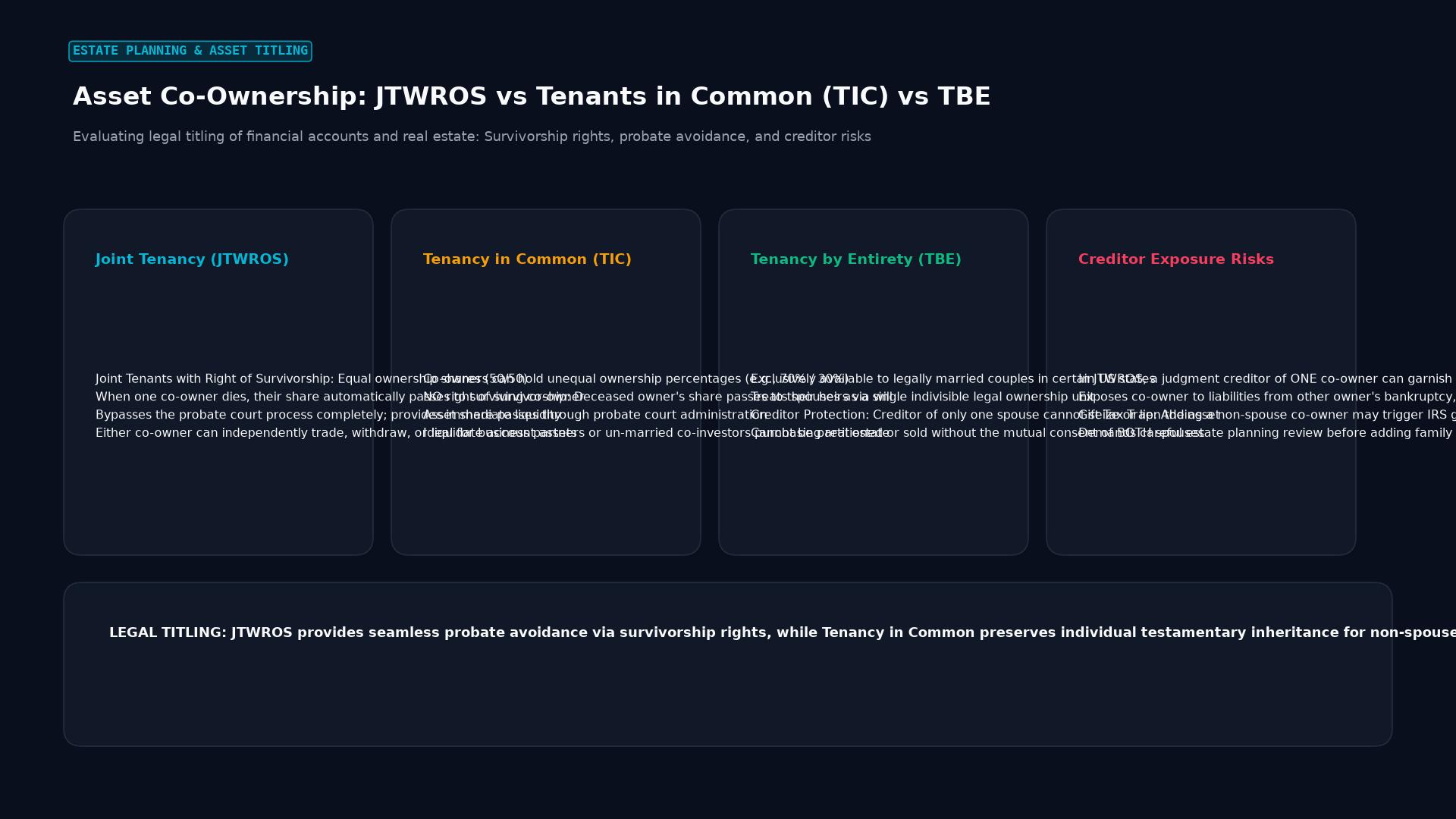 Figure: Evaluating legal titling of financial accounts and real estate: Survivorship rights, probate avoidance, and creditor risks
Key Takeaways
- Equal Operational Authority: In standard “either-to-sign” joint accounts, either co-owner has full legal authority to execute trades, deposit capital, enter leveraged positions, or withdraw 100% of the funds without the prior consent of the other.
- Joint and Several Margin Liability: If one co-owner executes an aggressive leveraged trade that triggers a catastrophic negative balance, both co-owners are jointly and individually liable to repay the brokerage firm.
- Estate Planning & Survivorship: The legal structure chosen at account opening—such as Joint Tenancy with Rights of Survivorship (JTWROS)—determines whether assets transfer automatically to the survivor or must pass through judicial probate court.
- KYC/AML Compliance: Financial regulators (e.g., FINRA, FCA, ASIC) mandate that all co-owners undergo rigorous individual Know-Your-Customer (KYC) identity verification and Anti-Money Laundering (AML) background checks.
Legal Forms of Co-Ownership in Brokerage Accounts
Brokerages offer several distinct legal frameworks for establishing a co-owned account, each carrying distinct legal and taxation ramifications:
| Account Type | Ownership Allocation | Action upon Death of a Co-Owner | Common Use Case |
|---|---|---|---|
| Joint Tenants with Rights of Survivorship (JTWROS) | Undivided 100% interest shared equally | Account assets bypass probate and transfer automatically to the surviving co-owner | Married couples, long-term life partners |
| Tenants in Common (TIC) | Proportional shares (e.g., 50/50, 70/30, or 80/20) specified at inception | The deceased co-owner’s specific share transfers to their designated estate heirs via probate | Business partners, friends, co-investors pooling capital |
| Tenancy by the Entirety (TBE) | Undivided marital ownership; cannot be severed unilaterally | Transfers automatically to the surviving spouse; protected from individual debtor lawsuits | Married couples in specific U.S. states |
Operational Mechanics: Trading Permissions and Liabilities
Co-ownership introduces unique operational dynamics that participants must understand before funding a joint trading account:
1. The “Either-to-Sign” vs. “Both-to-Sign” Mandate
- Either-to-Sign (Standard): The overwhelming majority of retail brokerage joint accounts operate under an “either-to-sign” rule. Either co-owner can independently place market orders, modify leverage, transfer funds, or request withdrawals.
- Both-to-Sign (Restricted): Some institutional private banking accounts require dual authorization (signatures from both co-owners) for major capital disbursements or significant changes to portfolio risk parameters.
2. Joint and Several Liability
In margin trading, if high leverage results in a margin call and a subsequent negative balance (such as during a black-swan currency unpegging event), the broker can legally pursue debt collection against either or both co-owners. A co-owner cannot claim immunity by arguing they did not initiate the trade.
$$\text{Joint Exposure} = \text{Total Account Deficit} \implies 100% \text{ Claimable from Co-Owner A or B}$$
Tax Reporting and Government Compliance
Even though two individuals co-own an account, national tax authorities (such as the U.S. Internal Revenue Service or UK HM Revenue & Customs) require a streamlined administrative process:
Primary Tax Identification Number (TIN):
- At account inception, one co-owner must be designated as the Primary Account Holder whose Social Security Number (SSN) or National Insurance number receives the annual tax reporting forms (e.g., IRS Form 1099-B).
- However, for domestic income tax filings, the co-owners are responsible for dividing the reported capital gains, dividends, and interest proportionally on their respective individual tax returns based on their beneficial ownership agreement.
FATCA and CRS Implications:
Under the Foreign Account Tax Compliance Act (FATCA) and Common Reporting Standard (CRS), if one co-owner is a U.S. citizen or resident while the other is a foreign national, the entire account is classified as a U.S. reportable account, requiring cross-border disclosure to tax authorities.
Real-World Case Study: Margin Liquidation in a Co-Owned FX Account
A husband and wife establish a co-owned joint trading account (JTWROS) with $50,000 in deposited equity. Both hold equal trading access.
The Trade Execution:
- Without consulting his spouse, the husband opens a 10-lot long position in GBP/JPY ahead of an unscheduled central bank monetary briefing.
- An unexpected emergency rate cut triggers a violent 350-pip flash crash in the British Pound.
- The account suffers a rapid loss: $$\text{Loss} = 10 \text{ Lots} \times 100,000 \times (0.01 \text{ Pip Value}) \times 350 \text{ Pips} \approx $35,000$$
- Total floating equity plummets from $50,000 to $15,000, triggering an automated margin closeout.
Legal and Financial Consequences:
- When the wife logs in to trade later that afternoon, 70% of the joint portfolio capital has been liquidated.
- Because the account was established under standard “either-to-sign” joint tenancy, the broker executed the orders legally without requiring spousal verification.
- If the flash crash had generated a negative balance deficit of -$10,000, the wife’s personal credit and external bank assets would be equally liable to the broker’s debt recovery proceedings alongside her husband’s.
Frequently Asked Questions
What is the difference between a co-owner and an authorized trader (Power of Attorney)?
A co-owner holds legal property ownership of the account funds, is credited with profits, and bears personal liability for account debt. An authorized trader (holding a Limited Power of Attorney or LPOA) only has permission to execute trades on behalf of the owner; they hold zero beneficial ownership of the assets and cannot withdraw funds.
Can one co-owner remove the other co-owner from the account?
No. Brokerages strictly prohibit one co-owner from unilaterally removing another co-owner’s name from an account. To dissolve co-ownership, both parties must provide written notarized authorization to close the account and disburse remaining assets according to their legal agreement.
How does negative balance protection work on co-owned retail accounts?
Under regulatory regimes like the UK FCA and European ESMA, retail accounts benefit from mandatory Negative Balance Protection, which prevents client accounts from falling below zero. In these jurisdictions, co-owners cannot owe more than their deposited capital. However, in unregulated offshore accounts or professional accounts, co-owners remain fully exposed to unbounded debt liability.
Ready to trade forex?
Open a free demo account with a regulated broker. Practice with virtual funds before risking real money.