Conversion Rate
A conversion rate in foreign exchange is the numerical ratio at which one national currency can be exchanged for another, establishing the relative valuation and purchasing power between two distinct monetary units.
What Is a Conversion Rate?
In foreign exchange and international banking, a conversion rate (frequently termed an exchange rate or FX rate) is the precise financial ratio that dictates how many units of one currency (the quote or term currency) are required to purchase a single unit of another currency (the base currency).
Every currency conversion operates as a simultaneous dual transaction: selling one sovereign currency while purchasing another. Conversion rates reflect the relative economic vitality, inflation differentials, interest rate structures, and trade balances between two sovereign nations. While interbank institutions trade at the tight, wholesale mid-market conversion rate, retail consumers and corporate businesses typically pay a markup or spread embedded within the conversion rate offered by banks, payment processors, and foreign exchange desks.
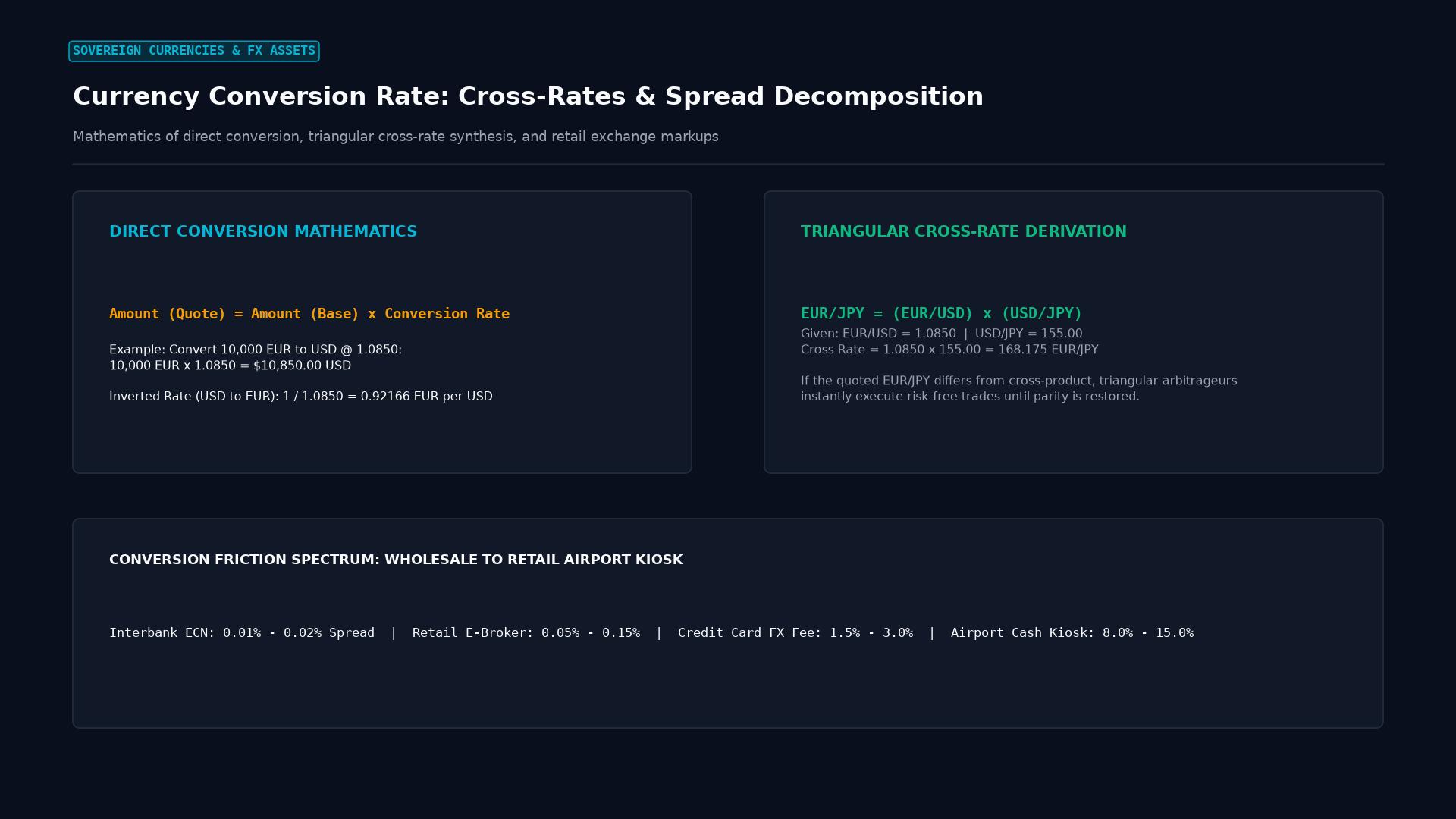 Figure: Exchange rate mathematics: direct conversion formula, triangular cross-rate synthesis, and retail airport markup versus interbank ECN spread friction.
Key Takeaways
- Base vs. Quote Currency: The first currency listed in the pair is the base currency (always standardized to 1 unit); the second is the quote currency, which shows how much of it is required to buy one base unit.
- Wholesale vs. Retail Rates: The true interbank rate is the mid-point between the institutional bid and ask. Retail banks and credit card networks add a 1.5% to 4.0% hidden conversion markup above this mid-market rate.
- Currency Triangulation: If two currencies do not have an active direct interbank market (e.g., Thai Baht to South African Rand), their conversion rate is derived through triangulation using the U.S. Dollar or Euro as a common intermediary vehicle.
- Accounting Implications: Under international accounting standards (IFRS IAS 21 and US GAAP ASC 830), multinational corporations must translate foreign subsidiary revenues into their domestic reporting currency using standardized period-average or spot conversion rates.
Direct vs. Indirect Currency Quotation
Depending on geographical convention and financial context, conversion rates are quoted in one of two formats:
| Quotation Format | Definition | Example (from U.S. Perspective) | Mathematical Expression |
|---|---|---|---|
| Direct Quotation | Number of domestic currency units required to buy one unit of foreign currency | Quoting the Euro in New York: $1.0850 USD per 1.00 EUR | Domestic Units / 1 Foreign Unit |
| Indirect Quotation | Number of foreign currency units received for one unit of domestic currency | Quoting the Japanese Yen in New York: ¥155.00 JPY per 1.00 USD | Foreign Units / 1 Domestic Unit |
$$\text{Indirect Rate} = \frac{1}{\text{Direct Rate}}$$
Currency Triangulation: Synthesizing Cross Conversion Rates
In the global foreign exchange matrix, over 88% of all transactions involve the U.S. Dollar. Consequently, cross-currency conversion rates between minor or exotic pairs are calculated algorithmically via currency triangulation.
Formula:
To calculate the synthetic cross conversion rate for Currency Pair $A/B$ using the U.S. Dollar ($USD$):
$$\left( \frac{A}{B} \right) = \left( \frac{A}{USD} \right) \times \left( \frac{USD}{B} \right) \quad \text{or} \quad \left( \frac{A}{B} \right) = \frac{(A / USD)}{(B / USD)}$$
Practical Triangulation Example:
Calculate the conversion rate for EUR/GBP given:
- $\text{EUR/USD} = 1.0850$ (1 EUR = $1.0850 USD)
- $\text{GBP/USD} = 1.2750$ (1 GBP = $1.2750 USD)
$$\text{EUR/GBP} = \frac{\text{EUR/USD}}{\text{GBP/USD}} = \frac{1.0850}{1.2750} \approx 0.85098$$
Result: 1 Euro converts into 0.8510 British Pounds. If an interbank broker quotes EUR/GBP at 0.8550, high-frequency triangular arbitrage algorithms will instantly buy GBP/USD, sell EUR/USD, and buy EUR/GBP to capture the mispricing until equilibrium is restored.
Deconstructing the Retail Currency Conversion Spread
When retail consumers or small businesses convert money through commercial banks, credit cards, or airport kiosks, the advertised “zero commission” marketing often conceals substantial conversion rate markups.
Institutional Interbank Mid-Market Rate:   1.0000 EUR = 1.0850 USD
----------------------------------------------------------------------
Bank Retail "Buy" Rate (Customer buys USD): 1.0000 EUR = 1.0525 USD (-3.0% Hidden Markup)
Bank Retail "Sell" Rate (Customer sells USD): 1.0000 EUR = 1.1175 USD (+3.0% Hidden Markup)
$$\text{Hidden Markup Percentage} = \left( \frac{|\text{Retail Conversion Rate} - \text{Mid-Market Rate}|}{\text{Mid-Market Rate}} \right) \times 100%$$
On a corporate international supplier invoice of $1,000,000, a 2.5% bank conversion markup extracts $25,000 in unrecorded fees, which is why modern multinational treasuries bypass retail banks in favor of multi-currency fintech rails and direct prime broker FX liquidity.
Real-World Case Study: Corporate Balance Sheet Translation Risk
Consider a U.S.-headquartered tech company that owns a wholly owned European subsidiary generating €50,000,000 in annual net operating profit.
Conversion Scenarios:
- Baseline Year 1: The average EUR/USD conversion rate is 1.1500. $$\text{Reporting Profit} = €50,000,000 \times 1.1500 = $57,500,000 \text{ USD}$$
- Subsequent Year 2: The European subsidiary generates identical organic revenue of €50,000,000. However, macroeconomic rate cuts weaken the Euro, causing the average conversion rate to drop to 1.0500. $$\text{Reporting Profit} = €50,000,000 \times 1.0500 = $52,500,000 \text{ USD}$$
Corporate Impact:
Despite zero change in physical European product sales or operational efficiency, the company experiences a $5,000,000 USD translation loss on its consolidated SEC 10-K income statement purely due to the adverse shift in the foreign currency conversion rate. To neutralize this vulnerability, corporate treasurers execute forward contracts and FX options to lock in balance-sheet conversion benchmarks.
Frequently Asked Questions
What is the difference between a conversion rate and an exchange rate?
In financial theory and trading, the terms conversion rate and exchange rate are completely synonymous and used interchangeably. “Exchange rate” is the formal institutional and academic term, while “conversion rate” is commonly used in retail banking, e-commerce, and commercial payment gateways.
How are conversion rates set on international credit card transactions?
When you make an international purchase with a credit card, the payment network (Visa or Mastercard) applies its wholesale benchmark conversion rate compiled from daily interbank feeds. However, the issuing commercial bank frequently tacks on a separate 1.0% to 3.0% Foreign Transaction Fee (FX fee).
Why do airport foreign currency exchange booths offer worse conversion rates?
Airport exchange booths operate with high fixed overhead costs (rent, security, physical cash transport, and insurance for physical banknotes) and low transaction volumes. As a result, they widen their bid-ask spreads by 10% to 20% compared to the interbank mid-market rate.
Ready to trade forex?
Open a free demo account with a regulated broker. Practice with virtual funds before risking real money.