Confirmation
A trade confirmation is a legally binding formal document or electronic notification transmitted post-execution that details all key economic terms of a financial transaction, including trade date, settlement date, instrument, counterparty, rate, and notional amount.
What Is a Trade Confirmation?
A trade confirmation (frequently referred to simply as a “confirm”) is an official, legally binding document or electronic message exchanged between counterparties immediately following the execution of a financial transaction. The confirmation formally specifies and verifies all essential economic and legal parameters of the agreed contract, ensuring that both parties share an identical understanding of their rights, liabilities, and settlement obligations.
In modern institutional foreign exchange and derivatives markets, trade confirmations are predominantly automated, transmitted within seconds of execution via electronic messaging protocols like SWIFT (Society for Worldwide Interbank Financial Telecommunication) or central matching utilities such as the Depository Trust & Clearing Corporation (DTCC) and CLS Bank. In retail trading, an electronic confirmation is generated directly by the broker’s trading platform or sent via email.
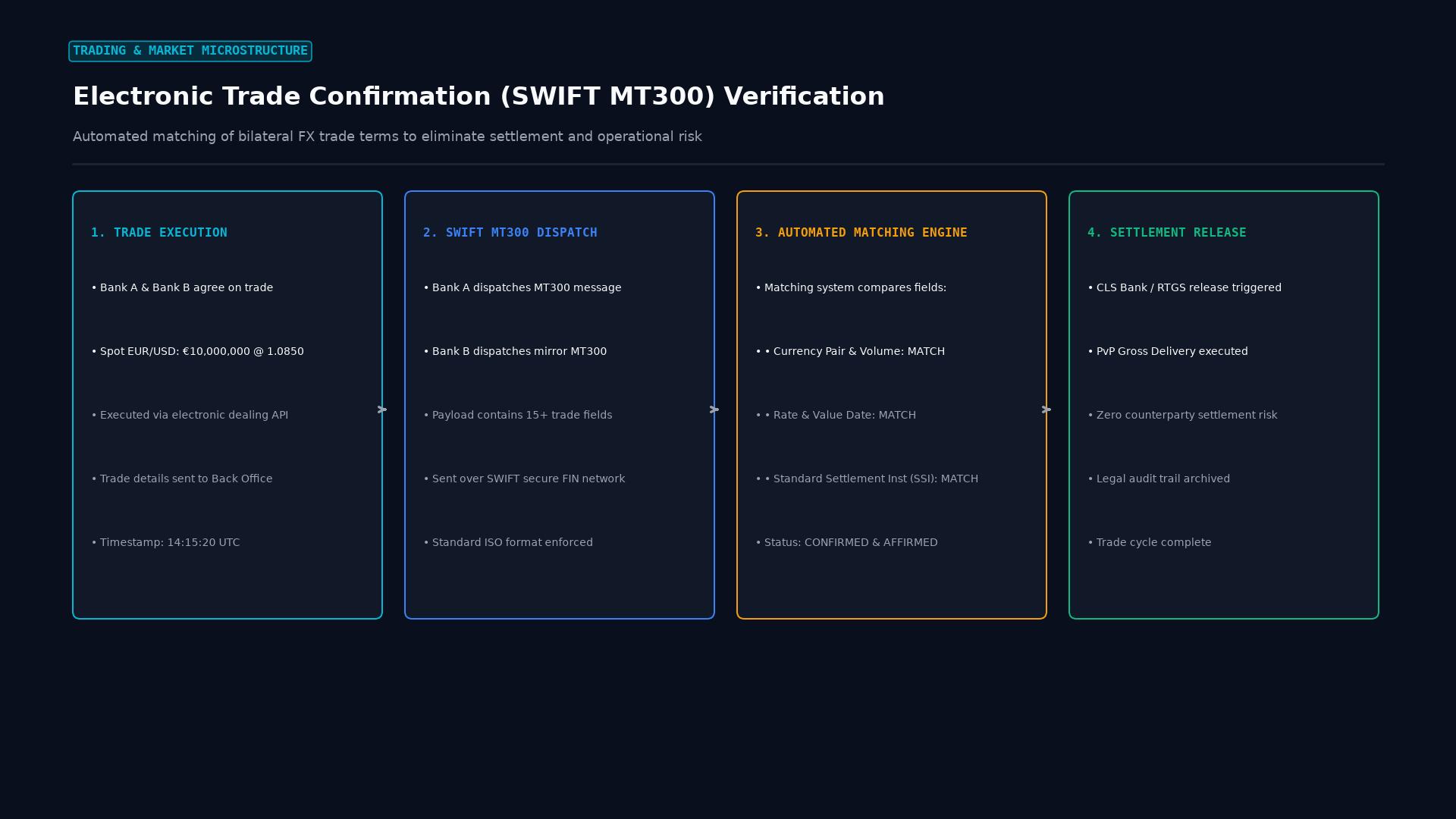 Figure: Post-trade verification pipeline: bilateral SWIFT MT300 matching comparing volumes, rates, value dates, and standard settlement instructions (SSIs) prior to gross delivery release.
Key Takeaways
- Legal Binding Authority: Under standard ISDA (International Swaps and Derivatives Association) Master Agreements, an uncontradicted trade confirmation constitutes the definitive legal evidence of a transaction’s terms in the event of a dispute.
- Affirmation and Matching: Trade confirmation is followed by trade affirmation or matching, where both counterparties’ middle-office systems automatically reconcile economic terms down to the penny.
- Operational Risk Mitigation: Timely trade confirmation prevents costly settlement breaks, incorrect wire routings, unhedged market exposures, and counterparty misunderstandings.
- Regulatory Mandates: Post-2008 global regulations (such as Dodd-Frank in the U.S. and EMIR in Europe) legally require institutional derivatives trades to be confirmed within strict timeframes (typically $T+0$ or $T+1$).
Key Elements of a Foreign Exchange Trade Confirmation
Whether issued as a SWIFT MT300 message between tier-one investment banks or an electronic statement from a retail broker, every complete FX trade confirmation must include specific structural data points:
| Confirmation Field | Description | Example Interbank Entry |
|---|---|---|
| Trade Identifier (UTI) | Unique Trade Identifier for global regulatory reporting | UTI-9847120348719238 |
| Trade Date & Timestamp | Exact date and time the order was matched to the millisecond | 2026-09-22 14:15:32.104 UTC |
| Value (Settlement) Date | The date on which currency funds must be delivered | 2026-09-24 (T+2 Spot) |
| Counterparty Identities | Legal Entity Identifiers (LEI) of buyer and seller | Bank A (LEI) vs. Asset Manager B (LEI) |
| Currency Pair & Direction | Base and quote currency, indicating buy or sell | Buy EUR / Sell USD |
| Notional Amounts | Precise gross volumes exchanged in both currencies | Bought: €10,000,000 / Sold: $10,850,000 |
| Agreed Exchange Rate | Contracted execution price | 1.08500 |
| Standard Settlement Instructions (SSIs) | Beneficiary bank, BIC code, and account routing numbers | Account details at Federal Reserve Bank of NY / Bundesbank |
SWIFT MT300: The Global Interbank Standard
In institutional interdealer trading, FX confirmations rely heavily on the SWIFT MT300 (Foreign Exchange Confirmation) message type.
When Bank A and Bank B agree to an OTC spot, forward, or currency swap transaction:
- Bank A generates an MT300 message to Bank B through the SWIFT financial messaging network.
- Simultaneously, Bank B sends an MT300 message to Bank A.
- Both messages are processed by SWIFT Accord or internal middle-office matching engines.
- If all mandatory fields match (value date, currency amounts, rate, and counterparty), the system issues a “Matched Confirmation” status.
- If there is a discrepancy—such as a 1-pip difference in rate or an incorrect value date—an unmatched break exception is flagged immediately for middle-office dispute resolution.
SWIFT MT300 Block Structure:
- Sequence A: General Information (Senders Reference, Trade Date, Contact)
- Sequence B: Scope of Operation (Bought Currency/Amount, Sold Currency/Amount, Rate)
- Sequence C: Settlement Details (Receiving Agent, Intermediary, Beneficiary)
Legal and Regulatory Framework (ISDA & Dodd-Frank)
In OTC derivatives, the confirmation supplements and forms part of the master agreement between the parties:
1. ISDA Hierarchy
Under standard ISDA contract architecture, if a conflict arises between the general terms of an ISDA Master Agreement, the Schedule, and the specific Trade Confirmation, the Trade Confirmation takes legal precedence. This ensures that the unique negotiated parameters of the specific transaction override general boilerplate terms.
2. Timely Confirmation Rules (EMIR & Dodd-Frank)
Under the European Market Infrastructure Regulation (EMIR) and the U.S. Dodd-Frank Wall Street Reform Act, market participants face mandatory confirmation timelines. For non-centrally cleared OTC derivatives:
- Trades executed prior to 4:00 PM local time must be confirmed no later than the end of the next business day ($T+1$).
- Failure to adhere to confirmation rules incurs substantial regulatory fines from the CFTC and ESMA, as unconfirmed trades create systemic clearing and settlement risk.
Real-World Case Study: Resolving a Post-Trade Settlement Break
In June 2024, a London-based hedge fund executed an OTC forward purchase of $50,000,000 against Japanese Yen with a Zurich investment bank over a voice-brokered chat channel.
The Error:
- The execution trader verbally contracted at
155.45for settlement on September 15. - The Swiss bank’s trade capture clerk mistakenly keyed the trade into their internal risk system at
155.54(a 9-pip discrepancy).
The Confirmation Interception:
- Two hours post-execution, the Swiss bank’s automated back-office dispatched a SWIFT MT300 confirmation message.
- The hedge fund’s automated confirmation matching software flagged a mismatch exception:
- Hedge Fund Record: Bought USD $50,000,000 @ 155.45 = Sold ¥7,772,500,000
- Swiss Bank Record: Sold USD $50,000,000 @ 155.54 = Bought ¥7,777,000,000
- Net Discrepancy: ¥4,500,000 (approx. $29,000 USD)
- The hedge fund immediately rejected the confirmation before end-of-day reconciliation.
- Voice recordings and time-stamped chat transcripts confirmed the agreed price was 155.45.
- The Swiss bank issued a cancellation message (
35=For MT300 Cancel) and a corrected replacement confirmation, averting a costly settlement dispute on delivery day.
Frequently Asked Questions
What should a retail trader do if they find an error on their broker confirmation?
If a retail trader identifies an incorrect entry on their daily account statement or execution confirmation (such as slippage outside quoted tolerance, wrong position size, or unauthorized commission), they must notify the broker’s compliance department in writing within the dispute window specified in their client agreement (typically 24 to 48 hours).
What is the difference between a trade confirmation and a trade affirmation?
A trade confirmation is the formal document containing the terms generated by one party. An affirmation is the explicit agreement by the counterparty verifying that those terms are accurate. In automated platforms, affirmation is achieved seamlessly through electronic two-way matching.
Can a trade be canceled after a confirmation has been issued?
Only with the mutual written consent of both counterparties. Because a confirmed trade is a legally enforceable contract, neither party can unilaterally cancel or amend the terms unless a specific cancellation clause was agreed upon or a demonstrable clerical pricing error (“manifest error”) occurred.
Ready to trade forex?
Open a free demo account with a regulated broker. Practice with virtual funds before risking real money.