Continuous Linked Settlement (CLS)
Continuous Linked Settlement (CLS) is a global financial market infrastructure that eliminates foreign exchange settlement risk (Herstatt risk) by facilitating simultaneous Payment-versus-Payment (PvP) settlement across 18 major eligible currencies.
What Is Continuous Linked Settlement (CLS)?
Continuous Linked Settlement (CLS) is the world’s preeminent financial market infrastructure dedicated to mitigating systemic risk in the global foreign exchange market. Operated by CLS Bank International (headquartered in New York and regulated by the Federal Reserve Bank of New York), CLS provides a centralized, multi-currency cash settlement system that settles trillions of dollars in FX transactions daily.
Prior to the launch of CLS in 2002, the cross-border foreign exchange market operated under severe structural vulnerability known as settlement risk or Herstatt risk. Because currencies are settled in different time zones across disparate national central bank Real-Time Gross Settlement (RTGS) systems, one bank could irrevocably pay out its currency leg hours before discovering that the counterparty had defaulted, leaving the paying bank with a 100% principal loss.
CLS completely resolves this hazard through Payment-versus-Payment (PvP) settlement: both legs of an FX trade are settled simultaneously across central bank accounts, ensuring that one currency leg is paid if and only if the corresponding leg is successfully delivered.
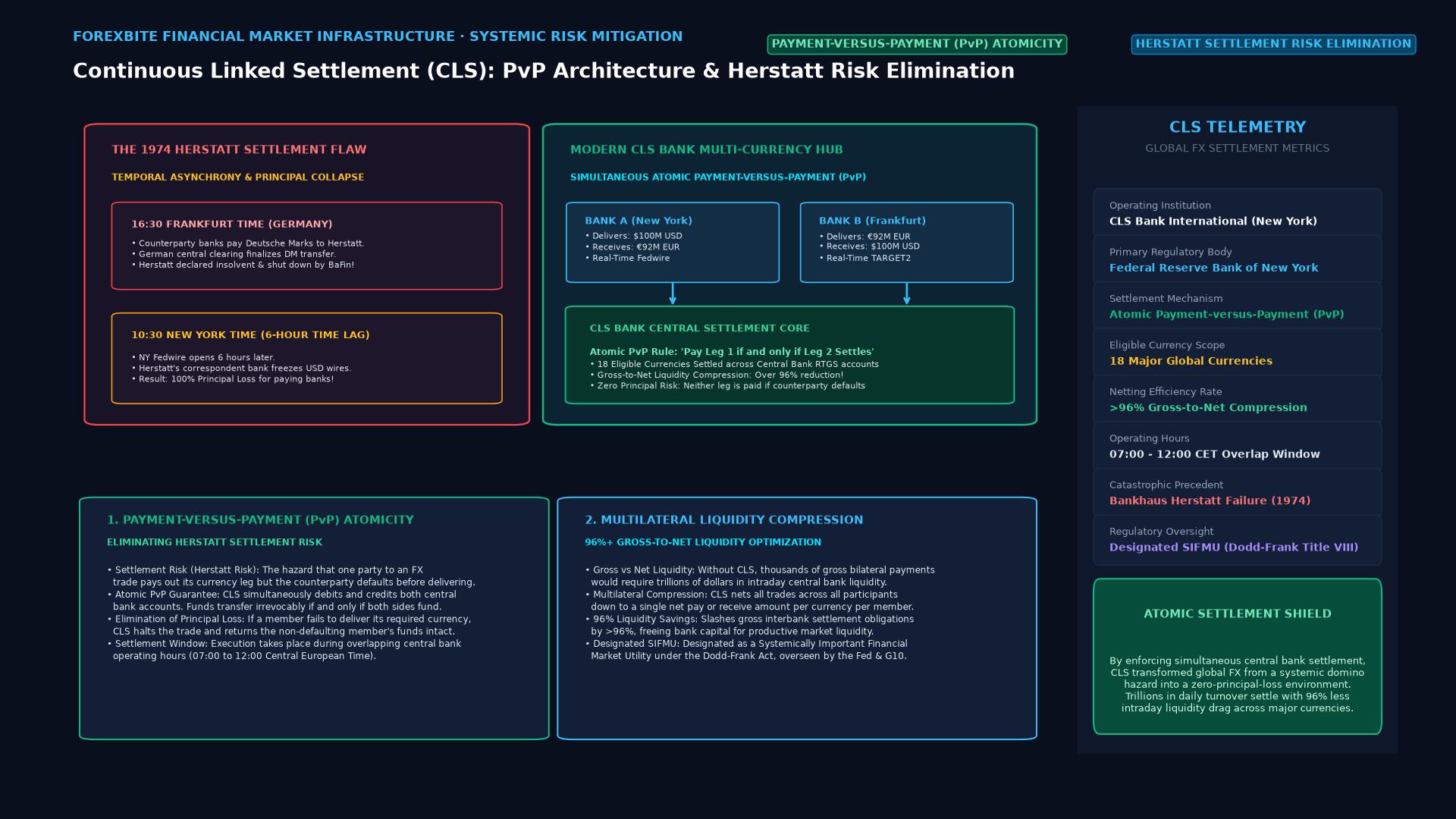 Figure: Continuous Linked Settlement (CLS) architecture, showing atomic Payment-versus-Payment (PvP) settlement eliminating Herstatt risk across central bank RTGS systems.
Key Takeaways
- Elimination of Principal Risk: By utilizing Payment-versus-Payment (PvP), CLS guarantees that no participant ever transfers a sold currency without definitively receiving the purchased currency.
- Multilateral Netting Efficiency: CLS compresses gross payment obligations by more than 96%, enabling hundreds of billions of dollars in daily gross transactions to be settled with a fraction of the actual liquidity.
- Eligible Currency Coverage: CLS currently settles 18 of the world’s most actively traded currencies, including USD, EUR, JPY, GBP, AUD, CAD, CHF, and major Scandinavian and Asia-Pacific currencies.
- Systemically Important Financial Market Utility (SIFMU): Designated under the Dodd-Frank Act in the U.S. and monitored by an international oversight committee chaired by the Federal Reserve, CLS is critical to the survival of global financial markets.
The Historical Catalyst: The 1974 Herstatt Bank Collapse
The existence of CLS is rooted in the infamous collapse of Bankhaus Herstatt in Cologne, Germany, on June 26, 1974:
- German banking regulators forced Bankhaus Herstatt into immediate bankruptcy and liquidation at 4:30 PM Frankfurt time (10:30 AM New York time).
- During the European morning, several counterparty banks in New York had already delivered hundreds of millions of Deutsche Marks to Herstatt’s Frankfurt accounts through the German clearing system.
- Because the New York Fedwire system had just opened and was operating on a 6-hour time lag, Herstatt’s New York correspondent bank ceased operations and froze outgoing dollar wires before paying out the contracted U.S. Dollars to the counterparties.
- The affected banks suffered total principal losses, causing an international liquidity freeze and paralyzing the global banking system. This disaster led directly to the creation of the Basel Committee on Banking Supervision and the eventual inception of CLS.
How CLS Operates: The Settlement Lifecycle
CLS processes institutional FX trades through a continuous multi-stage pipeline:
  00:00 - 06:30 CET: Submission & Matching of trades
  07:00 CET: Settlement Session Opens (5-hour window)
  07:00 - 09:00 CET: Funding and PvP Execution across Central Bank Accounts
  09:00 CET: Pay-outs and Final Account Reconciliation
1. Multilateral Netting
Instead of settling every single trade gross (which would require immense liquidity), CLS aggregates all trades submitted by a settlement member across all currency pairs. If Bank A owes $500M to Bank B, Bank B owes $300M to Bank C, and Bank C owes $250M to Bank A, CLS calculates the single net balance owed or receivable by each bank per currency.
$$\text{Liquidity Efficiency Ratio} = \left( 1 - \frac{\text{Net Funds Transferred}}{\text{Gross Trade Volume}} \right) \times 100%$$
In practice, this efficiency regularly exceeds 96%, freeing up vast amounts of working capital for global banking balance sheets.
2. The 5-Hour Settlement Window
Settlement occurs during a specific operational window when the RTGS payment systems of all 18 eligible currencies overlap. CLS holds direct accounts at each national central bank (such as the Federal Reserve, European Central Bank, Bank of England, Bank of Japan, and Swiss National Bank). Funds are moved across these central bank reserve accounts with absolute finality.
CLS Settlement Members vs. Third-Party Participants
Participation in CLS is organized into two primary tiers:
| Participant Tier | Eligibility & Criteria | Operational Role |
|---|---|---|
| Settlement Members (Shareholders) | Tier-1 global investment banks (e.g., JPMorgan, Citi, HSBC, Deutsche Bank, UBS) | Hold direct equity in CLS; maintain direct settlement accounts with CLS Bank; submit trades directly |
| Third-Party Participants | Regional banks, non-bank market makers, asset managers, hedge funds, multinational corporations | Access CLS indirectly through a designated Settlement Member who acts as their clearing custodian |
CLS Eligible Currencies (The 18 Currencies)
As of 2026, CLS provides PvP settlement for 18 primary global currencies:
- Americas: US Dollar (USD), Canadian Dollar (CAD), Mexican Peso (MXN).
- Europe: Euro (EUR), British Pound (GBP), Swiss Franc (CHF), Danish Krone (DKK), Norwegian Krone (NOK), Swedish Krona (SEK), Hungarian Forint (HUF), Israeli Shekel (ILS).
- Asia-Pacific: Japanese Yen (JPY), Australian Dollar (AUD), New Zealand Dollar (NZD), Hong Kong Dollar (HKD), Singapore Dollar (SGD), South Korean Won (KRW).
- Africa: South African Rand (ZAR).
Note: Major emerging market currencies such as the Chinese Yuan (CNY/CNH), Indian Rupee (INR), and Brazilian Real (BRL) remain outside CLS PvP settlement due to local capital controls or regulatory barriers, leaving trades in those currencies subject to bilateral settlement risk.
Frequently Asked Questions
Does CLS protect retail forex traders?
Indirectly, yes. Retail traders do not have direct accounts with CLS Bank; however, the retail brokers and liquidity providers (prime brokers) who clear retail trades rely on CLS for their interbank hedging transactions. By keeping the interbank liquidity plumbing solvent and safe from contagion, CLS protects the overall solvency of the retail brokerage ecosystem.
What happens if a CLS member bank fails to fund its net position?
CLS operates strict liquidity backstops. If a member experiences a temporary liquidity shortfall in a specific currency, CLS utilizes pre-arranged currency swap facilities with other member institutions to bridge the intraday deficit. If a member completely defaults, CLS suspends the member’s unsettled trades, returns undelivered currencies to non-defaulting counterparties, and accesses the default fund, ensuring no systemic spillover.
Why doesn’t CLS support all global currencies?
To add a new currency, the host nation’s central bank must operate a real-time gross settlement (RTGS) system that overlaps with the CLS settlement window. Furthermore, the local legal jurisdiction must guarantee the finality of netting and bankruptcy protection under international standards.
Ready to trade forex?
Open a free demo account with a regulated broker. Practice with virtual funds before risking real money.