Purchasing Power Parity (PPP)
Purchasing Power Parity (PPP) is an economic theory that states exchange rates between currencies should, in equilibrium, equalize the prices of identical goods and services in different countries. It provides a theoretical 'fair value' for currency exchange rates and a long-run benchmark against which actual exchange rates can be evaluated. The Economist's 'Big Mac Index' is the most famous simplified illustration of PPP.
The Logic Behind PPP
Imagine a hamburger costs $5 in New York and £4 in London. If USD/GBP is 1.25 (meaning £1 = $1.25), then the hamburger costs the same in both cities: £4 × 1.25 = $5. The exchange rate perfectly equalizes purchasing power.
Now suppose USD/GBP moves to 1.50 (dollar weakens). The London hamburger now costs £4 × 1.50 = $6 for an American buyer. The same hamburger is more expensive in London when measured in dollars. PPP says this discrepancy cannot persist indefinitely: traders, consumers, and arbitrageurs will exploit the difference until prices equalize.
This is the core of Purchasing Power Parity — in the long run, exchange rates adjust to equalize the price of tradeable goods across countries.
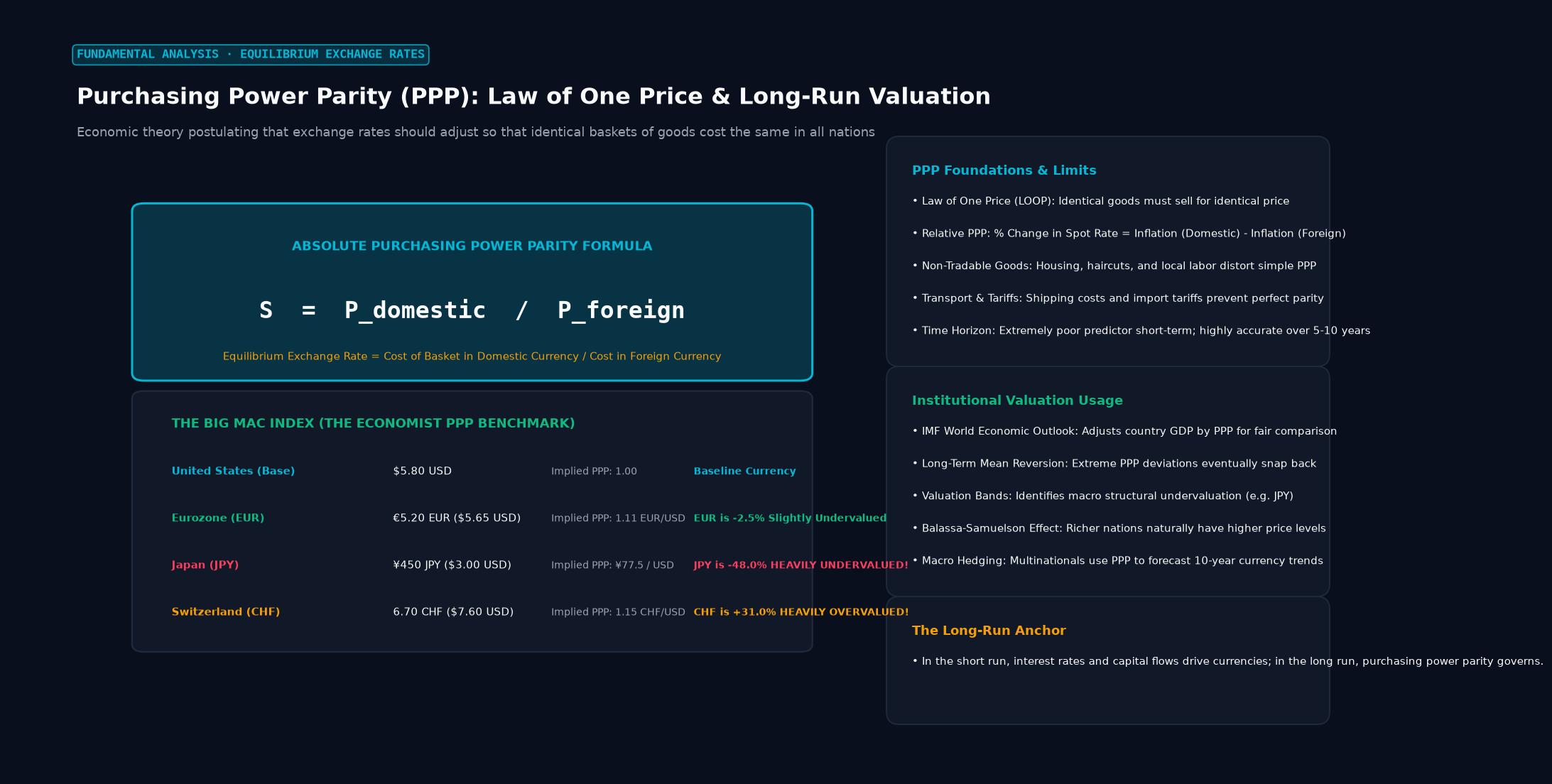 Figure: Economic theory postulating that exchange rates should adjust so that identical baskets of goods cost the same in all nations
Absolute vs. Relative PPP
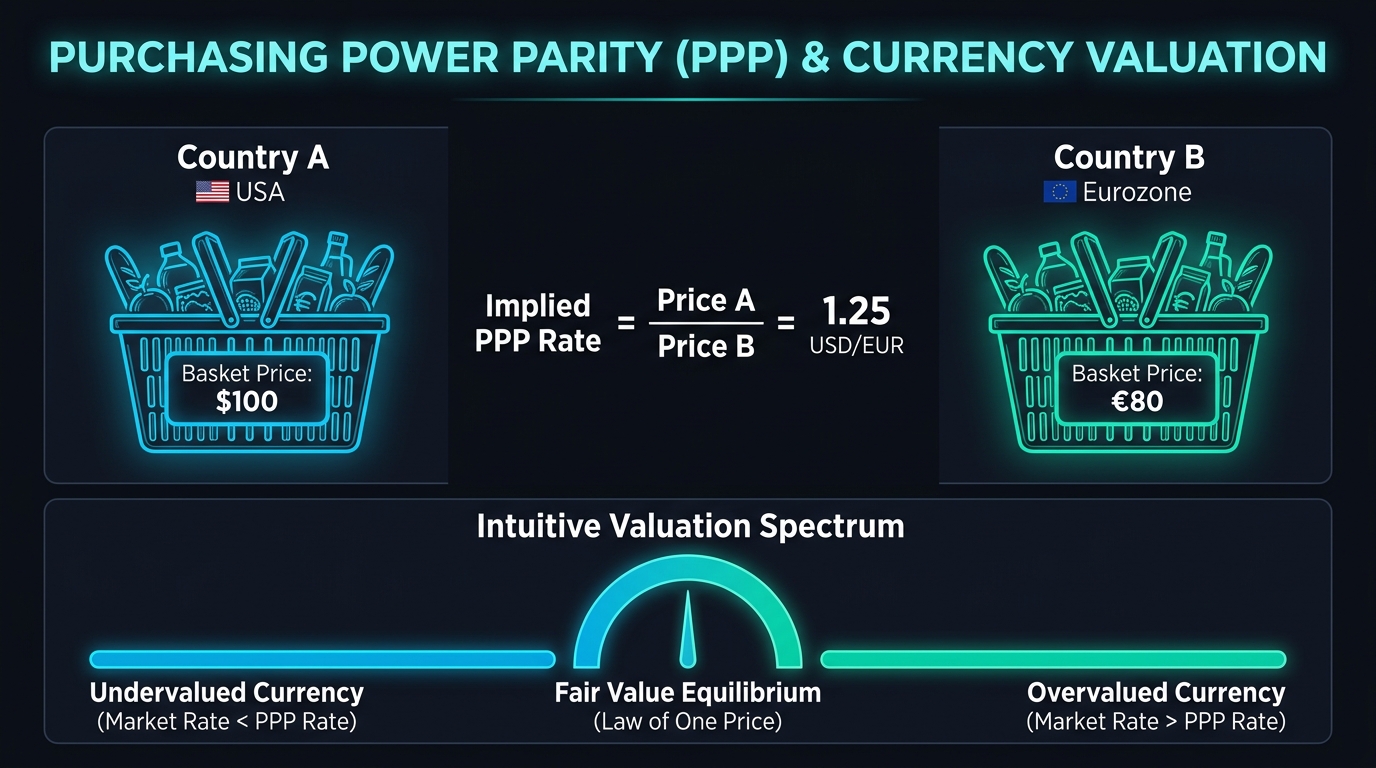
Absolute PPP is the strict version: exchange rates should equal the ratio of price levels between two countries. If a basket of goods costs $100 in the US and €80 in the Eurozone, the PPP exchange rate is $100/€80 = 1.25 (one euro should buy $1.25 of goods).
In practice, absolute PPP rarely holds exactly because:
- Not all goods are tradeable internationally (haircuts, real estate, restaurant meals can’t be arbitraged)
- Trade barriers, tariffs, and transportation costs create persistent price differences
- Consumer preferences differ between countries
Relative PPP is more practical: the rate of change in exchange rates should equal the inflation differential between two countries. If US inflation runs at 4% and Eurozone inflation at 2%, relative PPP predicts the dollar should weaken by approximately 2% per year against the euro.
This relative version is more testable and more useful for medium-term fundamental analysis. Over multi-year periods, currencies of high-inflation countries do tend to depreciate relative to currencies of low-inflation countries.
The Big Mac Index
In 1986, The Economist created the Big Mac Index as a light-hearted application of absolute PPP. The premise: McDonald’s Big Mac is essentially the same product in every country, making it a reasonable single-product proxy for price levels.
If a Big Mac costs $5.58 in the US and ¥390 in Japan, the implied PPP rate is ¥390 / $5.58 = ¥69.9 per dollar. If the actual exchange rate is USD/JPY 150, the yen is “undervalued” by PPP — Japan’s prices are significantly cheaper than US prices when measured in the same currency.
The Big Mac Index is obviously a simplification (it ignores labor costs, rent, local ingredient prices, corporate pricing strategy), but it captures the concept accessibly and has shown surprisingly strong correlation with long-run currency movements.
PPP as a Trading Tool: Long-Run vs. Short-Run
Here’s the critical limitation that trips up traders who first encounter PPP: in the short run, currencies can deviate dramatically from PPP for extended periods.
After the Fed’s aggressive rate hiking in 2022-2023, the dollar was significantly “overvalued” by PPP metrics against most currencies — and remained so for years because rate differentials provided a powerful non-PPP reason to hold dollars. A trader who shorted the dollar on PPP grounds in early 2022 would have faced a 27% move against their position before the theory showed any sign of working.
PPP is a long-run anchor, not a short-run trading signal. Useful for:
- Identifying currencies that are significantly overvalued or undervalued on a structural basis
- Informing long-term position trading or hedging decisions over 2-5 year horizons
- Understanding why persistent current account imbalances create eventual currency adjustment pressure
Not useful for:
- Timing entries or exits on a daily or weekly basis
- Predicting near-term moves driven by interest rate differentials or sentiment
OECD and IMF PPP Estimates
The Organisation for Economic Cooperation and Development (OECD) and International Monetary Fund (IMF) publish regular PPP estimates for major and emerging market currencies. These estimates use comprehensive consumer price baskets rather than single products.
The IMF’s PPP assessments sometimes trigger market commentary — particularly when a major currency appears substantially overvalued or undervalued by their models. Central banks in countries with persistently weak currencies sometimes cite PPP undervaluation as an argument against intervention.
Key Takeaways
- PPP theory states exchange rates should equalize the purchasing power of currencies across countries
- Absolute PPP: price levels should equalize; Relative PPP: exchange rate change should equal the inflation differential
- The Big Mac Index is a well-known single-product PPP approximation
- PPP is a long-run concept — currencies can deviate from PPP for years before mean-reverting
- Useful for multi-year strategic positioning; not suitable as a short-term trading signal
FAQ
Which currencies are most consistently undervalued by PPP? Emerging market currencies tend to be persistently “undervalued” by PPP because of the Balassa-Samuelson effect — developing economies have lower productivity in tradeable goods sectors, which results in lower price levels overall. The Chinese yuan, Indian rupee, and most developing world currencies consistently appear undervalued on Big Mac Index metrics.
Does PPP work better for some currency pairs than others? Relative PPP (inflation differential driving exchange rate change) works better for currency pairs where both countries have similar trade structures and policy frameworks. It tends to work less well for commodity-linked currencies where exchange rates are driven by commodity price cycles rather than inflation differentials.
Ready to trade forex?
Open a free demo account with a regulated broker. Practice with virtual funds before risking real money.