Daily Cut-Off
A daily cut-off is the designated, predetermined contractual time of day that establishes the formal boundary between two trading sessions in 24-hour financial markets, governing rollover swaps, option expiries, and wire settlements.
What Is a Daily Cut-Off?
In international banking and financial trading, a daily cut-off (or cut-off time) is the exact, legally defined moment in the 24-hour day that marks the formal conclusion of the current trading, clearing, or value date and the official commencement of the next. Because global foreign exchange markets operate continuously without a centralized physical opening or closing bell, market participants require standardized temporal cut-offs to reconcile ledgers, calculate mark-to-market balances, execute overnight rollover swaps, and clear interbank funds transfers.
A transaction executed even one second before the daily cut-off is booked for current-day settlement ($T$); an identical transaction executed one second after the cut-off is automatically pushed into the subsequent business day’s settlement ledger ($T+1$). In modern trading, distinct cut-off times govern different sectors of the financial architecture, spanning spot rollover accounting, currency option expirations, and central bank real-time payment rails.
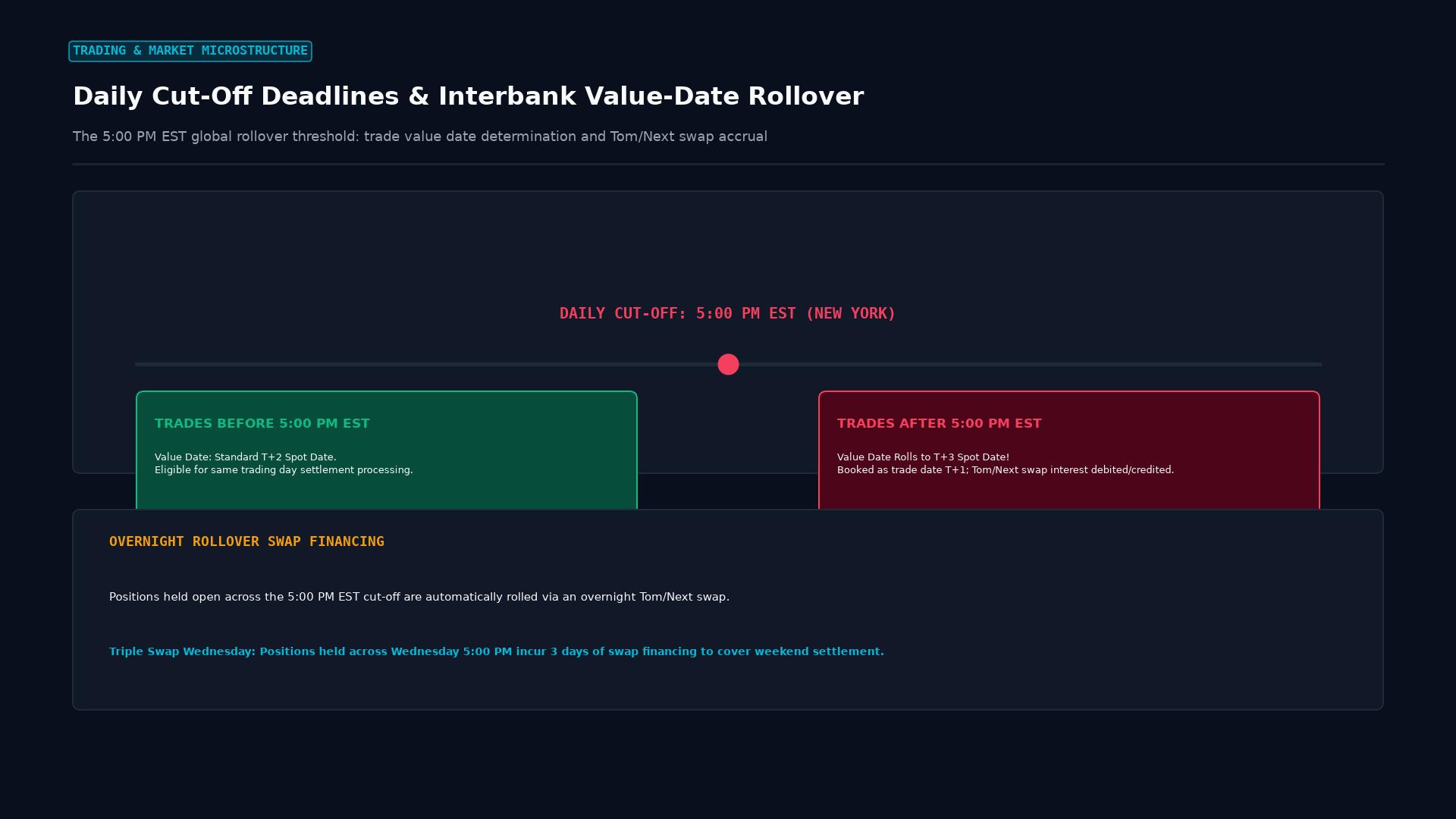 Figure: Global banking cut-off threshold: trades placed before 5:00 PM EST settle on standard spot T+2, while post-cutoff trades roll to T+3 and incur Tom/Next overnight swap financing.
Key Takeaways
- The 5:00 PM EST Rollover Cut-Off: Recognized globally by interbank dealers and retail brokers as the definitive daily end-of-day boundary where open spot positions are rolled into the next value date via Tom-Next (Tomorrow-Next) financing swaps.
- The 10:00 AM New York Option Cut: The world’s most critical derivatives deadline, representing the exact time at which billions of dollars in Over-the-Counter (OTC) currency options expire daily.
- Payment Rail Deadlines: Commercial bank wires (e.g., Fedwire, TARGET2, CHAPS) enforce rigid daily cut-offs; missing a wire cut-off forces funds to sit idle overnight, costing institutions thousands of dollars in lost interest.
- Liquidity Void at Rollover: At precisely 5:00 PM EST, bid-ask spreads widen significantly across all brokers for several minutes as liquidity providers reset their daily risk books.
The Three Primary Categories of Daily Cut-Offs
The global financial infrastructure relies on three distinct operational cut-off categories:
| Cut-Off Category | Benchmark Standard Time | Operational Action Executed | Market Implication for Traders |
|---|---|---|---|
| FX Spot Rollover Cut-Off | 5:00 PM EST (New York) | Open spot positions are rolled over via Tom-Next swap points; daily P&L and interest debited/credited | Spreads widen drastically for 2–5 minutes; trading during this window incurs high slippage |
| Vanilla FX Option Cut-Off | 10:00 AM EST (New York Cut) & 3:00 PM JST (Tokyo Cut) | Strike prices are evaluated against prevailing spot rates to determine option exercise or expiration | Spot price frequently acts like a magnet, “pinning” near large option strike clusters |
| RTGS Payment Rail Cut-Off | 6:30 PM EST (Fedwire) / 6:00 PM GMT (CHAPS) | National central bank wire systems close for interbank electronic funds transfers | International client deposits initiated after the cut-off fail to credit until the following morning |
The 5:00 PM New York Rollover Mechanism
In spot forex, settlement is formally scheduled for $T+2$ business days. To allow traders to hold positions indefinitely without taking physical delivery of currency, brokers automatically execute a synthetic Tom-Next rollover at the daily 5:00 PM EST cut-off:
At 5:00 PM EST Daily Cut-Off:
1. Broker simultaneously closes open spot position at current market price.
2. Broker re-opens position for the new value date (T+3) at a price adjusted for interest rate differentials (Swap Points).
3. The net interest difference (rollover swap) is credited or debited to the account balance.
$$\text{Wednesday Triple-Swap Rule:}$$ Because financial markets do not settle on weekends (Saturday and Sunday), positions held open through the Wednesday 5:00 PM EST cut-off incur a triple swap charge (or credit) to account for carrying the financing obligation over the two non-trading weekend days.
Market Dynamics: The 10:00 AM New York Option Cut & “Pin Risk”
One of the most profitable structural phenomena for intraday forex traders is understanding the 10:00 AM Eastern Time New York Option Cut.
Every trading day, investment banks, multinational corporations, and hedge funds hold massive currency options contracts expiring at 10:00 AM NY time. When open interest concentrates heavily around a specific round-number strike (e.g., €5 Billion in EUR/USD options with a strike at 1.0850), institutional option market makers engage in delta hedging:
- As price approaches 1.0850 from below ahead of 10:00 AM, market makers sell spot to hedge their gamma exposure, pulling price back down.
- As price drifts above 1.0850, market makers buy spot, pulling price back up.
- The Outcome: The spot exchange rate becomes magnetically “pinned” near the 1.0850 strike price until the 10:00 AM cut-off passes. The moment the clock strikes 10:00:01 AM, the hedging obligation vanishes, and the spot market frequently explodes into an aggressive directional breakout.
Real-World Case Study: Spread Widening at the Daily Rollover Cut-Off
A retail trader places a tight trailing stop-loss of 6 pips on a long EUR/USD position at 4:58 PM EST.
The Mechanics:
- Throughout the New York afternoon, the EUR/USD bid-ask spread is a pristine 0.2 pips (
1.08500 / 1.08502). - At 5:00 PM EST, the daily cut-off triggers. Tier-1 interbank banks in New York hand over pricing books to dealing desks in Sydney and Wellington.
- For approximately 90 seconds, interbank liquidity dries up while clearing engines process end-of-day balances and Tom-Next rollovers.
- The retail broker’s aggregated feed widens: the spread temporarily blows out from 0.2 pips to 7.5 pips (
1.08450 / 1.08525).
The Result:
The sudden artificial expansion of the bid price down to 1.08450 immediately triggers the trader’s 6-pip stop-loss, closing the trade at a loss despite the fact that underlying market sentiment had not changed. Two minutes later, liquidity normalizes, and the spread returns to 0.3 pips. Experienced traders avoid placing tight stop-loss orders or opening new market orders within five minutes of the 5:00 PM EST daily cut-off.
Frequently Asked Questions
Why does daylight saving time affect the daily cut-off for international traders?
Because the primary foreign exchange cut-offs are pegged to New York local time (EST/EDT), countries that do not observe daylight saving time (or shift clocks on different calendar weeks, such as Europe or Australia) will observe the daily rollover shifting by one hour on their local clocks twice a year.
What is the CLS Bank cut-off time for settlement?
For transactions settled through Continuous Linked Settlement (CLS), member banks must submit matched instructions prior to the daily 06:30 Central European Time (CET) cut-off. Any trades submitted after 06:30 CET cannot be settled via Payment-versus-Payment (PvP) on the current date and must roll to the next day.
Can a broker change their daily cut-off time?
While a retail broker could theoretically choose an arbitrary cut-off time, doing so would isolate them from the global interbank liquidity pool. Because global tier-one prime brokers settle overnight financing at 5:00 PM EST, virtually all legitimate international brokers synchronize their platforms to the 5:00 PM New York cut.
Ready to trade forex?
Open a free demo account with a regulated broker. Practice with virtual funds before risking real money.