Danish Krone (DKK)
The Danish Krone (ISO: DKK) is the official currency of Denmark, Greenland, and the Faroe Islands, operating under the European Exchange Rate Mechanism (ERM II) via a fixed peg within a narrow fluctuation band against the Euro.
What Is the Danish Krone (DKK)?
The Danish Krone (ISO code: DKK) is the sovereign currency of the Kingdom of Denmark, also circulating as legal tender in the autonomous territories of Greenland and the Faroe Islands (where it is issued as the Faroese Króna, pegged at a strict 1:1 parity with the Danish Krone).
While Denmark is a core member of the European Union, it is not part of the Eurozone. Under the 1992 Edinburgh Agreement, Denmark negotiated a formal legal opt-out from the third stage of Economic and Monetary Union (EMU), a decision reaffirmed by the Danish electorate in a historic national referendum in September 2000.
Rather than adopting a floating exchange rate like its Nordic neighbors Sweden (SEK) and Norway (NOK), Denmark entered into the European Exchange Rate Mechanism II (ERM II). The Danish Krone is tied directly to the Euro at a fixed central parity rate, managed with precision by Denmark’s central bank—Danmarks Nationalbank.
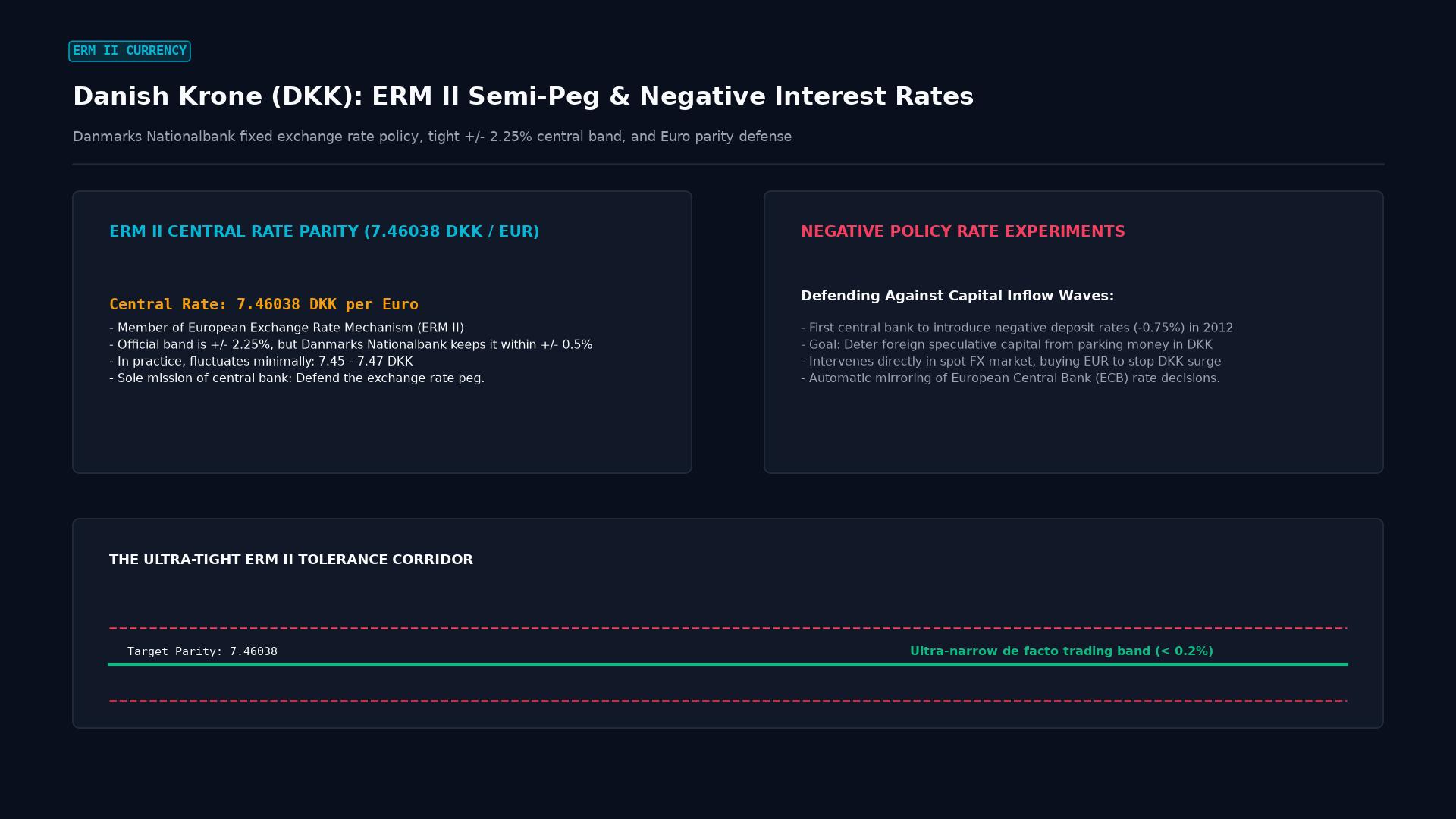 Figure: ERM II central parity: Danmarks Nationalbank defending the 7.46038 DKK/EUR peg with ultra-tight tolerance corridors and negative deposit rate experiments.
Technical Mechanics & The ERM II Target Band
Under the formal ERM II agreement established between Danmarks Nationalbank and the European Central Bank (ECB):
The Central Parity and Fluctuation Bands
The central exchange rate is legally fixed at:
$$1 \text{ EUR} = 7.46038 \text{ DKK}$$
While standard ERM II rules allow for a broad fluctuation margin of $\pm 15%$, Denmark negotiated a special bilateral agreement restricting the allowable fluctuation band to $\pm 2.25%$:
$$\text{Lower Limit} = 7.46038 \times (1 - 0.0225) = 7.29252 \text{ DKK}$$
$$\text{Upper Limit} = 7.46038 \times (1 + 0.0225) = 7.62824 \text{ DKK}$$
In practical daily market operations, Danmarks Nationalbank maintains an even tighter operational corridor, intervening aggressively whenever EUR/DKK deviates by more than $\pm 0.50%$ from the central parity.
The Monetary Policy Mandate
Danmarks Nationalbank does not set domestic interest rates to target domestic inflation or economic growth; its sole statutory mandate is the defense of the fixed currency peg:
$$i_{\text{Danmarks Nationalbank}} = i_{\text{ECB}} + \text{Policy Spread } (\Delta i)$$
When speculative international capital floods into Denmark (appreciating the DKK toward 7.43), the central bank cuts its policy rate below that of the ECB and sells DKK in the open market to accumulate Euro reserves:
$$\Delta \text{Foreign Exchange Reserves} = \text{Intervention Purchases of Foreign Currency}$$
Negative Interest Rate Pioneer
To defend the currency peg against massive capital inflows, Danmarks Nationalbank became the first central bank in modern economic history to implement negative interest rates. In July 2012, the central bank cut its Certificates of Deposit (CD) rate to $-0.20%$, penalizing commercial banks for holding excess liquidity in DKK and successfully disincentivizing international speculators.
Comparative Matrix: Scandinavian Currency Regimes
| Currency | ISO Code | Exchange Rate Mechanism | Peg Anchor | Central Bank |
|---|---|---|---|---|
| Danish Krone | DKK | Fixed Peg (ERM II) | Euro (7.46038) | Danmarks Nationalbank |
| Swedish Krona | SEK | Free Floating | None (Inflation Targeting) | Sveriges Riksbank |
| Norwegian Krone | NOK | Free Floating (Commodity) | None (Energy beta) | Norges Bank |
| Swiss Franc | CHF | Free Floating (Historic floor abandoned) | None (Safe-haven) | Swiss National Bank (SNB) |
Real-World Case Study: Defending the Peg Against the Swiss Franc Shock (2015)
The ultimate test of Denmark’s fixed exchange rate credibility occurred in January 2015, immediately after the Swiss National Bank (SNB) unexpectedly abandoned its 1.2000 floor on EUR/CHF.
Anatomy of an Attack on the Danish Krone Peg:
1. The Swiss Contagion: When the SNB collapsed its peg, global hedge funds assumed Denmark would be forced to follow suit and abandon ERM II, triggering a massive appreciation of the Krone.
2. The Speculative Influx: International capital flooded into Copenhagen, demanding Danish Krones.
3. The Counter-Attack:
   * Danmarks Nationalbank slashed its deposit rate four consecutive times in three weeks, driving it to a historic record of -0.75%.
   * The central bank conducted colossal open-market interventions, selling a staggering 275 billion DKK ($40 billion) in foreign exchange over two months.
   * The Ministry of Finance temporarily suspended the issuance of all new Danish government bonds to choke off safe-haven sovereign debt supply.
4. The Victory: The peg held perfectly at 7.46 DKK per Euro. Speculators, bleeding negative interest rates and unable to break the central bank's unlimited liquidity defense, capitulated and unwound their positions at massive losses.
The episode solidified Denmark’s status as having the most credible and rigorously defended currency peg in the world.
Frequently Asked Questions (FAQ)
Why did Denmark choose to peg to the Euro instead of adopting it outright?
Denmark’s fixed peg represents a political compromise. Danish voters rejected adopting the Euro in the 2000 referendum due to national sovereignty concerns, desiring to preserve their historical currency, distinct banknotes, and symbolic independence. However, Danish policymakers recognized that Denmark is a small, open export-driven economy heavily dependent on trade with Germany and the European Union. By pegging the Krone to the Euro via ERM II, Denmark secures the economic benefits of currency stability and zero transaction risk with the Eurozone without surrendering political sovereignty.
What happens if the Danish Krone hits the outer limit of the ERM II band?
If EUR/DKK approaches the upper (7.6282) or lower (7.2925) limit of the ERM II band, automatic and unlimited intervention is legally mandated. Both Danmarks Nationalbank and the European Central Bank (ECB) are treaty-bound to intervene in the foreign exchange market to defend the parity. The ECB would provide unlimited credit lines to support the intervention, making speculative attacks against the peg mathematically unwinnable for private hedge funds.
How do forex traders trade EUR/DKK?
Due to Danmarks Nationalbank’s ironclad defense of the 7.46038 peg, EUR/DKK exhibits virtually zero long-term directional volatility. Institutional traders do not trade EUR/DKK for speculative trend-following. Instead, hedge funds and corporate treasuries use EUR/DKK for mean-reversion scalping (buying when the pair touches 7.435 and selling at 7.465) or for cross-currency basis arbitrage, taking advantage of localized spreads between Danish interbank rates and Euribor.
Ready to trade forex?
Open a free demo account with a regulated broker. Practice with virtual funds before risking real money.