Date of Maturity (Maturity Date)
The date of maturity is the final calendar date upon which a debt security, loan, derivative contract, or certificate of deposit expires, triggering the mandatory repayment of the principal amount alongside all remaining accrued interest.
What Is the Date of Maturity?
The date of maturity (universally termed the maturity date) is the terminal calendar date on which a debt security, loan, commercial bill, or financial derivative contract legally expires. On this date, the borrower is legally obligated to return the full nominal principal (par value) to the investor or lender, alongside the final periodic interest coupon.
The maturity date represents the definitive temporal boundary of a credit contract. In sovereign bond markets, it anchors the construction of national benchmark yield curves. As an instrument approaches its date of maturity, its interest rate duration sensitivity steadily contracts toward zero, causing its secondary market price to converge tightly toward its par value—a foundational fixed-income principle known as the pull-to-par effect.
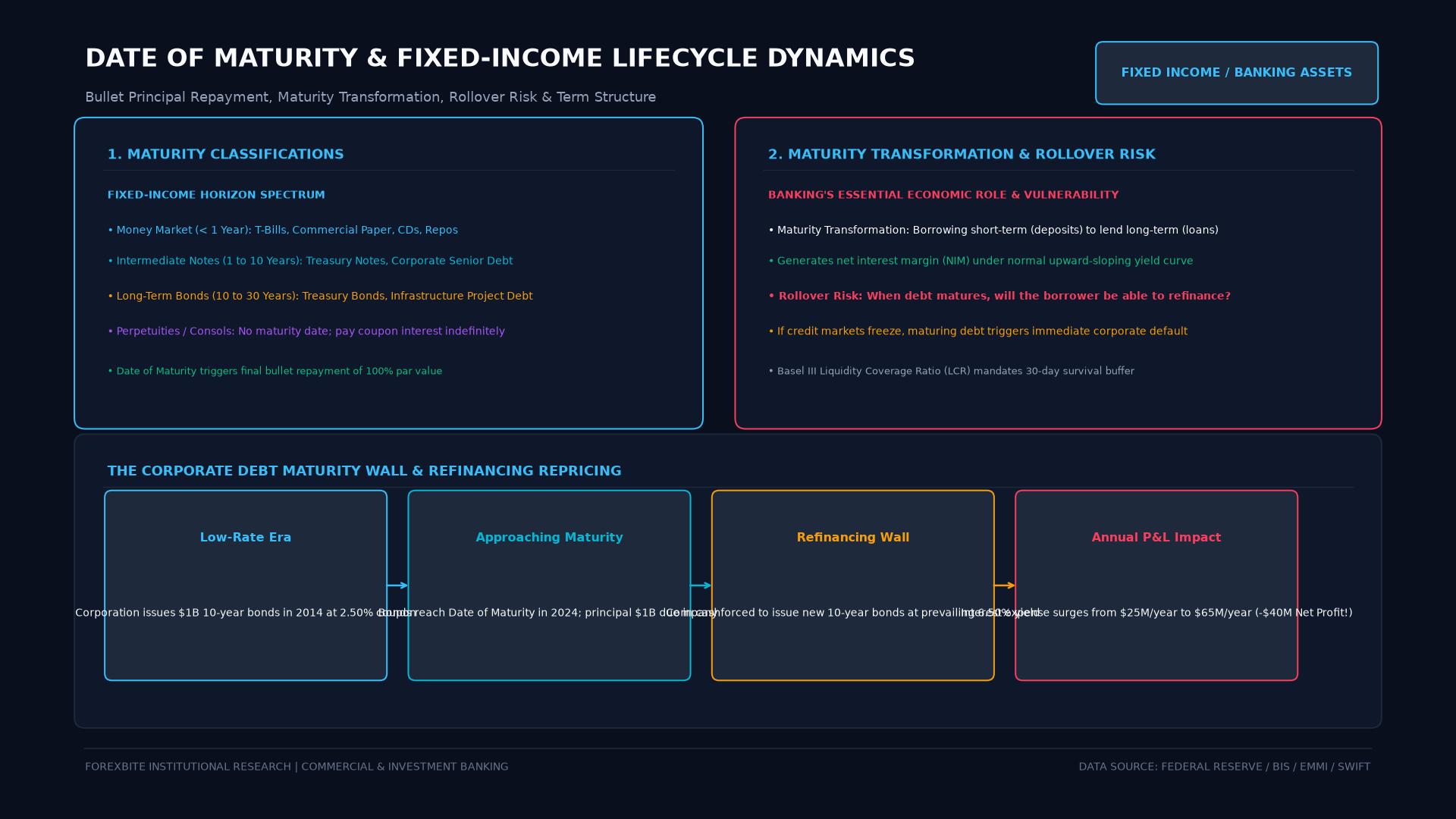 Figure: Debt maturity profiles: short-term commercial paper, bullet bonds, amortizing term loans, and perpetual debt capital redemption features.
Technical Mechanics & The Pull-to-Par Formulation
In fixed-income mathematical modeling, a bond’s secondary market price ($P$) is the present value of scheduled coupons ($C$) plus the par value ($F$) discounted at prevailing yield-to-maturity ($y$):
$$P(t) = \sum_{k=1}^{n(t)} \frac{C}{(1 + y)^k} + \frac{F}{(1 + y)^{n(t)}}$$
Where $n(t)$ represents the number of coupon periods remaining until the date of maturity.
The Convergence Principle
As the current date approaches the date of maturity ($n(t) \to 0$):
$$\lim_{n(t) \to 0} P(t) = F \quad (\text{Pull-to-Par})$$
Regardless of whether a bond was initially issued at a deep discount (e.g., $850) or traded at an extreme premium (e.g., $1,150) during periods of volatile interest rates, its theoretical market value on the date of maturity is mathematically fixed at exactly 100% of par value ($1,000).
Debt Maturity Structures
| Maturity Structure | Principal Repayment Mechanics | Cash-Flow Profile | Typical Instruments |
|---|---|---|---|
| Bullet Maturity | 100% of principal paid on final maturity date | Constant coupon interest; lump-sum principal | US Treasuries, Corporate Eurobonds |
| Serial Maturity | Staggered tranches mature annually over several years | Declining principal and interest burden | Municipal infrastructure bonds |
| Amortizing Debt | Principal repaid incrementally in each periodic payment | Blended monthly payments of principal + interest | Residential mortgages, auto loans |
| Balloon Maturity | Small amortizing payments with large lump-sum at maturity | Substantial final maturity obligation | Commercial real estate loans |
| Perpetual Debt (Consols) | Zero maturity date ($T \to \infty$) | Perpetual interest; principal never repaid | UK Consols, Bank AT1 Capital |
Real-World Case Study: The Corporate “Maturity Wall” of 2024–2026
The strategic importance of managing maturity dates was demonstrated following the global monetary tightening cycle of 2022–2023.
Anatomy of the Corporate Maturity Wall:
1. The Low-Rate Bonanza (2020-2021): S&P 500 corporations and private equity sponsors issued trillions of dollars in corporate debt at historic record-low coupon rates of 2.50% to 4.00%, locking in 5-year maturities.
2. The Rate Shock: In 2022-2023, the Federal Reserve hiked interest rates by 525 basis points, pushing high-yield borrowing costs above 8.50%.
3. The Collision (2024-2026): A massive cluster of corporate debt—exceeding $2.5 trillion globally—faced maturity dates between 2024 and 2026 (the "Maturity Wall").
4. The Refinancing Squeeze: Corporations whose debt reached its date of maturity could not pay cash from operational earnings; they were forced to refinance at double their previous interest rates, triggering corporate credit downgrades and margin compression.
Frequently Asked Questions (FAQ)
What is the difference between a bond’s maturity date and its duration?
A bond’s maturity date is a fixed calendar date specifying when the contract terminates and the final principal is repaid. Duration (such as Macaulay Duration or Modified Duration) is a mathematical measure of the bond’s effective weighted average time to receive all cash flows, which measures its price sensitivity to interest rate changes. For a coupon-paying bond, duration is always shorter than maturity because intermediate coupon payments return cash to the investor before the final maturity date arrives.
What happens if an issuer cannot pay principal on the date of maturity?
If an issuer fails to wire the full par value to the paying agent on the date of maturity, the event constitutes an immediate Event of Default under the bond indenture. The bond trustee issues a formal Notice of Default, credit rating agencies downgrade the issuer to “D” (Default), and bondholders obtain the legal right to accelerate all other outstanding debt and file for involuntary corporate bankruptcy or debt restructuring.
What is a “perpetual bond” and does it ever reach a maturity date?
A perpetual bond (often called a “perpetual debenture” or “consol”) is a bond that has no maturity date. The issuer has no legal obligation to ever repay the principal amount; instead, the issuer commits to paying an indefinite stream of periodic interest coupons forever. However, most modern perpetual bonds include call options that allow the issuer to redeem the bonds after a designated period (e.g., after 5 or 10 years).
Ready to trade forex?
Open a free demo account with a regulated broker. Practice with virtual funds before risking real money.