Zero-Coupon Bond
A zero-coupon bond is a fixed-income security that pays no periodic interest coupons, sold at a deep discount to its face value and redeemed at full par value at maturity, with returns generated exclusively through capital accretion.
What Is a Zero-Coupon Bond?
A zero-coupon bond (frequently referred to as a “pure discount bond” or “accrual bond”) is a debt security that pays no periodic interest payments (coupons) throughout its lifecycle. Instead, the bond is initially issued at a deep discount to its par value (face value) and matures at the full nominal face amount upon expiration.
The investor’s financial return consists entirely of the scheduled capital appreciation (accretion) from the discounted purchase price up to the final par value. Because zero-coupon bonds do not distribute cash flows before maturity, they completely eliminate reinvestment rate risk—the danger that intermediate coupons must be reinvested at lower prevailing market interest rates.
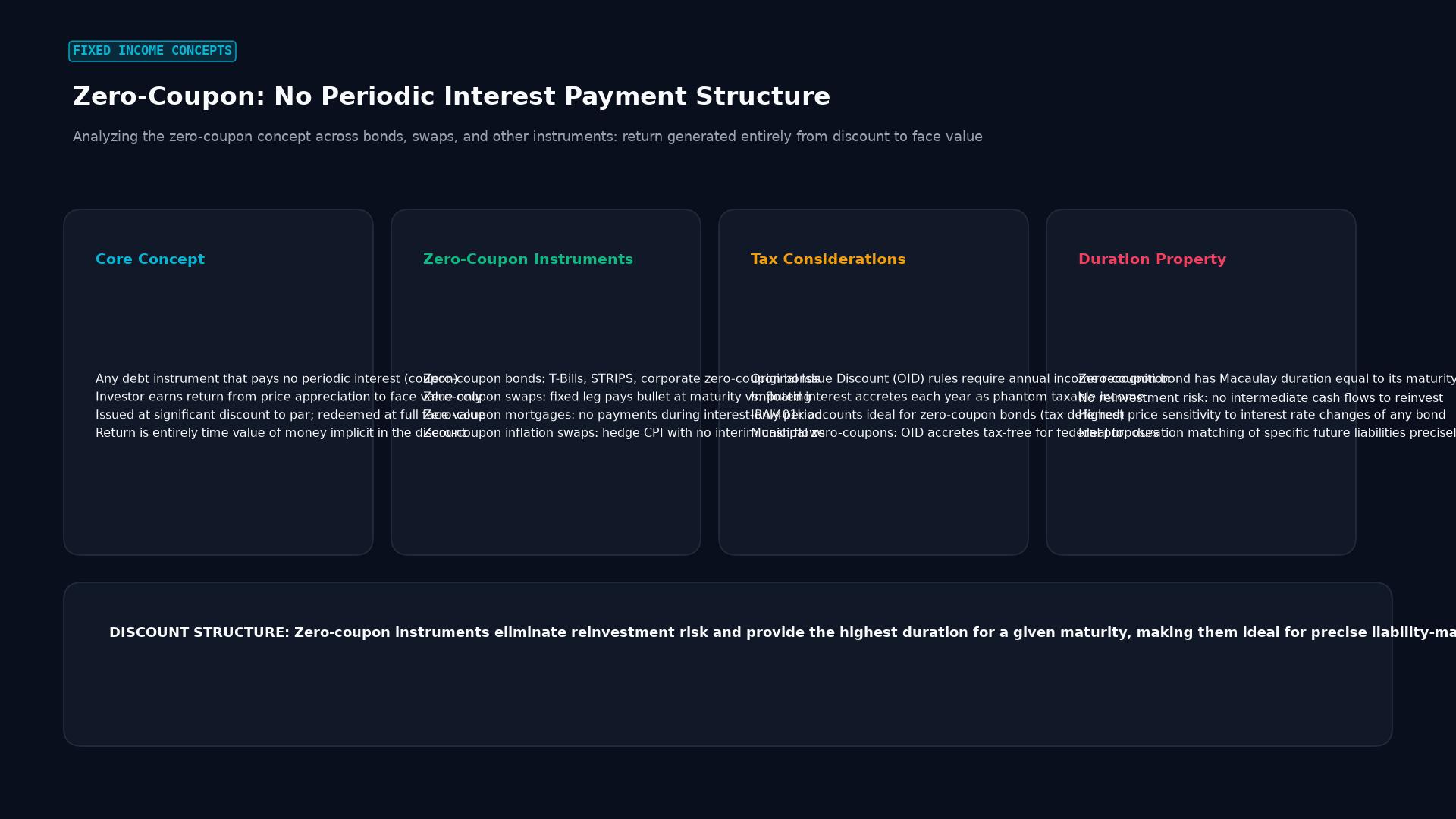 Figure: Analyzing the zero-coupon concept across bonds, swaps, and other instruments: return generated entirely from discount to face value
Quantitative Mechanics: Valuation, Duration, and Volatility
1. Pricing Equation
The theoretical price of a zero-coupon bond is calculated using standard time-value-of-money discounting:
$$P = \frac{F}{\left(1 + \frac{y}{m}\right)^{m \cdot T}}$$
Where:
- $P$: Current purchase price of the bond.
- $F$: Face value paid at maturity (typically $1,000).
- $y$: Annualized yield to maturity (YTM).
- $m$: Compounding frequency per year (in the US market, semi-annual compounding $m = 2$ is standard).
- $T$: Number of years until maturity.
2. The Macaulay Duration Property
A foundational mathematical property of a zero-coupon bond is that its Macaulay duration ($D_{\text{Mac}}$) is exactly equal to its time to maturity ($T$):
$$D_{\text{Mac}} = T$$
For a traditional 20-year coupon bond, intermediate coupon cash flows pull the Macaulay duration down to roughly 12 or 14 years. For a 20-year zero-coupon bond, duration remains a full 20.0 years.
3. Modified Duration & Extreme Price Sensitivity
The bond’s percentage price sensitivity to interest rate shifts is governed by its modified duration ($D_{\text{mod}}$):
$$D_{\text{mod}} = \frac{T}{1 + \frac{y}{2}}$$
$$\frac{\Delta P}{P} \approx -D_{\text{mod}} \cdot \Delta y$$
Because zero-coupon bonds carry the longest possible duration for a given maturity, they exhibit the highest price volatility in the fixed-income universe.
Comparative Matrix: Bond Structures
| Characteristic | Zero-Coupon Bond | Conventional Fixed-Coupon Bond | Floating Rate Note (FRN) |
|---|---|---|---|
| Periodic Cash Flow | Zero | Fixed semi-annual/annual cash | Variable coupon tied to SOFR/Euribor |
| Purchase Price | Deep discount to par | Near par (premium or discount) | At or very close to par |
| Reinvestment Risk | None (Zero reinvestment risk) | High (Coupons reinvested at market) | Low |
| Duration | Equals full maturity ($D = T$) | Significantly less than maturity | Near zero (resets quarterly) |
| Interest Rate Risk | Maximum possible price volatility | Moderate | Negligible price volatility |
Real-World Case Study: The 2022–2023 Long-Duration STRIPS Crash
In the United States, the Department of the Treasury does not issue 30-year zero-coupon bonds directly; instead, financial institutions create them by “stripping” the principal and individual coupon cash flows of standard Treasuries through the STRIPS program (Separate Trading of Registered Interest and Principal of Securities).
The Anatomy of a Zero-Coupon Crash (2020-2023):
1. In August 2020, 30-year US Treasury STRIPS traded at record highs, yielding approximately 1.25%.
2. A 30-year zero-coupon STRIPS priced at $68.80 (per $100 par) with a duration of roughly 29.5 years.
3. Over the next three years, the Federal Reserve hiked interest rates by 525 basis points, pushing 30-year sovereign yields from 1.25% to 5.15% in October 2023 (a yield shift of +390 bps).
4. Price Impact:
   $$\frac{\Delta P}{P} \approx -29.5 \times (+3.90\%) \approx -115\% \text{ (Adjusted for convexity: actual price dropped from $68.80 to $22.10)}$$
5. Result: 30-year zero-coupon bondholders suffered a staggering 67.8% peak-to-trough capital loss—a decline worse than the equity market crash during the 2008 Great Financial Crisis.
This historic drawdown proved that zero-coupon sovereign bonds, despite possessing zero credit or default risk, carry massive interest rate duration risk.
Frequently Asked Questions (FAQ)
How do investors earn a return on a zero-coupon bond if there are no interest payments?
The entire return on a zero-coupon bond is delivered through capital accretion. The bond is bought at a substantial discount to its face value. For example, an investor might purchase a 10-year zero-coupon bond with a $1,000 face value for $600 today. When the bond matures in 10 years, the issuer pays the investor the full $1,000 face value. The $400 difference represents the compounded interest return earned across the 10-year holding period.
What is “phantom income” and how are zero-coupon bonds taxed?
In many jurisdictions, including the United States under Internal Revenue Service (IRS) regulations, the annual increase in a zero-coupon bond’s accreted value is classified as Original Issue Discount (OID). The IRS treats this annual accretion as taxable interest income in the year it accrues, even though the investor receives zero physical cash until the bond matures. This creates “phantom income”—a tax liability on cash that has not yet been received. Consequently, taxable investors often hold zero-coupon bonds inside tax-advantaged retirement accounts (such as IRAs or 401(k)s) to defer annual taxes.
Why do institutional asset-liability managers (pension funds) buy zero-coupon bonds?
Institutional pension funds and life insurance companies face strict, long-dated future liabilities—such as guaranteed pension payouts due in exactly 20 or 30 years. By purchasing zero-coupon sovereign bonds whose maturities precisely match those payout dates, pension managers achieve cash flow immunization. Because there are no intermediate coupons that must be reinvested at unpredictable future interest rates, the exact terminal cash payoff is locked in with mathematical certainty.
Ready to trade forex?
Open a free demo account with a regulated broker. Practice with virtual funds before risking real money.