Dated Date
The dated date is the specific calendar date from which a newly issued bond or fixed-income security legally begins to accrue interest, which may differ from the formal issuance or settlement date.
What Is the Dated Date?
In fixed-income underwriting and bond syndication, the dated date is the designated calendar date from which a newly issued debt security begins to accumulate contractual coupon interest.
While the dated date frequently coincides with the bond’s formal issue date or settlement date, in many primary market offerings—particularly in municipal bonds and corporate debt syndicates—the dated date is set prior to the date the bonds are physically delivered and paid for by investors.
Understanding the dated date is critical for calculating accrued interest on new issues. Because the issuer will pay a full, standardized coupon on the first scheduled payment date, buyers who settle their purchases after the dated date must pay the underwriting syndicate the interest that accrued between the dated date and the settlement date.
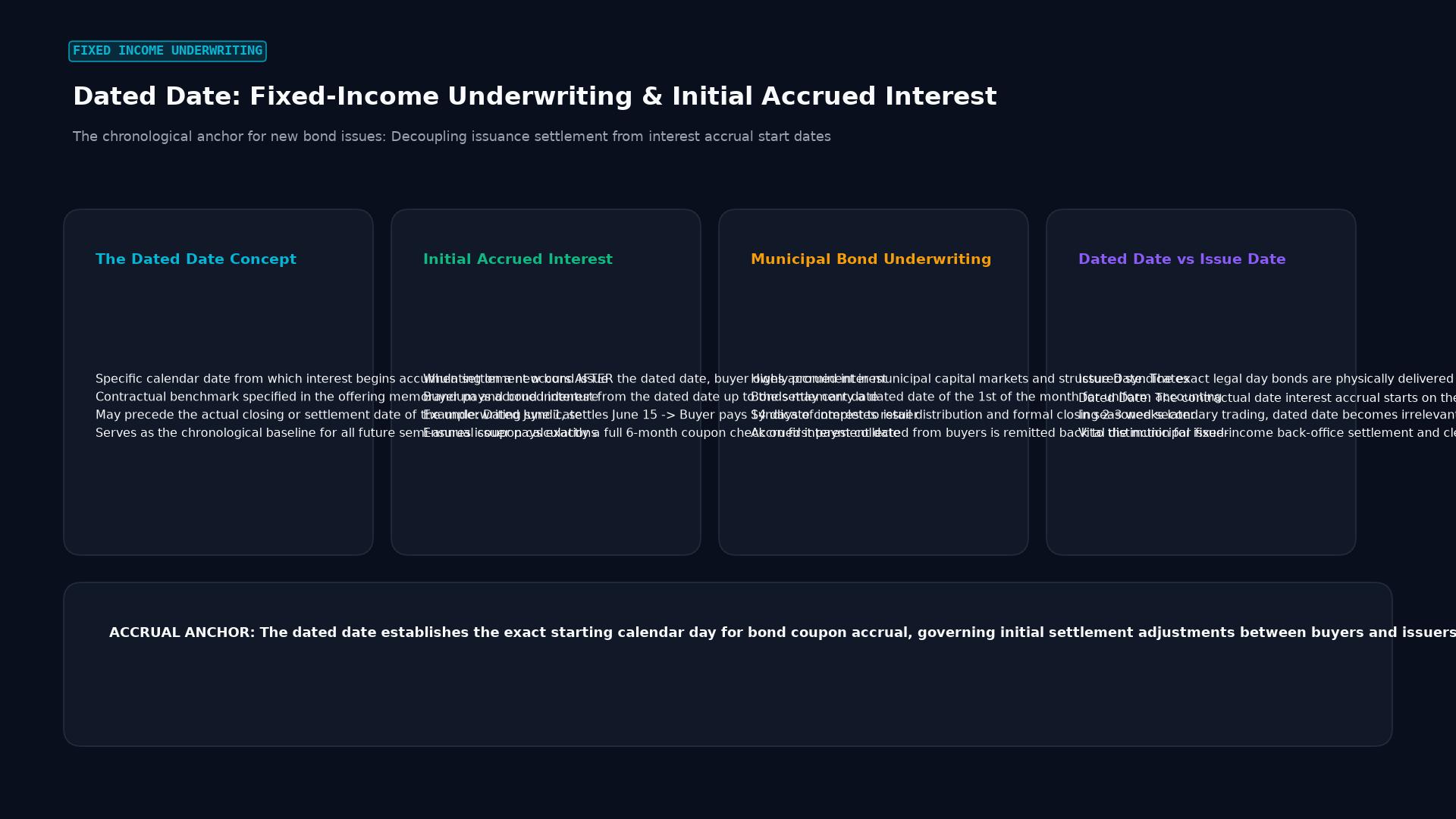 Figure: The chronological anchor for new bond issues: Decoupling issuance settlement from interest accrual start dates
Technical Mechanics & Accrued Interest Formulations
When an investor acquires a bond in the primary market that settles after its dated date, the financial transaction settles at the dirty price (the clean price plus accrued interest).
Initial Primary Market Accrued Interest Formulation
$$\text{Accrued Interest} = \text{Par Value } (F) \times \left( \frac{\text{Annual Coupon } C}{m} \right) \times \left( \frac{\text{Days from Dated Date to Settlement Date}}{\text{Days in Coupon Period}} \right)$$
Where:
- $F$: Nominal par value ($1,000 or $5,000 for municipal bonds).
- $C$: Annual coupon interest rate.
- $m$: Annual coupon frequency (typically $m = 2$ for semi-annual bonds).
- $\text{Day-Count Convention}$: Typically 30/360 for corporate and municipal bonds, or Actual/Actual for US Treasury securities.
Long vs. Short First Coupons
If the interval between the dated date and the first coupon date deviates from the standard six-month period, the bond indenture specifies an adjusted initial cash flow:
- Short First Coupon: Occurs when the interval from dated date to first payment is less than 6 months (e.g., 4 months); the investor receives a smaller pro-rated coupon.
- Long First Coupon: Occurs when the interval is greater than 6 months (e.g., 7 or 8 months); the investor receives a larger initial cash payment:
$$C_{\text{long}} = F \times C \times \left( \frac{\text{Actual Days from Dated Date to Payment Date}}{\text{Base Days in Year}} \right)$$
Comparative Matrix: Fixed-Income Date Architecture
| Date Parameter | Formal Definition | Operational Role |
|---|---|---|
| Dated Date | Date interest legally begins to accrue | Benchmark for initial coupon calculation |
| Issue Date | Date debt is officially printed / registered | Legal creation of the security |
| Settlement Date | Date funds and securities are formally exchanged | Ownership transfers; dirty price paid |
| Date of Maturity | Terminal date when debt expires | Principal par value repaid |
| First Coupon Date | First scheduled interest disbursement | First cash payment delivered to bondholder |
Real-World Case Study: Municipal Bond Syndication Accruals
In the United States municipal bond market, local governments and school districts frequently price and date bond issues weeks before physical settlement occurs.
Anatomy of a Municipal Dated Date Transaction:
- Issuer: The State of California issues $1 billion in General Obligation School Construction Bonds carrying a 4.00% coupon ($200 per $5,000 bond annually).
- Dated Date: Set as September 1, 2023.
- Underwriting Delays: Complex legal bond counsel opinions delay formal closing and clearing.
- Settlement Date: September 21, 2023 (20 days after the dated date).
- The Calculation (30/360 Day Count):
  $$\text{Accrued Interest} = \$5,000 \times 0.04 \times \left( \frac{20}{360} \right) = \$11.11 \text{ per bond}$$
- The Execution: When institutional investors purchased the bonds at the primary offering price of par ($5,000), they remitted $5,011.11 per bond to the underwriting syndicate. On March 1, 2024, the State paid the investors a full 6-month coupon of $100.00, perfectly reconciling the net interest earned.
Frequently Asked Questions (FAQ)
Why is the dated date different from the settlement date on a newly issued bond?
In large corporate and municipal debt offerings, underwriters establish a clean, standard calendar date (such as the 1st or 15th of the month) as the dated date to synchronize all future semi-annual payment schedules. However, final credit ratings verification, institutional book-building syndication, and legal closing documentation take time to finalize, causing the physical settlement date to occur several weeks after the dated date.
Does the investor lose money by paying accrued interest from the dated date?
No. Paying accrued interest is economically neutral for the investor. Although the investor pays accrued interest upfront to the seller or underwriter on the settlement date, they receive that exact money back on the first coupon date. The issuer pays a full six-month coupon on the first payment date, which includes both the interest earned during the investor’s ownership and the interest pre-paid from the dated date.
How does the dated date affect zero-coupon bonds?
For a zero-coupon bond, no periodic interest coupons are distributed. However, the dated date remains crucial because it serves as the official starting point for calculating compound interest accretion and determining the annual Original Issue Discount (OID) phantom income that must be reported to tax authorities (such as the IRS) over the bond’s life.
Ready to trade forex?
Open a free demo account with a regulated broker. Practice with virtual funds before risking real money.