Stop Loss Strategy
A stop-loss strategy is a risk management approach that uses predefined price levels to automatically close losing positions before losses become unacceptable. It turns the potentially unlimited downside of an open trade into a known, controlled cost.
Why Stop-Loss Orders Are Non-Negotiable
Every professional trader uses stop-losses. Every single one. The argument for trading without them — “I’ll just watch the position and exit manually” — fails in practice for a simple reason: markets move faster than human reaction time during the moments that matter most. A news release, a flash crash, a gap at the Sunday open. By the time you realize you need to exit, the price is already well past where you intended to get out.
A stop-loss converts a potentially unlimited loss into a finite, predetermined one. That’s not just practical — it’s the foundation of all professional risk management.
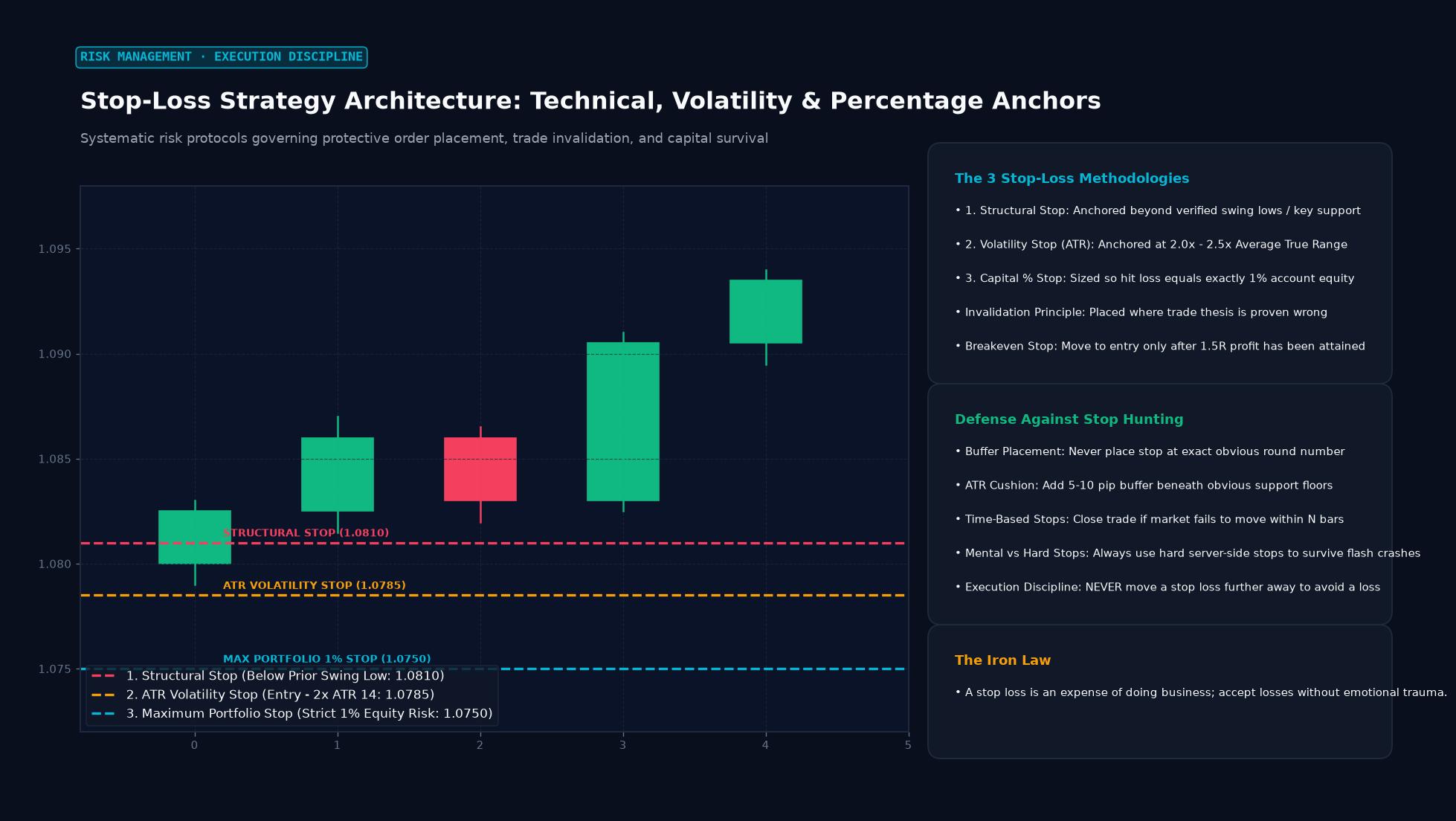 Figure: Systematic risk protocols governing protective order placement, trade invalidation, and capital survival
Types of Stop-Loss Approaches
Not all stop-losses are set the same way. There are four distinct approaches, each appropriate for different trading styles:
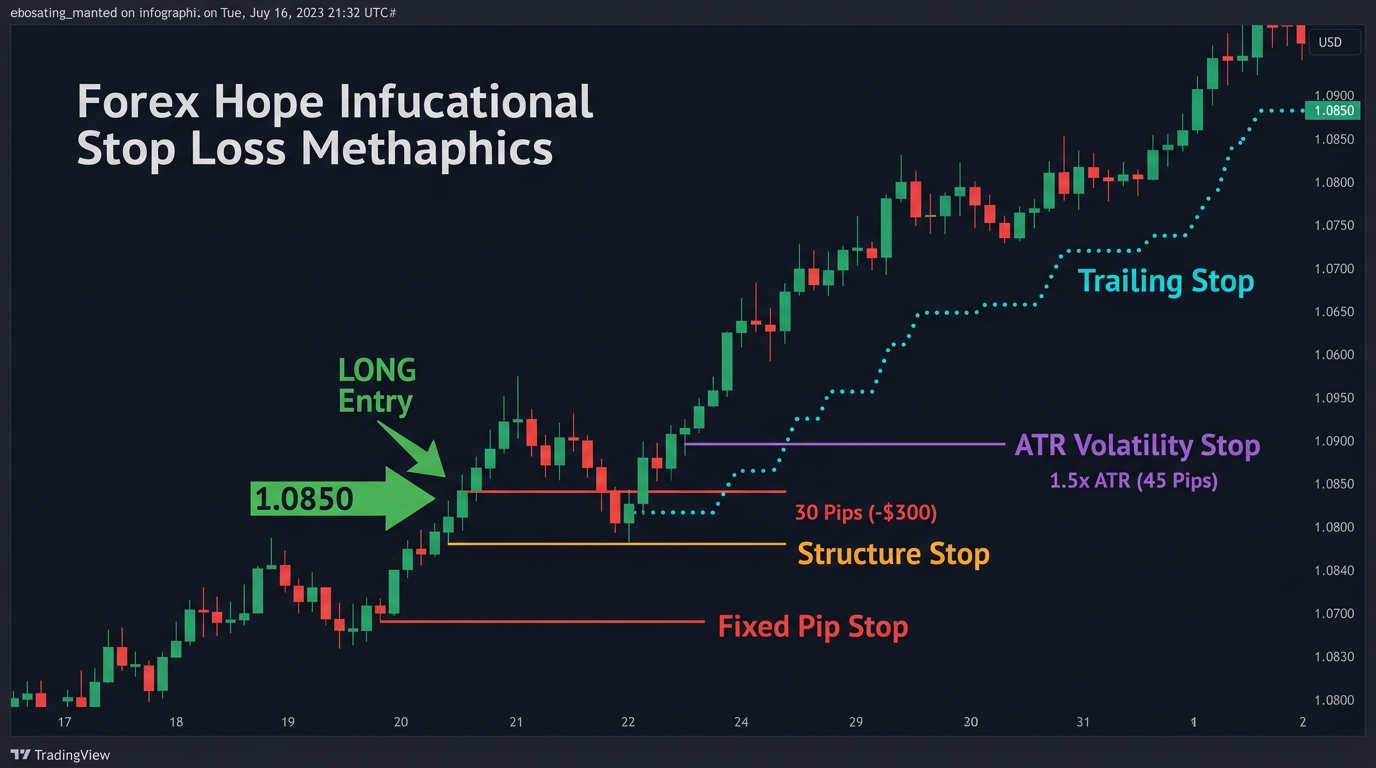
1. Fixed Pip Stop
The simplest form: you place a stop a fixed number of pips from your entry. If you enter EUR/USD at 1.0850 long and set a 30-pip stop, your stop sits at 1.0820 regardless of market structure.
This method is easy to calculate and fits neatly into position sizing formulas. Its weakness: it ignores what the chart is actually doing. A 30-pip stop might be perfectly placed on one setup and completely arbitrary on another.
2. Structure-Based Stop
A more sophisticated approach: place the stop just beyond a key market structure level — a swing low, a support zone, a recent pivot. The idea is that if the market reaches that level, the premise behind your trade is invalidated. You’re not guessing at a pip number; you’re reading the market’s own structure.
For example, if you’re going long EUR/USD because it bounced off a strong support zone at 1.0800, your stop sits at 1.0788 — below the support. If it breaks there, the bullish setup is wrong.
3. Volatility-Based Stop (ATR Stop)
The Average True Range (ATR) measures how far a currency pair typically moves in a given period. Placing a stop at 1.5× or 2× ATR from entry ensures the stop is sized to actual market volatility, not an arbitrary number.
During low-volatility periods, ATR-based stops are tighter. During high-volatility regimes, they widen automatically. This prevents you from being stopped out by normal noise while still protecting against genuine adverse moves.
4. Trailing Stop
A trailing stop moves with the market when the trade is profitable, locking in gains while still allowing the position to run. Set a 30-pip trailing stop on a trade that moves 60 pips in your favor — the stop has automatically trailed to +30 pips from entry, guaranteeing a profitable exit even if the market reverses.
Trailing stops are powerful for trend-following strategies where you want to maximize the capture of extended moves without manually adjusting the stop every few hours.
The Right Distance: Balancing Protection and Breathing Room
Too tight a stop-loss is as dangerous as none at all. Placing a stop 5 pips from entry on EUR/USD — a pair that regularly has 50–100 pip daily ranges — means normal market fluctuation will stop you out before the trade has a chance to develop. You’ll be right about direction and still lose money.
A useful reference: the stop should be at minimum 1× the pair’s average daily range (ADR) away from key noise levels. For EUR/USD with an ADR of 80 pips, that means your structure-based stop needs at least 15–20 pips of buffer beyond the level itself.
Multiple Stop Levels: Scaling Out
Some traders use a tiered stop approach rather than a single exit point. The initial stop covers the full position. Once the trade moves 50% toward target, part of the position is closed (partial profit taken) and the stop on the remaining position is moved to breakeven. This converts the remaining trade to a risk-free position.
This approach requires more active management but significantly improves overall risk-adjusted returns on winning trades. It also reduces the psychological pressure of watching a winning trade turn into a loss.
Stop-Loss vs. Stop-Limit Orders
Worth clarifying: a stop-loss order (also called a stop-market order) converts to a market order when triggered — meaning it guarantees execution but not a specific price. Slippage can occur, especially during gaps.
A stop-limit order sets a specific price at which the order becomes a limit order. It guarantees price but not execution — if the market gaps through your limit price, the order doesn’t fill at all. For most traders, especially in volatile conditions, stop-market orders are safer despite the slippage risk.
Key Takeaways
- Stop-losses convert unlimited potential losses into controlled, finite costs
- Structure-based stops (beyond key levels) outperform arbitrary pip-distance stops
- ATR-based stops automatically adjust to market volatility
- Trailing stops lock in profits while allowing winners to run
- Always use stop-market, not stop-limit, in volatile or fast-moving conditions
FAQ
Should I move my stop-loss once a trade is open? Only in one direction: further in your favor. Moving a stop against you (widening it to avoid a loss) is almost always a psychological mistake — you’re letting emotion override your original analysis.
What if my stop-loss gets hit and then the market reverses in my original direction? This happens. It’s called being “stopped out and reversed.” The correct response is to treat it as a cost of doing business, not evidence that stop-losses don’t work. Over enough trades, proper stop placement improves your overall expectancy even accounting for these frustrating instances.
Ready to trade forex?
Open a free demo account with a regulated broker. Practice with virtual funds before risking real money.