De Jure Corporation
A de jure corporation is a business entity that has fulfilled all legal statutory formalities and procedural requirements mandated by state incorporation statutes, granting it undisputed, flawless corporate legal personhood.
What Is a De Jure Corporation?
In corporate jurisprudence and commercial law, a de jure corporation (derived from the Latin meaning “of law” or “by right of law”) is a business entity that has strictly, substantially, and flawlessly complied with all legal formalities, statutory requirements, and procedural mandates established by the governing state or national corporation law.
Achieving de jure status grants the business undisputed legal recognition as an independent corporate person entirely separate from its shareholders, directors, and officers. As a de jure corporation, the entity’s legal standing is impregnable: it cannot be successfully challenged or dissolved through private lawsuits, and it enjoys full constitutional protections, perpetual existence, and the unbreachable corporate veil of limited liability, ensuring that shareholder liability is strictly limited to the capital they invested.
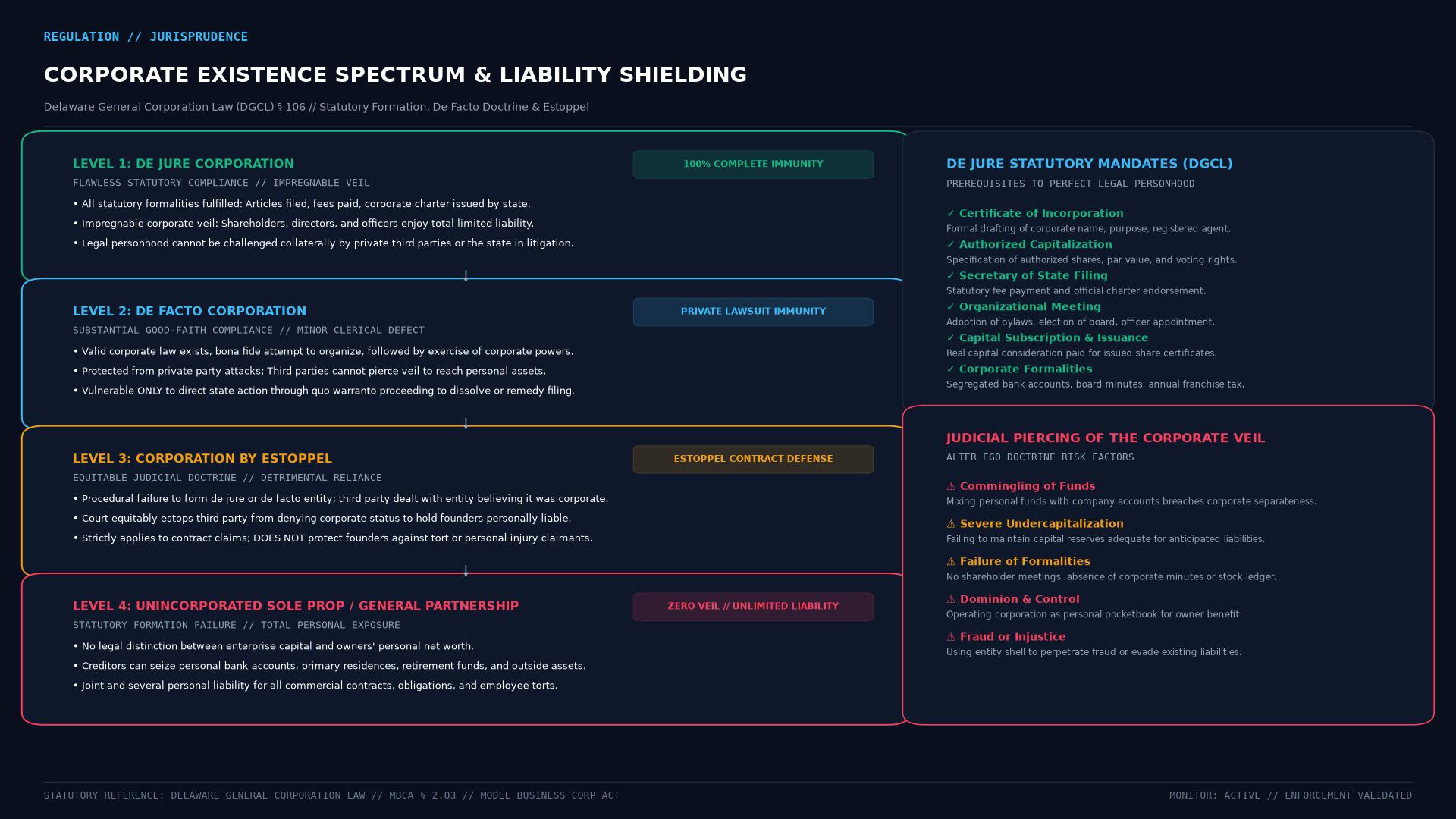 Figure: The corporate existence spectrum from flawless de jure standing down to unincorporated sole proprietorships, delineating statutory compliance requirements, vulnerability to quo warranto proceedings, and limited liability protections.
Technical Mechanics & Statutory Incorporation Criteria
To achieve and maintain de jure status under model state business statutes (such as the Delaware General Corporation Law - DGCL or the Model Business Corporation Act - MBCA), the entity must satisfy a rigorous statutory checklist:
The De Jure Statutory Checklist
- Filing of Articles of Incorporation (or Certificate of Incorporation): Must be drafted with statutory precision, including the legal corporate name, designated corporate purpose, total authorized share capitalization, and par value.
- Designation of Registered Agent: Formal appointment of an authorized physical agent and legal address within the state of incorporation to accept service of process.
- Execution of Organizational Meeting: Formal adoption of corporate bylaws by the board of directors, election of corporate officers (CEO, Secretary, Treasurer), and initial issuance of capital stock in exchange for consideration.
- Payment of Statutory Fees: Complete remittance of state filing fees, initial capitalization franchise taxes, and registration dues.
The Limited Liability Mathematical Boundary
Once de jure status is confirmed, the maximum potential economic loss ($\text{Loss}_{\max}$) sustained by an equity shareholder is mathematically capped:
$$\text{Loss}_{\max} = \text{Capital Subscribed and Invested}$$
Personal bank accounts, real estate holdings, and external assets of the corporate shareholders are insulated from corporate tort judgments, debt defaults, and commercial obligations.
Comparative Matrix: Corporate Legal Recognition Tiers
| Legal Classification | Statutory Compliance Level | Vulnerable to Private Attack? | Vulnerable to State Quo Warranto? | Limited Liability Shield Status |
|---|---|---|---|---|
| De Jure Corporation | 100% Substantial / Perfect | No (Immune) | No (Immune) | Fully Protected (Intact) |
| De Facto Corporation | Good-faith attempt; clerical error | No (Protected) | Yes (State may dissolve) | Protected against private creditors |
| Corporation by Estoppel | Equitable fairness doctrine only | Conditional (Case-by-case) | Not applicable | Protected only against specific contracting party |
| Alter Ego / Veil Pierced | Statutory abuse / commingling | Yes (Veil pierced) | Yes | Destroyed (Personal liability imposed) |
Real-World Case Study: Defective Incorporation & Robertson v. Levy (1964)
The legal boundary between a de jure corporation and personal liability was established in the landmark corporate law case Robertson v. Levy (197 A.2d 443, D.C. 1964).
Anatomy of a Premature Corporate Transaction:
1. The Agreement: On December 22, Eugene Levy signed an agreement to purchase a business from Martin Robertson on behalf of "Penn Ave. Record Shack, Inc."
2. The Filing Defect: Levy had submitted articles of incorporation to the corporate registrar on December 23, but the state rejected the paperwork due to defective documentation.
3. The Execution: Despite lacking a valid corporate charter, Levy began operating the record store, accepting merchandise deliveries and signing corporate promissory notes.
4. The Formal Charter: The state finally approved the articles and issued the Certificate of Incorporation on January 17 (granting de jure status from that date forward).
5. The Default: The record store subsequently became insolvent and defaulted on the promissory note to Robertson.
6. The Court Ruling: The court held that because Levy executed the contract before the certificate of incorporation was formally issued by the state, no de jure or de facto corporation existed at the time of execution. The corporate veil was non-existent; Levy was held 100% personally liable for the corporate debt.
The ruling established that individuals who assume to act as a corporation without statutory authority are personally liable for all debts incurred.
Frequently Asked Questions (FAQ)
What is the primary difference between a de jure and a de facto corporation?
A de jure corporation has complied with all statutory legal requirements so perfectly that its corporate existence is immune to legal challenge by anyone—including the state government. A de facto corporation made a bona fide, good-faith attempt to incorporate and exercised corporate powers, but suffered a minor procedural or clerical defect in its state paperwork. A de facto corporation is protected from private creditor lawsuits, but remains vulnerable to a legal challenge brought directly by the state Attorney General.
What is an action in the nature of quo warranto?
An action in the nature of quo warranto (Latin for “by what authority”) is a formal civil proceeding initiated directly by the state government (typically through the state Attorney General) questioning an entity’s legal right to exercise corporate franchises, privileges, or powers. While a de jure corporation is completely immune to quo warranto attacks, a defective or fraudulent de facto corporation can be dissolved by the state through this proceeding.
Can the corporate veil of a de jure corporation ever be pierced?
Yes, under exceptional legal circumstances. Even if a corporation achieves flawless de jure status upon formation, courts will “pierce the corporate veil” and hold shareholders personally liable if the owners subsequently abuse the corporate form. Common grounds for piercing the veil include:
- Commingling of Funds: Mixing personal and business bank accounts.
- Gross Undercapitalization: Deliberately failing to maintain sufficient capital to meet normal business risks.
- Fraud or Sham: Using the corporate shell strictly as an “alter ego” to perpetrate fraud or evade existing personal legal obligations.
Ready to trade forex?
Open a free demo account with a regulated broker. Practice with virtual funds before risking real money.