Withholding Tax
A withholding tax is a government requirement where the payer of cross-border income (such as dividends, interest, or royalties) deducts tax at source and remits it directly to the revenue authorities before distributing the net proceeds.
What Is Withholding Tax (WHT)?
A withholding tax (WHT) is an income tax deducted directly at source by the payer of passive income—most commonly dividends, bond coupon interest, royalties, or technical service fees—before distributing the remaining net funds to a non-resident individual or foreign corporate recipient.
Governments implement withholding taxes primarily to prevent non-resident investors and offshore entities from evading taxation. Because foreign investors do not reside within the domestic jurisdiction and often possess no local assets that tax authorities can seize, the source government mandates that domestic financial intermediaries (custodian banks, paying agents, and corporations) withhold the legal tax percentage upfront and remit it directly to the national treasury.
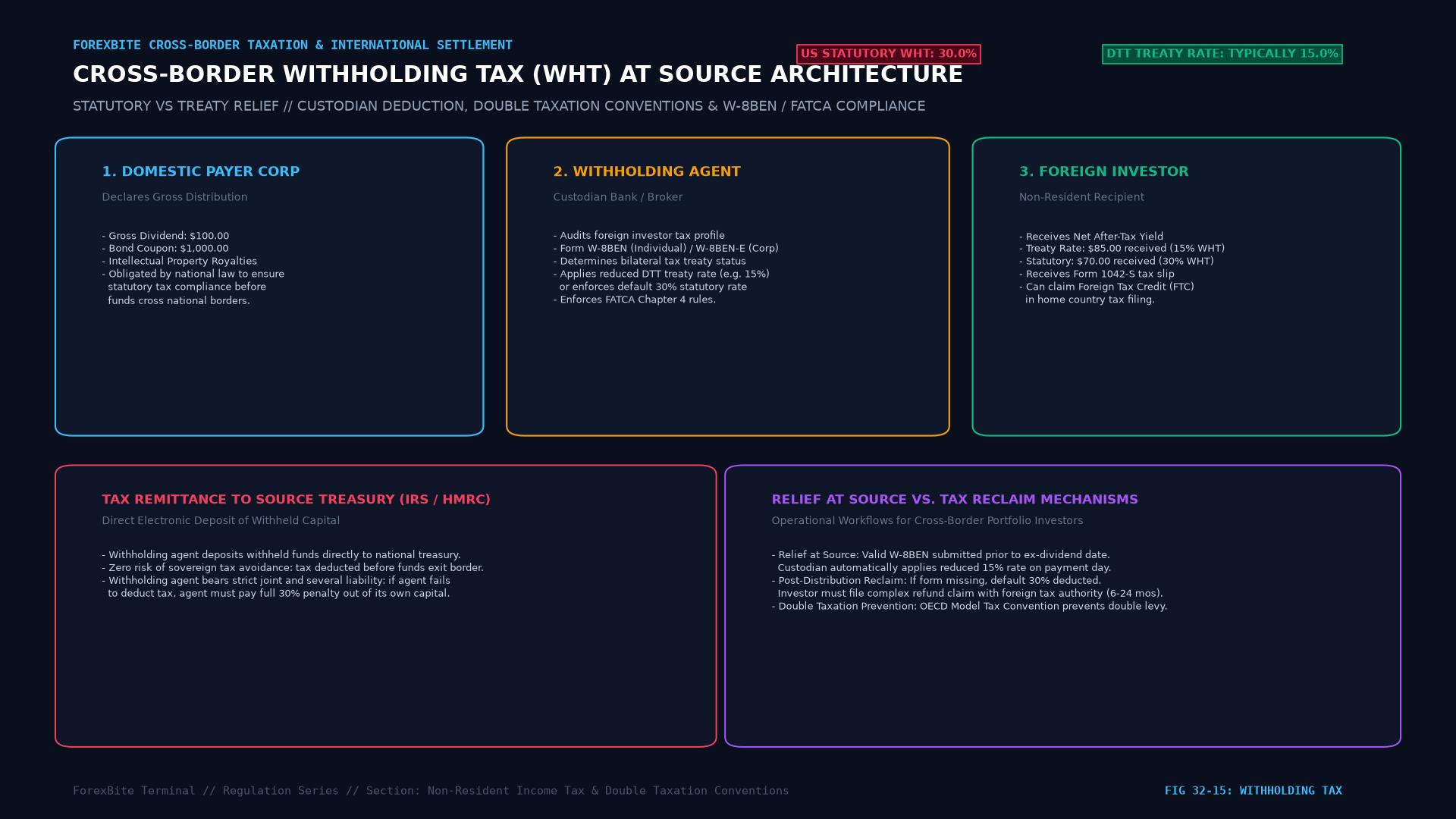 Figure: The cross-border withholding tax lifecycle from source corporation to intermediary withholding agent, showing statutory vs Double Tax Treaty (DTT) deduction and remittance to national revenue authorities.
Quantitative Mechanics: Net Yield and Double Taxation Relief
Cross-border investors evaluate international bond yields and equity dividend streams on an after-tax net yield basis:
$$\text{Net Dividend Yield} = \text{Gross Dividend Yield} \times \left(1 - t_{\text{WHT}}\right)$$
Where $t_{\text{WHT}}$ represents the applicable withholding tax rate.
Double Taxation Treaty (DTT) Relief
Under the OECD Model Tax Convention, bilateral Double Taxation Treaties (DTTs) reduce statutory withholding rates to prevent punitive double taxation:
$$\text{Effective Net Yield} = \text{Gross Yield} \times \left(1 - \min\left(t_{\text{statutory}}, t_{\text{treaty}}\right)\right) + \text{Foreign Tax Credit}$$
Where the investor’s home jurisdiction grants a foreign tax credit:
$$\text{Tax Credit} = \min\left(t_{\text{treaty}}, t_{\text{domestic}}\right)$$
US Withholding Architecture: Form W-8BEN and FATCA
Under United States Internal Revenue Code Chapter 3 and the Foreign Account Tax Compliance Act (FATCA), non-US residents are subject to a default 30% statutory withholding tax on US-sourced dividends and periodic income.
By submitting a certified Form W-8BEN (for individuals) or Form W-8BEN-E (for corporate entities), non-resident investors verify their tax residency, reducing the withholding rate down to the applicable bilateral treaty rate (commonly 15% for major treaty partners like the UK, Germany, and Japan).
Comparative Structure: International Withholding Tax Rates
| Country of Source | Statutory Equity WHT Rate | Typical Treaty Reduced Rate | Statutory Interest WHT Rate | Treaty Interest Rate |
|---|---|---|---|---|
| United States | 30% | 15% | 30% (Portfolio interest often 0%) | 0% - 10% |
| Germany | 26.375% (incl. Solidarity Surcharge) | 15% - 26.375% | 0% (Bank interest generally exempt) | 0% |
| Switzerland | 35.0% (Verrechnungssteuer) | 15% (20% reclaimable via treaty) | 35.0% on domestic bonds | 0% - 10% |
| United Kingdom | 0% (Dividends generally exempt) | 0% | 20.0% | 0% via treaty |
| Australia | 30% (Unfranked dividends) | 15% | 10.0% (Interest WHT) | 0% - 10% |
Real-World Case Study: The European “Cum-Ex” Scandal (2012–2020)
The mechanics of dividend withholding tax refund claims became the center of Europe’s largest tax fraud in modern history, known as the Cum-Ex scandal.
The Cum-Ex Tax Arbitrage Mechanism:
1. Traders, hedge funds, and investment banks executed rapid cross-border short sales of German equities immediately prior to the ex-dividend date ("cum-dividend") and settled them immediately after ("ex-dividend").
2. Settlement delays and blurred legal ownership across custodian chains caused tax certificates to be issued to both the initial owner and the short-buyer.
3. Multiple participants claimed refunds for withholding tax that had only been collected once by the German fiscal authorities.
4. Total Fiscal Cost: The scheme drained an estimated €50+ billion from European sovereign treasuries (primarily Germany, Denmark, and Belgium) before tax laws and cross-border custodial clearing protocols were overhauled.
The fallout prompted European authorities to mandate electronic tax verification ledgers and eliminate manual withholding tax reclaim vouchers.
Frequently Asked Questions (FAQ)
Does withholding tax apply to spot foreign exchange (forex) trading profits?
In the vast majority of jurisdictions, no. Spot foreign exchange trading profits and capital gains generated by trading currency pairs (such as EUR/USD or GBP/USD) are classified as capital gains or speculative trading income rather than fixed periodic income (like dividends or coupon interest). As such, brokers do not withhold taxes at source on closed forex trade profits. However, currency traders remain legally obligated to report realized gains on their domestic annual income tax filings according to their home country’s local tax laws.
What is the difference between relief-at-source and tax reclaim?
Relief-at-source occurs when the domestic broker or custodian bank applies the reduced treaty withholding tax rate (e.g., 15% instead of 30%) automatically at the moment of payment, ensuring the investor receives the maximum net cash immediately. Tax reclaim occurs when the custodian bank withholds the full statutory rate (e.g., 35% in Switzerland), requiring the foreign investor to file formal bureaucratic reclaim paperwork with the foreign tax agency months or years later to recover the withheld differential.
What is a “franked dividend” in markets like Australia?
In Australia and New Zealand, an imputation system operates to eliminate double taxation. A franked dividend has already had domestic corporate income tax paid on it at the company level (currently 30% in Australia). Because tax was already remitted to the Australian Taxation Office (ATO), non-resident shareholders receiving fully franked dividends are typically exempt from dividend withholding tax at source, receiving 100% of the declared dividend distribution.
Ready to trade forex?
Open a free demo account with a regulated broker. Practice with virtual funds before risking real money.