C Corporation
A C Corporation is a legal business structure under US corporate law where the entity is recognized as distinct from its owners, providing limited liability protection but subjecting profits to corporate income taxation and shareholder dividend taxation (double taxation).
What Is a C Corporation?
A C Corporation (governed by Subchapter C of Chapter 1 of the United States Internal Revenue Code) is a corporate legal structure in which the business entity is recognized under the law as an entirely separate legal person from its founders, directors, and shareholders.
Under Anglo-American corporate law, this legal separation endows the C Corporation with perpetual existence—meaning the company continues to operate indefinitely regardless of shareholder departures, transfers of ownership, or death. While shareholders enjoy complete limited liability protection (insulating personal assets from corporate debts and lawsuits), the fundamental tradeoff of a C Corporation is double taxation: the corporation pays income taxes on its net profits at the corporate level, and shareholders pay personal income taxes on those same earnings when distributed as dividends.
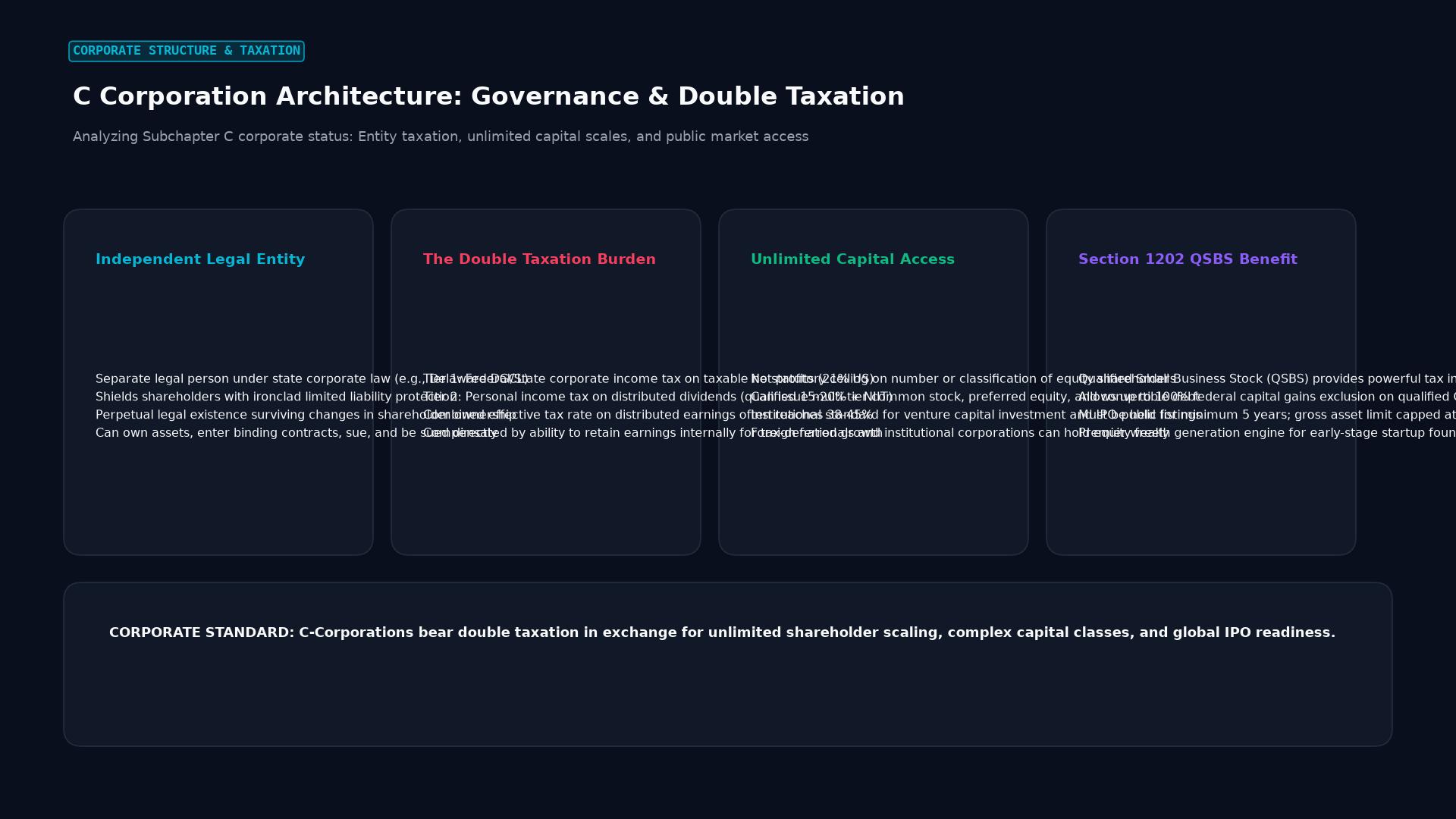 Figure: Analyzing Subchapter C corporate status: Entity taxation, unlimited capital scales, and public market access
Technical Mechanics & Double Taxation Modeling
The mathematical formulation of double taxation demonstrates how corporate earnings are eroded prior to reaching end-investors:
Effective Combined Tax Rate Formula
Let:
- $E$: Pre-tax corporate earnings.
- $t_{\text{corp}}$: Statutory federal and state corporate income tax rate.
- $t_{\text{div}}$: Qualified personal dividend tax rate (including the 3.8% Net Investment Income Tax - NIIT).
The net distributed capital ($\text{Net Cash}$) received by the equity owner is:
$$\text{Net Cash} = E \times \left(1 - t_{\text{corp}}\right) \times \left(1 - t_{\text{div}}\right)$$
The combined effective tax rate ($t_{\text{eff}}$) is derived as:
$$t_{\text{eff}} = 1 - \left(1 - t_{\text{corp}}\right)\left(1 - t_{\text{div}}\right)$$
Under current US federal law ($t_{\text{corp}} = 21%$ and $t_{\text{div}} = 23.8%$):
$$t_{\text{eff}} = 1 - (1 - 0.21)(1 - 0.238) = 1 - (0.79 \times 0.762) = 1 - 0.60198 = 39.80%$$
When factoring in state corporate and individual income taxes (such as in California or New York), the total effective tax drag frequently surpasses 48% to 52%.
Institutional Capital Advantages
Despite double taxation, the C Corporation is the universal vehicle for large-scale enterprise for three reasons:
- Unlimited Shareholders: Unlike an S Corporation (strictly capped at 100 US resident shareholders), a C Corporation can issue equity to millions of global investors.
- Multiple Share Classes: Enables the issuance of Common Stock (Series A, B, C) and Preferred Stock with liquidation preferences, anti-dilution ratchets, and voting covenants.
- Public Market Listing: Institutional stock exchanges (NYSE, Nasdaq, LSE) require companies to operate as C Corporations (or foreign corporate equivalents).
Comparative Matrix: US Business Entity Structures
| Feature | C Corporation | S Corporation | Limited Liability Company (LLC) |
|---|---|---|---|
| Tax Status | Double Taxation (Entity + Shareholder) | Pass-Through (Entity pays zero) | Pass-Through (Default) |
| Shareholder Limit | Unlimited | Strictly limited to 100 | Unlimited members |
| Foreign Ownership | Fully Permitted | Prohibited (US residents only) | Fully Permitted |
| Stock Classes | Multiple (Common, Preferred) | Strictly single class of stock | Multiple membership units |
| Venture Capital Fit | Universal Standard | Ineligible | Generally avoided due to UBTI |
| QSBS Eligible | Yes (Section 1202) | No | No |
Real-World Case Study: The 2017 Tax Cuts and Jobs Act (TCJA) Corporate Boom
Prior to 2017, the United States maintained the highest statutory corporate income tax rate among OECD developed nations at 35%, prompting US multinationals to hoard trillions of dollars in foreign subsidiaries through offshore tax havens (such as Ireland, Bermuda, and the Cayman Islands).
The Impact of TCJA (December 2017):
1. Rate Reduction: The statutory federal corporate tax rate was slashed from 35% to a flat 21%.
2. Mandatory Deemed Repatriation: Established a one-time transition tax on accumulated offshore earnings (15.5% on cash, 8% on illiquid assets).
3. Corporate Response:
   * S&P 500 corporations repatriated hundreds of billions in offshore liquidity.
   * Apple announced a $350 billion five-year US economic contribution commitment.
   * Total US corporate share repurchases (buybacks) hit an unprecedented record of $806 billion in 2018.
4. Valuation Multiple Expansion: The tax cut mechanically expanded net corporate earnings per share (EPS), driving a multi-year bull market across US equity benchmarks.
Frequently Asked Questions (FAQ)
Why do venture capital funds require tech startups to incorporate as Delaware C Corporations?
Venture capital (VC) funds and institutional private equity investors almost universally refuse to invest in LLCs or S Corporations. S Corporations cannot accept institutional or foreign capital and cannot issue preferred stock. LLCs pass complicated K-1 partnership tax filings to fund investors, generating Unrelated Business Taxable Income (UBTI) for tax-exempt limited partners (such as university endowments and pension funds). Furthermore, Delaware’s Court of Chancery offers the world’s most sophisticated and predictable body of corporate business law.
What is the Section 1202 Qualified Small Business Stock (QSBS) exemption?
Under Section 1202 of the Internal Revenue Code, non-corporate investors who purchase newly issued original stock directly from a gross-assets-qualified domestic C Corporation and hold the shares for at least five years can exclude up to 100% of their capital gains from federal income tax upon sale, subject to a cap of $10 million or 10 times the original investment basis. This tax shield is one of the most powerful wealth-creation incentives in early-stage angel investing and tech entrepreneurship.
Can a foreign citizen establish and own 100% of a US C Corporation?
Yes. Unlike S Corporations (which legally require all shareholders to be US citizens or permanent resident aliens), a US C Corporation has zero restrictions regarding the nationality or geographic residency of its owners. A non-US citizen living abroad can legally incorporate, fund, and own 100% of a Delaware or Wyoming C Corporation, appoint foreign directors, and conduct cross-border commerce, subject to standard US withholding taxes on dividends.
Ready to trade forex?
Open a free demo account with a regulated broker. Practice with virtual funds before risking real money.