Capital Asset
A capital asset is any significant piece of property owned by an individual or enterprise with a useful economic life exceeding one year, acquired for long-term investment, production of goods, or wealth accumulation.
What Is a Capital Asset?
A capital asset is any significant financial, real, or tangible property owned by an individual or business entity that possesses a useful economic lifecycle extending beyond a single fiscal year.
In modern financial markets and corporate accounting, the term “capital asset” carries two distinct institutional definitions:
- Tax Law & Investment Definition (IRC §1221): Under United States tax code and global revenue authorities, a capital asset encompasses virtually all property held for personal enjoyment or investment purposes—including corporate equities, sovereign bonds, residential real estate, precious metals, and digital assets. It explicitly excludes business inventory and accounts receivable.
- Corporate Financial Accounting Definition (CapEx / PP&E): On corporate balance sheets, capital assets are long-term tangible or intangible assets (Property, Plant, and Equipment - PP&E, heavy machinery, logistics fleets, patents) utilized to generate ongoing commercial revenue. Unlike day-to-day operational expenses (OpEx), capital assets cannot be expensed immediately; they are capitalized and amortized or depreciated across their useful economic lives.
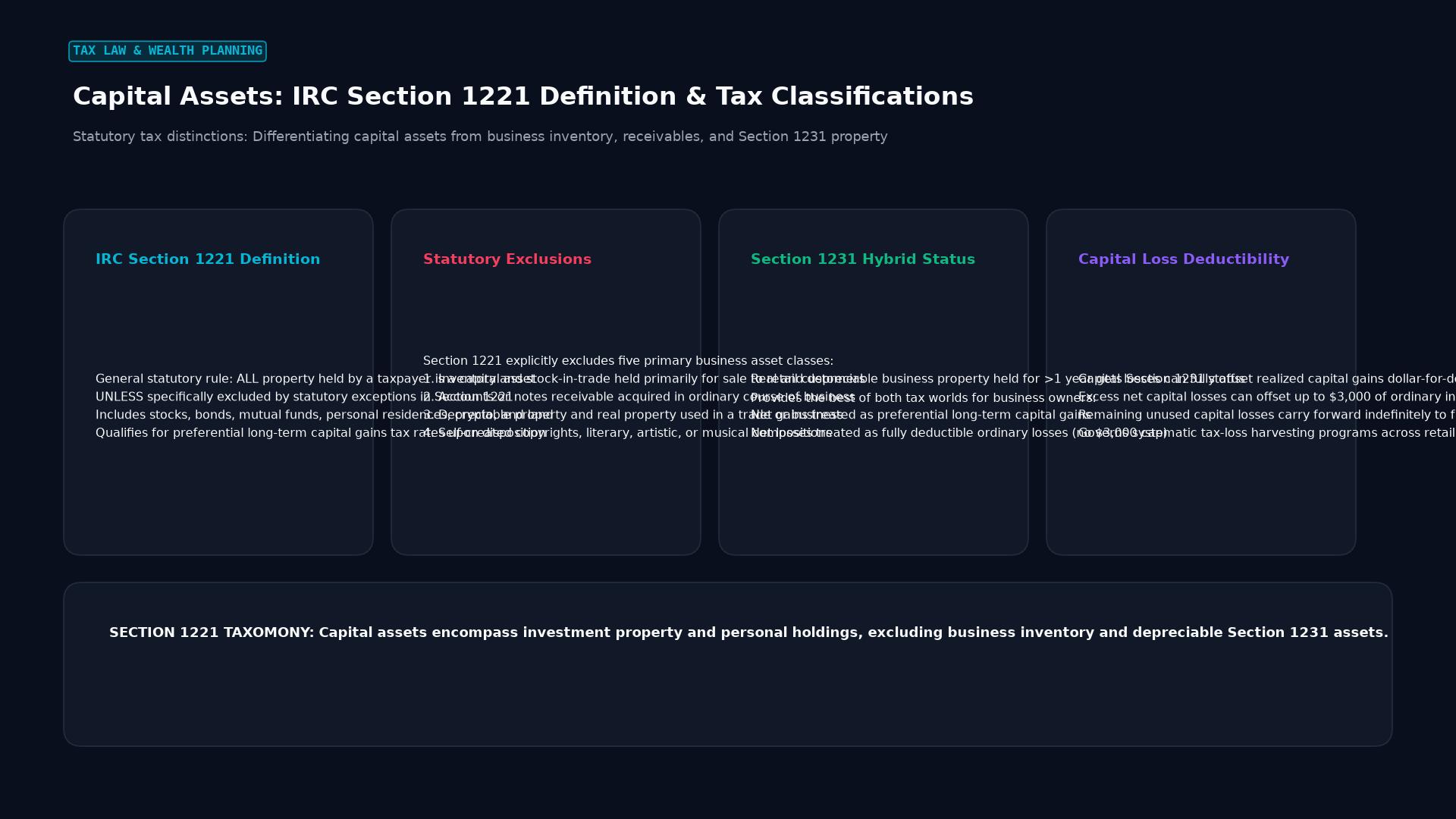 Figure: Statutory tax distinctions: Differentiating capital assets from business inventory, receivables, and Section 1231 property
Technical Mechanics: Depreciation & Tax Gain Modeling
When a corporation acquires a capital asset, the cost is recognized on the balance sheet and depreciated over time using standard accounting schedules:
1. Straight-Line Depreciation Formulation
$$\text{Annual Depreciation Expense} = \frac{\text{Historical Cost Basis} - \text{Salvage Value}}{\text{Useful Economic Life } (N)}$$
Where:
- $\text{Historical Cost Basis}$: Purchase price plus all direct delivery, shipping, legal, and installation costs required to place the asset into service.
- $\text{Salvage Value}$: Estimated scrap or residual value at the conclusion of its useful life.
2. Capital Gain Computation on Disposition
When a capital asset is liquidated, the realized gain or loss is determined by comparing the net sales proceeds to the asset’s adjusted basis:
$$\text{Adjusted Cost Basis} = \text{Original Purchase Price} + \text{Capital Improvements} - \text{Accumulated Depreciation}$$
$$\text{Taxable Capital Gain/Loss} = \text{Net Sales Proceeds} - \text{Adjusted Cost Basis}$$
If the holding period exceeds one year (365 days), individual investors qualify for preferential long-term capital gains tax rates (0%, 15%, or 20% federally in the US), rather than higher ordinary personal income tax rates.
Comparative Matrix: Asset Classifications
| Dimension | Capital Asset (Investment) | Capital Asset (Corporate PP&E) | Inventory / Current Asset |
|---|---|---|---|
| Primary Intent | Wealth appreciation / Yield | Production of goods and services | Immediate sale to retail customers |
| Balance Sheet Tier | Long-Term Investment | Non-Current Assets (Fixed PP&E) | Current Assets |
| Depreciation Applied | No (Bonds/stocks not depreciated) | Yes (Straight-line or MACRS) | No (Subject to Lower of Cost or NRV) |
| Tax Rate on Sale | Long-term capital gains rates | Section 1231 gains / Depr. recapture | Ordinary corporate income tax |
| Liquidity Horizon | Days to years | Multi-year (3 to 39 years) | Under 12 months (Operating cycle) |
Real-World Case Study: The Hyperscaler AI CapEx Boom (2023–2024)
The strategic distinction between operating expenses and capital assets became the focal point of Wall Street equity analysis during the generative artificial intelligence boom.
Anatomy of AI Data Center Capitalization:
1. The Scale: In 2023-2024, technology giants Microsoft, Alphabet, Meta, and Amazon deployed over $150 billion in capital expenditures (CapEx).
2. The Accounting Treatment: Rather than expensing the billions spent on Nvidia H100 GPU clusters and server racks immediately as OpEx (which would have crushed reported quarterly operating earnings), the tech giants capitalized them on their balance sheets as long-term capital assets.
3. The Depreciation Shield:
   * Servers are assigned a useful economic life of 4 to 6 years.
   * A $10 billion GPU procurement is expensed at roughly $2.0 billion per year via straight-line depreciation, protecting near-term operating margins while expanding enterprise book value.
Financial analysts tracking tech stocks closely monitor the ratio of CapEx to Operating Cash Flow to evaluate whether heavy capital asset accumulation will generate sufficient future return on invested capital (ROIC).
Frequently Asked Questions (FAQ)
What property is explicitly excluded from being a capital asset by the IRS?
Under Section 1221 of the US Internal Revenue Code, the following items are legally excluded from capital asset status:
- Inventory or property held primarily for sale to customers in the ordinary course of business.
- Accounts receivable or notes receivable acquired through everyday business operations.
- Depreciable real and personal property used in a trade or business (governed separately under Section 1231).
- Self-created copyrights, literary works, and musical compositions held by the creator.
Can an intangible asset be classified as a capital asset?
Yes. Intangible assets that have a useful life exceeding one year—such as acquired patents, commercial trademarks, franchise rights, proprietary software, and purchased corporate goodwill—are recognized on corporate balance sheets as capital assets. Rather than being depreciated, the cost of intangible capital assets is expensed across future accounting periods through amortization.
How does depreciation recapture impact the sale of a corporate capital asset?
When a business sells a depreciated capital asset for more than its depreciated adjusted tax basis, the portion of the gain that resulted from previous depreciation deductions cannot be taxed at low capital gains rates. Under IRS rules (such as Section 1245 or Section 1250), this amount is “recaptured” and taxed at ordinary corporate income tax rates, preventing companies from double-dipping on tax benefits.
Ready to trade forex?
Open a free demo account with a regulated broker. Practice with virtual funds before risking real money.