Deal Flow
Deal flow is the quantitative volume and rate of prospective investment proposals, venture financing opportunities, and buyout transactions submitted to and evaluated by private equity firms, venture capitalists, and investment banks.
What Is Deal Flow?
In private equity, venture capital, and investment banking, deal flow refers to the steady stream and total aggregate volume of business proposals, venture funding opportunities, private placements, and corporate buyout pitches received and evaluated by an investment team over a specific timeframe.
Deal flow is the operational lifeblood of private capital markets. Unlike public equity fund managers who can buy shares in any exchange-listed company with the click of a button, private equity and venture capital funds operate in highly illiquid, private markets where attractive investment opportunities are proprietary, negotiated, and scarce. An investment firm’s ultimate financial performance and internal rate of return (IRR) depend directly on the quality, proprietary access, and selectivity of its deal flow pipeline.
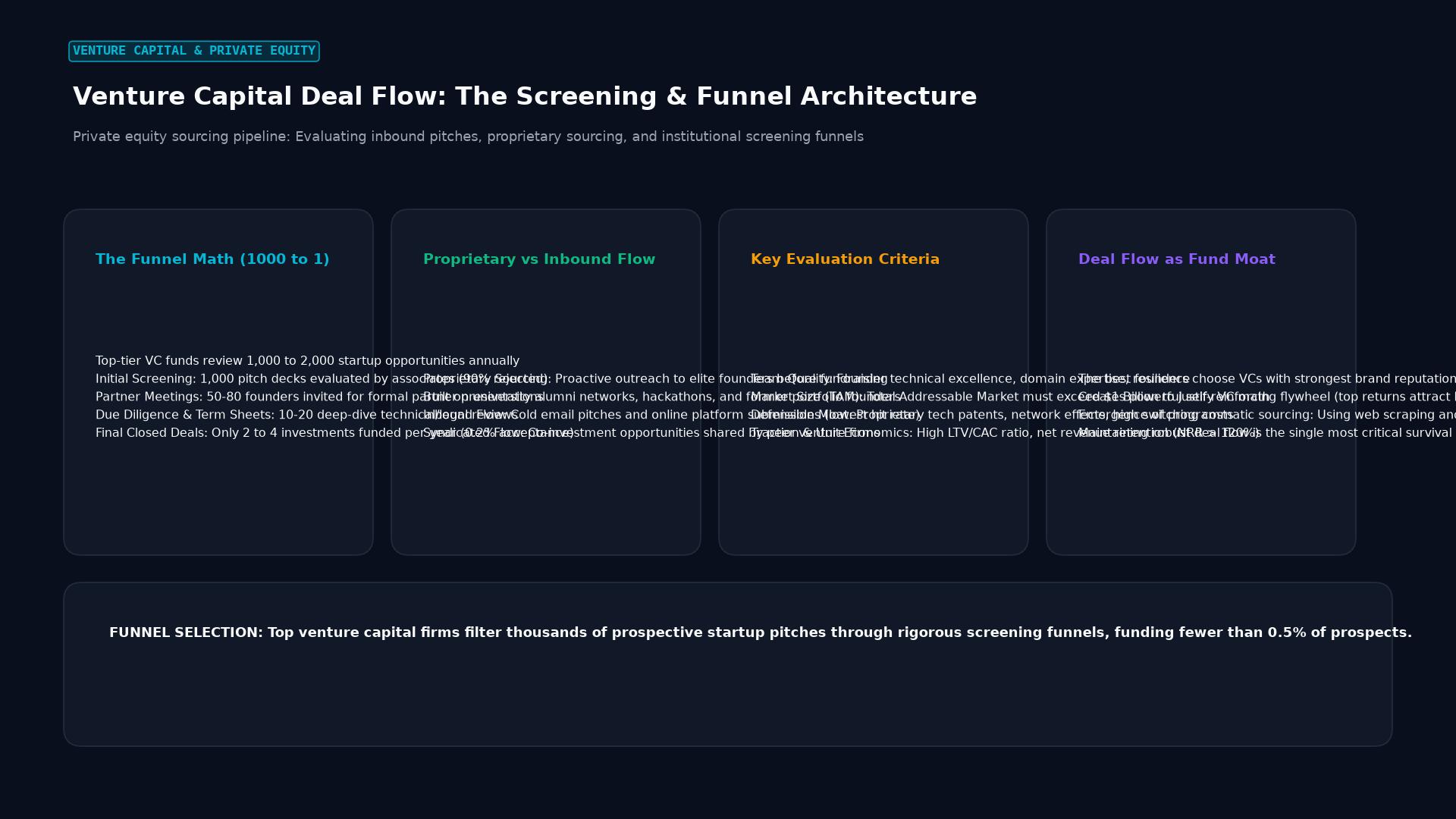 Figure: Private equity sourcing pipeline: Evaluating inbound pitches, proprietary sourcing, and institutional screening funnels
Technical Mechanics & The Venture Capital Funnel
Investment firms track deal flow as a multi-stage quantitative conversion pipeline:
The Pipeline Conversion Equation
$$\text{Conversion Efficiency } (\eta) = \frac{\text{Transactions Closed}}{\text{Total Deals Screened}} \times 100$$
In premier venture capital funds (such as Andreessen Horowitz or Benchmark), the conversion ratio is famously selective, typically ranging between 0.5% and 1.5%.
The Power Law of Venture Capital Returns
Deal flow volume is critical because venture capital returns follow a Power Law distribution (Pareto distribution) rather than a Gaussian normal curve:
$$P(X > x) \sim x^{-\alpha}$$
In a typical VC fund of 30 portfolio companies:
- 15 to 20 companies fail completely or fail to return capital.
- 6 to 8 companies generate modest single-digit returns ($1\times$ to $3\times$).
- 1 or 2 outlier investments generate massive returns ($50\times$ to $500\times$), returning the entire fund multiple times over.
Because outlier “fund-maker” investments cannot be predicted with certainty, maintaining massive, top-tier deal flow is mathematically mandatory to ensure the fund captures the rare statistical tail-event winners.
Comparative Matrix: Deal Sourcing Methodologies
| Sourcing Channel | Origin of Opportunity | Competition Level | Valuation Pricing Dynamics | Primary Asset Class |
|---|---|---|---|---|
| Proprietary Deal Flow | Direct founder relationship / In-house incubator | Zero (Exclusive) | Highly favorable; bilateral negotiation | Early-Stage Venture Capital |
| Inbound Sourcing | Cold outreach, website applications, referrals | Low to Moderate | Fair market terms | Seed / Accelerator funds |
| Intermediated (Auction) | Investment bank or M&A broker (Teaser / CIM) | Extreme (Formal bidding war) | Fully priced; premium multiples paid | Large-Cap Private Equity |
| Algorithmic Sourcing | Data scraping (GitHub stars, headcount, web traffic) | Moderate (First-mover advantage) | Founder-direct outreach | Quantitative Growth Equity |
Real-World Case Study: Sequoia Capital’s Proprietary Sourcing of WhatsApp (2011)
The supreme value of proprietary, non-auction deal flow was demonstrated by Sequoia Capital’s investment in WhatsApp.
Anatomy of a Proprietary Venture Sourcing:
1. The Detection: In early 2011, Sequoia partner Jim Goetz tracked emerging smartphone app store data, noticing that WhatsApp was organically topping international utility app charts without spending a single dollar on marketing.
2. The Outbound Hustle: Rather than waiting for an investment bank to shop a pitch deck, Goetz spent months proactively courting WhatsApp founders Jan Koum and Brian Acton, who were famously hostile to traditional venture capitalists.
3. The Exclusivity: Goetz promised the founders that Sequoia would act as an advisor without forcing intrusive advertising onto the platform, securing an exclusive, non-intermediated $8 million Series A investment for a 15% equity stake.
4. The Outcome: In February 2014, Facebook acquired WhatsApp for $19 billion. Sequoia's total $60 million invested across Series A and B yielded over $3.0 billion in cash and stock—a staggering 50x net fund return driven entirely by proprietary deal flow.
Frequently Asked Questions (FAQ)
What is the difference between proprietary deal flow and syndicated deal flow?
Proprietary deal flow refers to unique investment opportunities discovered or developed directly through a firm’s private network, where the firm is the sole party negotiating with the company’s founders. Syndicated deal flow occurs when another lead venture firm or investment bank packages an investment round and invites external funds to participate as minority co-investors (“co-investing on the syndicate”). Proprietary deals offer superior valuation terms and larger equity ownership, whereas syndicated deals provide passive diversification with less operational due diligence.
How has artificial intelligence transformed modern venture deal flow?
Modern quantitative funds (such as EQT’s Motherbrain or Coatue) deploy automated machine learning models that scan millions of external data points 24 hours a day. Algorithms monitor real-time GitHub code commit velocity, corporate LinkedIn employee hiring surges, corporate credit card spending patterns, app store download acceleration, and web traffic spikes. When an unheralded startup exhibits exponential growth signals, the system automatically alerts investment partners to initiate contact weeks before competitors become aware of the company.
What is a “Confidential Information Memorandum” (CIM) in private equity deal flow?
A Confidential Information Memorandum (CIM)—frequently termed the “deal book”—is an extensive 50- to 100-page document prepared by an investment bank handling an intermediated company sale. The CIM provides prospective private equity buyers with detailed operational audits, audited historical financial statements, customer churn metrics, three-statement financial projections, and corporate organizational charts, serving as the basis for initial binding valuation bids.
Ready to trade forex?
Open a free demo account with a regulated broker. Practice with virtual funds before risking real money.