Capital Appreciation
Capital appreciation is the increase in the market price or capital value of an asset over time, measured as the unrealized or realized gain in the asset's secondary market value above its original purchase price.
What Is Capital Appreciation?
Capital appreciation refers to the growth in the market value of an investment asset relative to its original acquisition cost. It represents one of the two foundational components of an investor’s overall return, alongside periodic cash-flow income (such as equity stock dividends or fixed-income bond coupons).
While income-oriented investors seek stable, ongoing cash distributions, growth-oriented investors and corporate venture capital funds prioritize capital appreciation. Assets capable of generating substantial capital appreciation typically include technology equities, prime real estate, precious metals, early-stage private equity, and foreign exchange currency reserves.
Until the asset is formally liquidated, capital appreciation remains an unrealized (paper) gain; once sold, the gain becomes realized and is subject to national capital gains taxation.
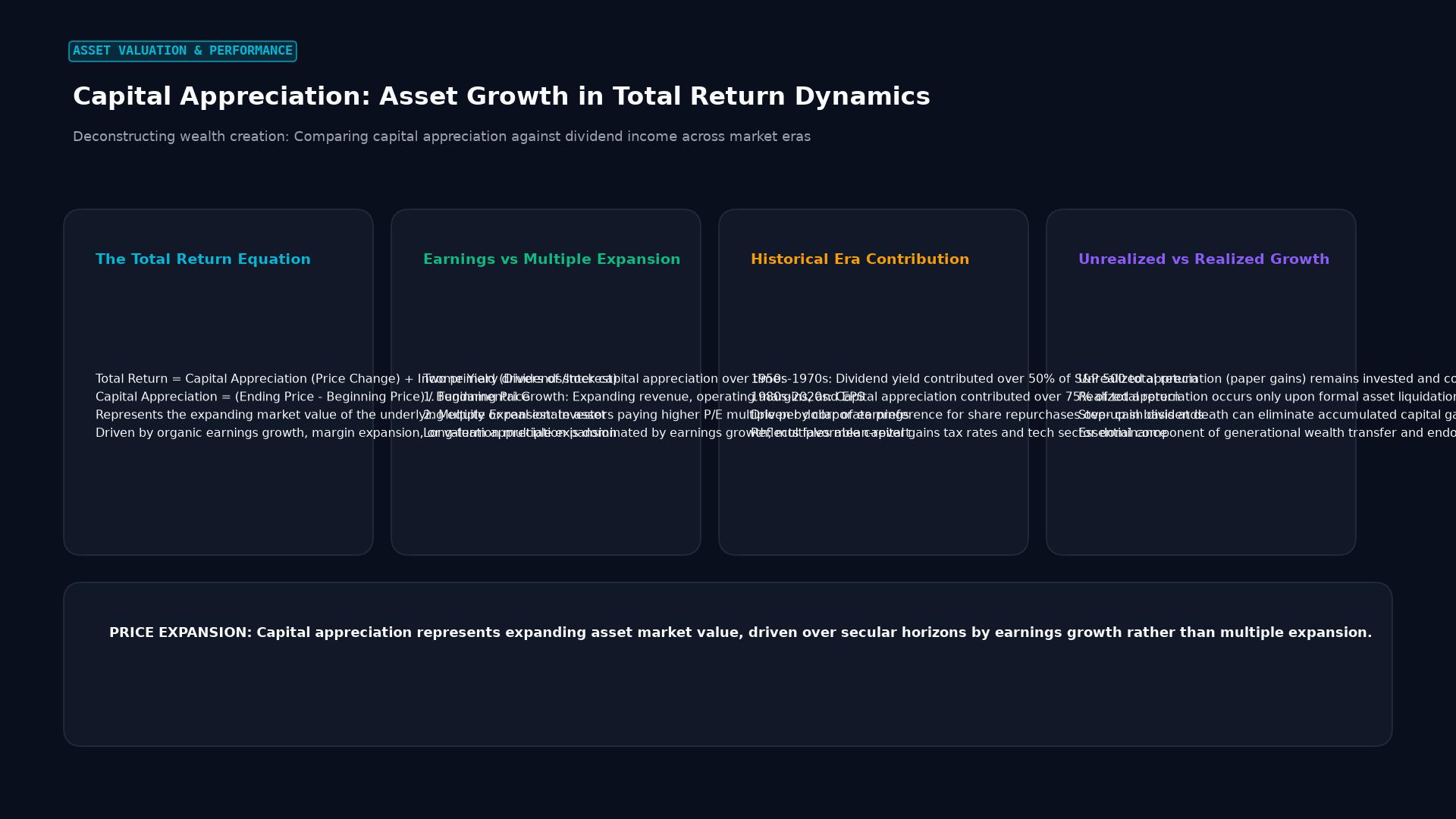 Figure: Deconstructing wealth creation: Comparing capital appreciation against dividend income across market eras
Technical Mechanics & Total Return Formulation
An investor’s total financial performance across any holding period is calculated by combining price growth with cash-flow yield:
The Total Return Formula
$$R_{\text{total}} = \frac{\left( P_t - P_0 \right) + D_t}{P_0} \times 100$$
Where:
- $P_0$: Initial purchase price (cost basis).
- $P_t$: Market price of the asset at evaluation period $t$.
- $P_t - P_0$: Capital Appreciation (or capital depreciation if negative).
- $D_t$: Cumulative cash dividends or coupon distributions received during the holding period.
The percentage contribution of capital appreciation to total return is isolated as:
$$\text{Appreciation Contribution} = \frac{P_t - P_0}{(P_t - P_0) + D_t} \times 100$$
For high-growth technology equities (such as Amazon, Alphabet, or Tesla), the appreciation contribution historically represents 100% of total investor return, as these firms pay zero cash dividends, plowing all operating cash flow back into research, development, and market expansion.
Comparative Matrix: Capital Growth vs. Alternative Investment Goals
| Investment Objective | Primary Asset Vehicles | Cash Distribution | Volatility / Risk | Tax Implications |
|---|---|---|---|---|
| Capital Appreciation | Growth Equities, Tech, Venture, Crypto | Zero to Minimal | High | Tax-deferred until asset sale |
| Current Income | Dividend Aristocrats, REITs, High-Yield Bonds | High (Quarterly/Monthly) | Low to Moderate | Immediate tax liability upon distribution |
| Capital Preservation | Short T-Bills, Money Market, CDs | Low (Interest only) | Negligible | Taxed annually as ordinary interest |
| Balanced / Total Return | 60/40 Equity/Bond Funds | Moderate | Moderate | Blend of deferred gains and annual income |
Real-World Case Study: Warren Buffett & Berkshire Hathaway’s Zero-Dividend Model
The most prominent institutional endorsement of capital appreciation over dividend income is Warren Buffett’s multi-decade capital allocation strategy at Berkshire Hathaway.
The Compounding Power of Retained Capital:
1. The Philosophy: Berkshire Hathaway has not paid a cash dividend to shareholders since 1967.
2. The Mathematical Rationale: Buffett demonstrated that paying a cash dividend forces shareholders to pay immediate double taxation on distributions. Instead, retaining 100% of corporate net profits allows the company to reinvest capital into high-return acquisitions and marketable securities.
3. The Performance:
   * 1965 Share Price: ~$19.00 per share.
   * 2024 Share Price: Exceeded $600,000 per Class A share.
   * Compound Annual Growth Rate: ~20% annualized over nearly 60 years.
4. Capital Appreciation Capture: Shareholders who require cash simply sell a tiny fraction of their appreciated shares when needed, controlling the timing and magnitude of their capital gains tax obligations.
Frequently Asked Questions (FAQ)
What is the difference between capital appreciation and capital gain?
Capital appreciation describes the ongoing increase in an asset’s market value, which can be unrealized (an existing position that has grown on paper) or realized. A capital gain is the formal accounting and tax term for the realized profit locked in when the asset is officially sold: $$\text{Capital Gain} = \text{Net Sale Proceeds} - \text{Adjusted Cost Basis}$$ Until the asset is sold, the investor experiences capital appreciation, but does not yet trigger a taxable capital gain.
Why do young investors generally prioritize capital appreciation over dividend income?
Young investors with decades-long investment horizons prioritize capital appreciation because equity growth stocks historically generate significantly higher long-term compounded annualized returns than income-oriented assets (such as bonds or utility stocks). Furthermore, capital appreciation allows wealth to compound tax-free inside the asset until sale, whereas dividend income creates annual tax drag throughout an investor’s peak-earning career years.
How does currency depreciation affect foreign exchange capital appreciation?
In international investing, capital appreciation must be calculated in the investor’s home base currency. If an American investor buys a European equity that appreciates by 15% in Euros, but the Euro simultaneously depreciates by 10% against the US Dollar, the investor’s net dollar-denominated capital appreciation is compressed: $$\text{Net Return}_{\text{USD}} \approx (1 + 0.15)(1 - 0.10) - 1 = 1.035 - 1 = +3.5%$$ Unhedged currency fluctuations can either amplify or completely erase foreign asset capital appreciation.
Ready to trade forex?
Open a free demo account with a regulated broker. Practice with virtual funds before risking real money.