Deal Stock
A deal stock is the publicly traded equity of a corporation that has become the target of an announced or actively rumored merger, acquisition, or hostile takeover, whose market price trades at a discount to the proposed acquisition price.
What Is a Deal Stock?
In equity capital markets and event-driven hedge fund strategies, a deal stock refers to the publicly listed shares of a target corporation that has formally entered into a definitive merger agreement, received an unsolicited buyout bid, or is the central target of a publicized corporate acquisition.
Once a friendly or hostile takeover bid is formally announced, the market behavior of a deal stock changes fundamentally. Rather than tracking broader macroeconomic trends, general stock market indices, or industry sector peers, the equity price becomes detached from normal fundamentals. Instead, the deal stock trades in tight correlation with the probability, timing, and regulatory clearance of the transaction closing, typically trading at a narrow discount below the announced cash or stock offer price—a gap known on Wall Street as the arbitrage spread.
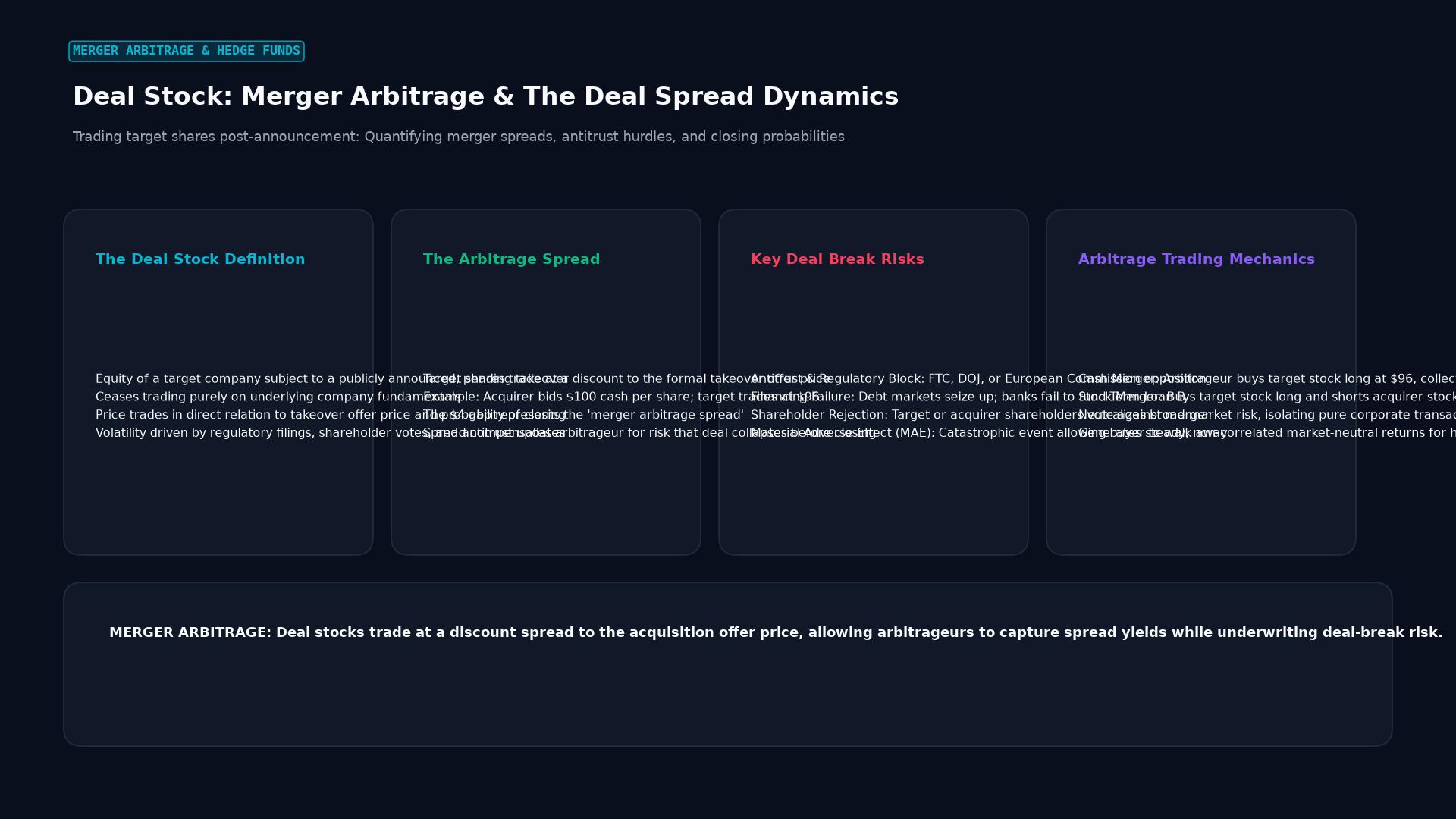 Figure: Trading target shares post-announcement: Quantifying merger spreads, antitrust hurdles, and closing probabilities
Technical Mechanics & The Risk Arbitrage Equation
Institutional event-driven hedge funds—known as risk arbitrageurs or merger arbitrageurs—systematically purchase deal stocks to capture the spread between the prevailing market price ($P_{\text{market}}$) and the contractual acquisition offer price ($P_{\text{offer}}$).
The Annualized Arbitrage Return Formulation
For an all-cash acquisition offer, the raw spread and the annualized rate of return ($R_{\text{annualized}}$) are computed as:
$$\text{Gross Spread} = P_{\text{offer}} - P_{\text{market}}$$
$$R_{\text{annualized}} = \left( \frac{P_{\text{offer}} - P_{\text{market}}}{P_{\text{market}}} \right) \times \left( \frac{365}{D} \right) \times 100$$
Where $D$ represents the estimated number of calendar days remaining until the legal merger closes.
Implied Deal Probability Modeling
The secondary market price of a deal stock mathematically embeds the market’s collective estimate of deal completion probability ($p$):
$$P_{\text{market}} = p \cdot P_{\text{offer}} + (1 - p) \cdot P_{\text{unaffected}}$$
Solving for the market-implied probability of deal success ($p$):
$$p = \frac{P_{\text{market}} - P_{\text{unaffected}}}{P_{\text{offer}} - P_{\text{unaffected}}}$$
Where $P_{\text{unaffected}}$ is the estimated fundamental price where the target stock would collapse to if the acquisition is aborted or blocked by antitrust regulators. If an acquisition carries severe regulatory litigation risk, $p$ drops, causing the deal stock to trade at a massive discount to the offer price.
Comparative Matrix: Takeover Transaction Frameworks
| Acquisition Type | Consideration Delivered | Arbitrage Execution Strategy | Primary Risk Factor |
|---|---|---|---|
| All-Cash Deal | Pure cash per share | Buy target stock; hold to settlement | Antitrust veto or financing failure |
| Fixed Stock Exchange | Ratio of acquirer shares (e.g. 0.5 shares) | Buy target; short $N$ shares of acquirer | Deal collapse / ratio renegotiation |
| Floating Collar Deal | Dollar-pegged stock value bounded by collars | Dynamic delta hedging across collar bounds | Acquirer price breaching collar limits |
| Hostile Tender Offer | Cash or debt securities | Buy target if board capitulation likely | Poison pill defense / White knight |
Real-World Case Study: Microsoft’s Acquisition of Activision Blizzard (2022–2023)
The ultimate modern masterclass in deal stock trading occurred during Microsoft’s $68.7 billion acquisition of Activision Blizzard (ATVI).
Anatomy of a Historic Merger Arbitrage Spread:
1. The Offer (Jan 18, 2022): Microsoft announced an all-cash buyout of Activision Blizzard at $95.00 per share (a 45% premium over ATVI's unaffected price of $65.00).
2. The Regulatory Warfare:
   * Dec 2022: The US Federal Trade Commission (FTC) sued to block the merger.
   * April 2023: The UK Competition and Markets Authority (CMA) issued a shock veto.
3. The Deal Stock Plunge: ATVI shares collapsed to $72.00, implying an enormous 32% annualized arbitrage yield, as market participants priced the completion probability (p) below 40%.
4. The Courtroom Victory: In July 2023, federal judge Jacqueline Scott Corley rejected the FTC's injunction request. Microsoft restructured cloud-streaming rights to satisfy the UK CMA.
5. The Payoff: In October 2023, the transaction formally closed at exactly $95.00 cash per share, delivering extraordinary, market-neutral profits to risk arbitrageurs who bought the depressed deal stock.
Frequently Asked Questions (FAQ)
Why does a deal stock almost never trade at the exact announced offer price?
A deal stock trades at a discount to the offer price to account for three fundamental risks:
- Deal Break Risk: The probability that regulatory antitrust agencies (FTC, European Commission), national security panels (CFIUS), or shareholder votes reject the transaction, causing the stock to collapse back to its unaffected price.
- Time Value of Money: Months or quarters will elapse before the transaction legally settles and cash is disbursed.
- Financing Risk: The danger that debt underwriting syndicates fail to deliver financing during systemic credit crunches.
What happens to a deal stock if the merger is legally terminated or abandoned?
If a merger agreement is cancelled, the deal stock experiences an immediate, violent price collapse toward its pre-announcement unaffected baseline (or lower if macroeconomic conditions deteriorated during the review). To partially cushion this downside, target corporations negotiate reverse termination break-up fees (often ranging from 3% to 7% of total transaction value), requiring the acquirer to wire a cash penalty of hundreds of millions—or billions—of dollars to the target upon deal cancellation.
How does an arbitrageur hedge a “stock-for-stock” deal?
In an all-stock transaction where the acquirer offers a fixed exchange ratio (for example, offering 0.5 shares of Acquirer Corp for every 1.0 share of Target Corp), the arbitrageur executes a pairs trade: they purchase 100 shares of the target deal stock and simultaneously short-sell 50 shares of the acquiring company. This market-neutral hedge eliminates broad equity market direction risk, locking in the fixed spread regardless of whether the overall market rallies or crashes.
Ready to trade forex?
Open a free demo account with a regulated broker. Practice with virtual funds before risking real money.