Undervalued
An undervalued asset or currency trades at a market price significantly below its fundamental equilibrium value, intrinsic cash-flow generation, or relative Purchasing Power Parity (PPP), indicating potential long-term mean reversion or a structural risk discount.
What Does Undervalued Mean?
In financial economics and foreign exchange analysis, an asset or currency is described as undervalued when its prevailing market clearing price trades substantially below its intrinsic, theoretical, or equilibrium fair value. In equity and corporate debt markets, undervaluation reflects discounted cash flow (DCF) multiples below peer benchmarks. In global currency markets, undervaluation indicates that a nation’s legal tender possesses far greater domestic purchasing power than its international nominal exchange rate implies.
Undervaluation represents a core driver for institutional value investing and quantitative global macro strategies. However, an asset does not automatically appreciate simply because it is undervalued; market prices frequently diverge from macroeconomic fundamentals for months or years due to interest rate differentials, sovereign risk premiums, capital flight, or central bank intervention.
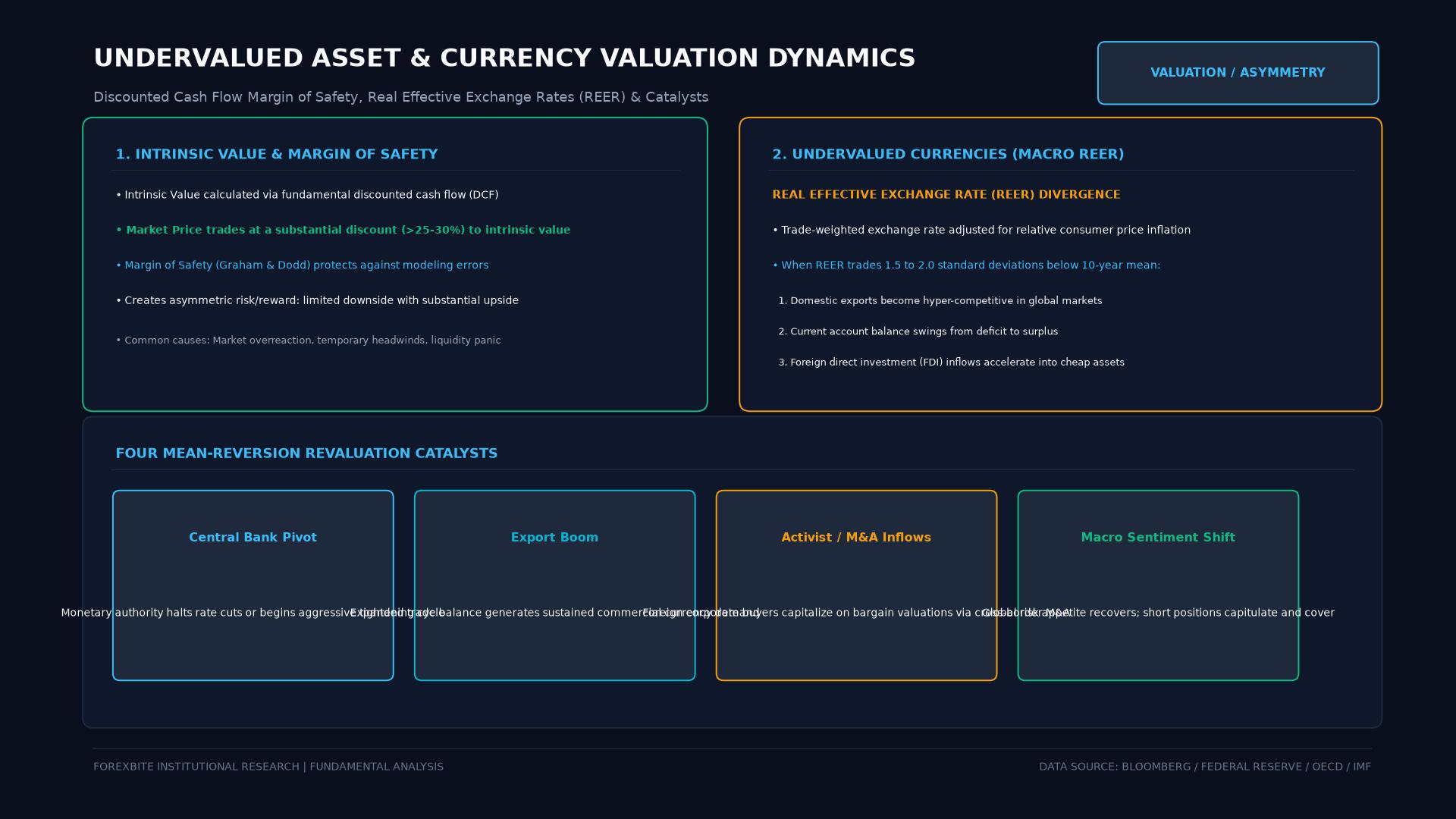 Figure: Analytical framework for undervalued assets and currencies, contrasting intrinsic DCF valuation with market price discounts (Margin of Safety) and Real Effective Exchange Rate (REER) mean-reversion catalysts.
Quantitative Valuation Frameworks in FX
Global macro strategists deploy mathematical frameworks to quantify whether a currency is undervalued relative to international trading partners.
1. Purchasing Power Parity (PPP) Misalignment
Absolute Purchasing Power Parity postulates that identical baskets of tradable goods should cost the same when expressed in a common currency:
$$S_{\text{PPP}} = \frac{P_{\text{domestic}}}{P_{\text{foreign}}}$$
The percentage undervaluation ($\text{Misalignment}$) relative to the actual spot rate $S$ is expressed as:
$$\text{Misalignment (%)} = \left( \frac{S - S_{\text{PPP}}}{S_{\text{PPP}}} \right) \times 100$$
A negative value indicates the currency is undervalued, requiring fewer foreign currency units to purchase than implied by domestic price levels.
2. Behavioral Equilibrium Exchange Rate (BEER)
While PPP provides a long-term anchor, the BEER model econometrically estimates medium-term equilibrium values based on macroeconomic variables ($Z_t$):
$$q_t = \beta_0 + \beta_1 (r_t - r^*_t) + \beta_2 \text{ToT}_t + \beta_3 \text{NFA}_t + \varepsilon_t$$
Where:
- $r_t - r^*_t$: Real interest rate differential against foreign benchmarks.
- $\text{ToT}_t$: Terms of trade (export prices divided by import prices).
- $\text{NFA}_t$: Net foreign asset position as a percentage of GDP.
If the actual real effective exchange rate ($q_t$) trades significantly below the modeled equilibrium ($\hat{q}_t$), the currency is systematically undervalued.
Valuation Dynamics Across Asset Classes
The mechanisms driving undervaluation vary significantly across financial market sectors:
| Asset Class | Primary Valuation Anchor | Typical Drivers of Undervaluation | Catalyst for Value Realization |
|---|---|---|---|
| Sovereign Currencies | Real Effective Exchange Rate (REER), PPP | Aggressive central bank dovishness, carry-trade outflows, capital flight | Monetary policy tightening, FX intervention, terms-of-trade rebound |
| Public Equities | DCF Intrinsic Value, P/E, EV/EBITDA | Cyclical earnings recession, negative headline sentiment, forced selling | Earnings surprise, corporate buybacks, activist intervention |
| Corporate Bonds | Credit default probability, recovery rates | Sector liquidity panic, rating agency downgrades | Balance sheet deleveraging, debt tender offers, debt maturity refinancing |
| Commodities | Marginal cost of extraction / production | Global demand shock, inventory oversupply | Mine/well closures, supply depletion, macroeconomic recovery |
Macro Consequences: Competitive Undervaluation
When a nation’s currency is undervalued, it creates profound macroeconomic shifts:
[Domestic Currency Undervaluation]
                   |
     +-------------+-------------+
     v                           v
EXPORTERS BENEFIT           DOMESTIC CONSUMERS SUFFER
* Goods are cheaper abroad  * Imported goods (energy, food) become expensive
* Manufacturing booms       * Real purchasing power and living standards erode
* Trade surplus expands     * Imported inflation pressures central bank
When governments deliberately maintain an undervalued currency through persistent foreign exchange interventions (accumulating US Dollar reserves to prevent domestic currency appreciation), trading partners may designate the country as a currency manipulator under international trade rules.
Real-World Institutional Case Study: The Japanese Yen’s Historic Undervaluation (2022–2024)
Between 2022 and mid-2024, the Japanese Yen (JPY) experienced one of the most severe episodes of currency undervaluation in modern financial history.
As the US Federal Reserve aggressively raised the Federal Funds rate from $0.25%$ to $5.50%$ to combat post-pandemic inflation, the Bank of Japan (BOJ) stubbornly maintained its Yield Curve Control (YCC) and negative interest rate policy ($-0.10%$). This created a massive $500+$ basis point interest rate disparity, triggering global hedge funds and retail margin traders to borrow Yen at near-zero rates and invest in high-yielding US assets (the FX carry trade).
[2022-2024 Macro Disconnect]
OECD PPP Fair Value: ~95 - 105 USD/JPY
Big Mac Index Implied Rate: ~85 - 90 USD/JPY
Actual Market Spot Rate: Plunged from 115 to 160.20 USD/JPY (July 2024)
                    |
                    v
Calculated Undervaluation: JPY traded over 45% below fundamental purchasing parity
Real Effective Exchange Rate (REER): Lowest level since 1970
                    |
                    v
THE CATALYST: BOJ unexpectedly raised rates to 0.25% on July 31, 2024
US economic data softened -> Carry trade rapidly unwound
                    |
                    v
Violent Mean Reversion: JPY rallied 12% in 4 trading sessions (160 -> 141)
Triggered global stock market volatility spike (Nikkei crashed 12.4% on Aug 5)
The Yen’s trajectory demonstrated that extreme undervaluation can persist as long as monetary carry dynamics dominate order flow, but once the macro catalyst shifts, the subsequent mean reversion back toward fair value can unleash catastrophic volatility across global capital markets.
Frequently Asked Questions
What is a “value trap” in financial markets?
A value trap occurs when an investor purchases an asset simply because its valuation metrics (e.g., low P/E ratio or cheap PPP exchange rate) look historically attractive, without recognizing that the underlying business model or national economy has suffered structural, permanent degradation. In such cases, the asset does not mean-revert; instead, fair value collapses to meet the depressed market price.
Why doesn’t purchasing power parity immediately correct currency undervaluation?
PPP relies on the “Law of One Price,” which assumes frictionless international trade without transportation costs, tariffs, capital restrictions, or trade barriers. In reality, non-tradable services (housing, healthcare, education), massive speculative capital flows, and multi-trillion-dollar foreign exchange swaps overwhelm merchandise trade flows in the short and medium term, allowing undervaluation to persist for years.
How do algorithmic macro funds exploit undervalued currencies?
Quantitative funds build multi-factor models that blend valuation (REER or PPP deviation) with momentum (trend filters) and carry (interest rate spreads). Rather than buying an undervalued currency prematurely, systematic models wait for momentum indicators to turn positive, entering positions only when institutional order flow begins confirming fundamental mean reversion.
Ready to trade forex?
Open a free demo account with a regulated broker. Practice with virtual funds before risking real money.