Demo Account
A demo account (paper trading account) is a simulated trading environment funded with virtual capital, allowing traders to practice market execution and backtest strategies on live price feeds without financial risk.
What Is a Demo Account?
A demo account (frequently termed a paper trading account or simulated trading environment) is an electronic account provided by online retail brokerages and trading platforms funded entirely with simulated, virtual currency. Connected to live or near-live market price feeds, a demo account mirrors the visual interface, charting software, order execution types, and financial instruments of a real live trading account, permitting users to trade real-time market movements with zero financial capital risk.
Demo accounts serve essential educational and operational functions across all experience levels:
- Beginner Traders: Familiarize themselves with the broker’s platform mechanics, learning how to place market orders, configure stop-losses, calculate lot sizes, and navigate charting tools without risking real money.
- Experienced Discretionary Traders: Test, refine, and optimize new technical strategies or indicators across varied market conditions before deploying real savings.
- Quantitative Algorithmic Developers: Backtest and forward-test automated Expert Advisors (EAs), custom algorithmic trading bots, and API execution scripts in real-time environments to verify logic and bug-free operation.
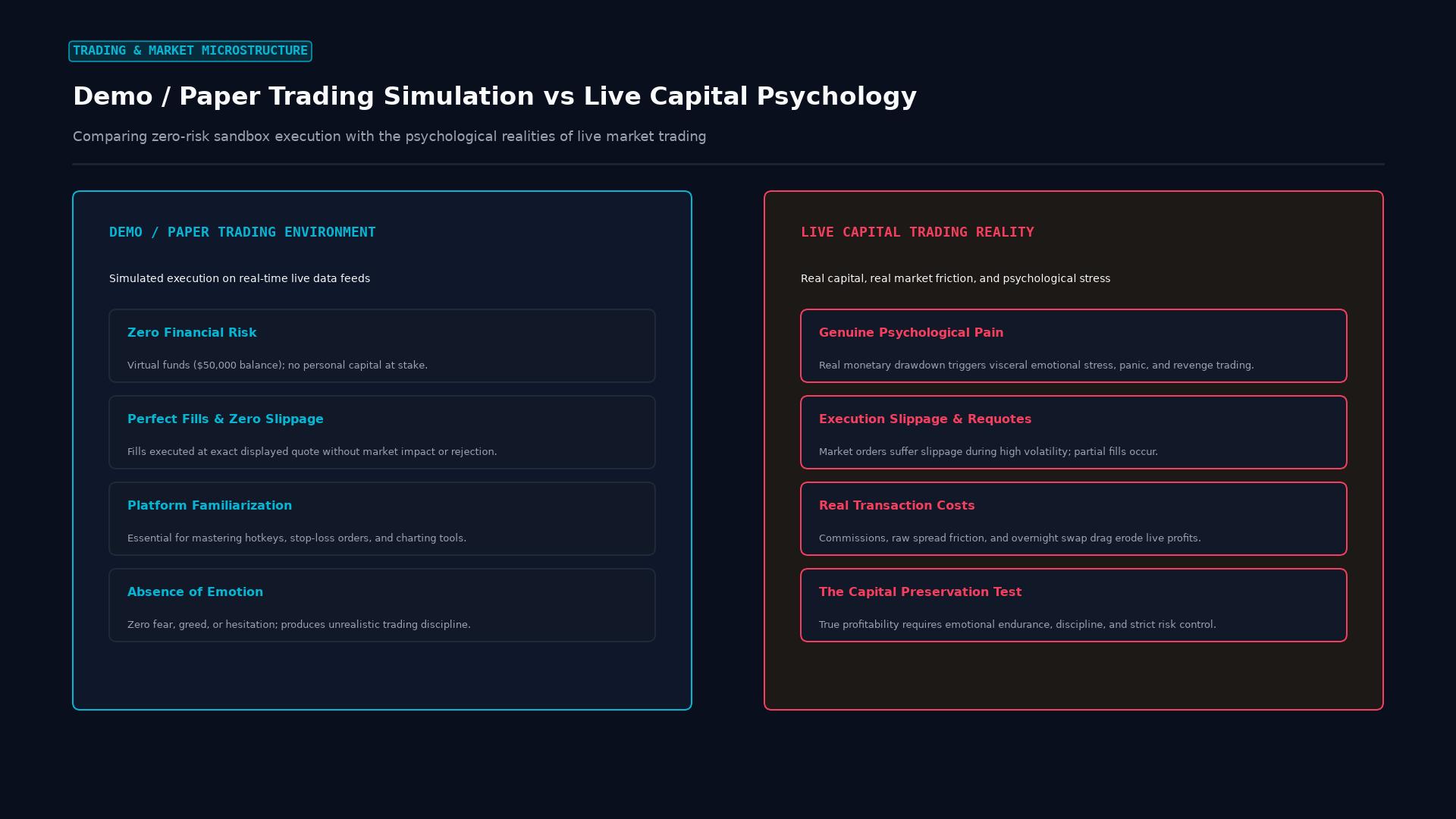 Figure: Simulated trading environments: risk-free platform familiarization and strategy backtesting contrasted with the emotional discipline, slippage, and capital preservation of live trading.
Key Takeaways
- Zero Capital Hazard: Permits unlimited practice and technical experimentation without the danger of financial loss or margin calls.
- Platform Literacy: Teaches traders how to avoid catastrophic operational mistakes (e.g., miscalculating lot sizes, hitting “Buy” instead of “Sell,” or failing to set stop-losses).
- The Execution Reality Gap: Demo accounts execute orders in a frictionless vacuum with instantaneous fills, whereas live trading accounts experience real-world latency, execution slippage, and requotes.
- The Psychological Void: The greatest danger of demo trading is the total absence of emotional stress; success on a demo account rarely translates directly to live trading unless emotional discipline is deliberately cultivated.
Critical Differences: Demo Accounts vs. Live Accounts
Novice traders frequently experience a rude awakening when transitioning from a profitable demo account to an unprofitable live account. This discrepancy stems from two structural divergences:
| Operational Dimension | Demo Paper Account | Real Live Account |
|---|---|---|
| Capital Type | Virtual, simulated paper money | Real hard-earned savings |
| Order Fill Execution | Frictionless: 100% fill rates at quoted price; zero latency | Real-World: Partial fills, order queueing, slippage during fast news |
| Slippage on Stop-Losses | Negligible; orders execute at exact triggered price | Subject to real market gaps and negative slippage during volatility |
| Broker Requotes | Rare to non-existent | Common on instant-execution dealing desk brokers |
| Psychological Pressure | Zero fear, zero panic, zero emotional attachment | Intense emotional stress: fear of loss, greed, revenge trading |
| Risk Management Habits | Unrealistic holding of massive losses hoping for reversal | Capital preservation demands strict adherence to stop-losses |
The Psychological Pitfalls of Extended Demo Trading
While demo trading is indispensable for the first few weeks of learning, remaining on a demo account for too long can cultivate toxic trading psychology:
1. The “Play Money” Fallacy
When trading virtual funds, a novice trader experiencing a 300-pip drawdown casually leaves the position open, indifferent to the paper deficit. Eventually, the market reverses, and the trade closes in profit. The trader mistakenly concludes that “holding through drawdowns works.” When this habit is repeated on a live account with real money, a similar drawdown triggers a real margin liquidation, wiping out their deposited savings.
2. Sizing Distortion
Most brokerages automatically default new demo accounts to $50,000 or $100,000 in virtual funds. A trader opening 1.0 standard lot on a $100,000 account risks only 1% of their equity. However, when that same individual funds a live account with $1,000, opening that same 1.0 standard lot represents catastrophic 100:1 leverage where a 20-pip adverse move destroys 20% of their entire account.
Best Practices for Maximizing Demo Account Value
To make demo trading an effective training ground rather than an unrealistic fantasy, traders should follow four core protocols:
- Match Your Virtual Balance to Your Planned Deposit: If you plan to deposit $1,000 of real money, instruct your broker or platform to reset your demo account balance to exactly $1,000—not $100,000.
- Treat Virtual Dollars as Irreplaceable Cash: Enforce strict mathematical risk management. Risk no more than 1% to 2% of the virtual account balance on any single trade ($10 to $20 risk per trade on a $1,000 account).
- Log Every Trade in a Journal: Maintain a formal trading journal recording entry reasons, technical setups, stop-loss levels, and exit outcomes, analyzing your statistical win rate and risk-to-reward ratio.
- Graduate Quickly to a Live Micro-Account: Once you have executed 30 to 50 demo trades and understand platform mechanics, transition to a live micro-account ($100 to $500 balance, trading 0.01 micro-lots). Experiencing the emotional reality of risking real money—even if it is just $1.00 per trade—is the only way to build true institutional trading discipline.
Real-World Case Study: The Danger of Unrealistic Demo Sizing
A new trader opens a default $50,000 demo account on MetaTrader 5:
The Demo Phase:
- The trader executes 5.0 standard lots ($50/pip) on GBP/JPY.
- The trade moves 80 pips into profit, generating an effortless $4,000 paper gain (+8% on the $50k account).
- Confident in their “innate talent,” the trader deposits $2,000 of real money into a live account.
The Live Transition:
- Attempting to reproduce their $4,000 profit, the trader opens 2.0 standard lots ($20/pip) on the live $2,000 account—a massive 100:1 effective leverage.
- Ten minutes later, UK inflation data prints higher than expected. GBP/JPY flashes 65 pips against the position.
- At $20 per pip, the 65-pip move generates a -$1,300 loss (a catastrophic 65% loss of account capital in minutes).
- Panicking, the trader overrides their rules, freezes, and suffers a complete margin call stop-out as the broker liquidates the remaining equity at 100 pips loss (-$2,000).
Frequently Asked Questions
Do demo account price feeds differ from live account price feeds?
In reputable, regulated brokerages, the underlying market price quotes (the live streaming bid and ask feeds) are identical on both demo and live servers. However, the execution latency and order routing engines differ: demo accounts simulate instantaneous fills, whereas live accounts interact with real interbank liquidity queues.
Do demo accounts expire?
Yes. Many brokerages automatically expire inactive demo accounts after 30 to 90 days to conserve server bandwidth. However, most brokers permit clients to open unlimited new demo accounts for free or maintain permanent non-expiring demo accounts if connected to an active funded profile.
Can automated trading bots be tested on demo accounts?
Yes. In quantitative finance, demo accounts are the industry standard for forward-testing (paper trading) algorithmic Expert Advisors (EAs). Developers run bots on demo VPS (Virtual Private Server) environments for several months to ensure the code executes properly without software bugs before allocating live capital.
Ready to trade forex?
Open a free demo account with a regulated broker. Practice with virtual funds before risking real money.