Deal Ticket
A deal ticket (trade ticket) is the primary digital or physical record generated at order execution that captures all specific economic parameters of an individual financial transaction, serving as the legal source document for trade confirmation.
What Is a Deal Ticket?
A deal ticket (frequently termed a trade ticket) is the primary operational document or electronic data object generated at the exact moment a financial transaction is agreed upon and executed between counterparties. It serves as the definitive point-of-sale record, capturing every granular technical and economic parameter of an individual trade.
Historically, deal tickets were physical paper slips handwritten or mechanically printed by floor brokers and pit clerks on exchange floors, then physically handed to back-office clearing runners. In modern electronic financial markets, deal tickets are entirely digital, instantiated via Order Management Systems (OMS), Execution Management Systems (EMS), or retail trading platforms (like MetaTrader, cTrader, and TradingView). The digital deal ticket constitutes the legal source of truth that feeds the aggregate deal blotter, populates client account statements, and triggers automated post-trade settlement messaging.
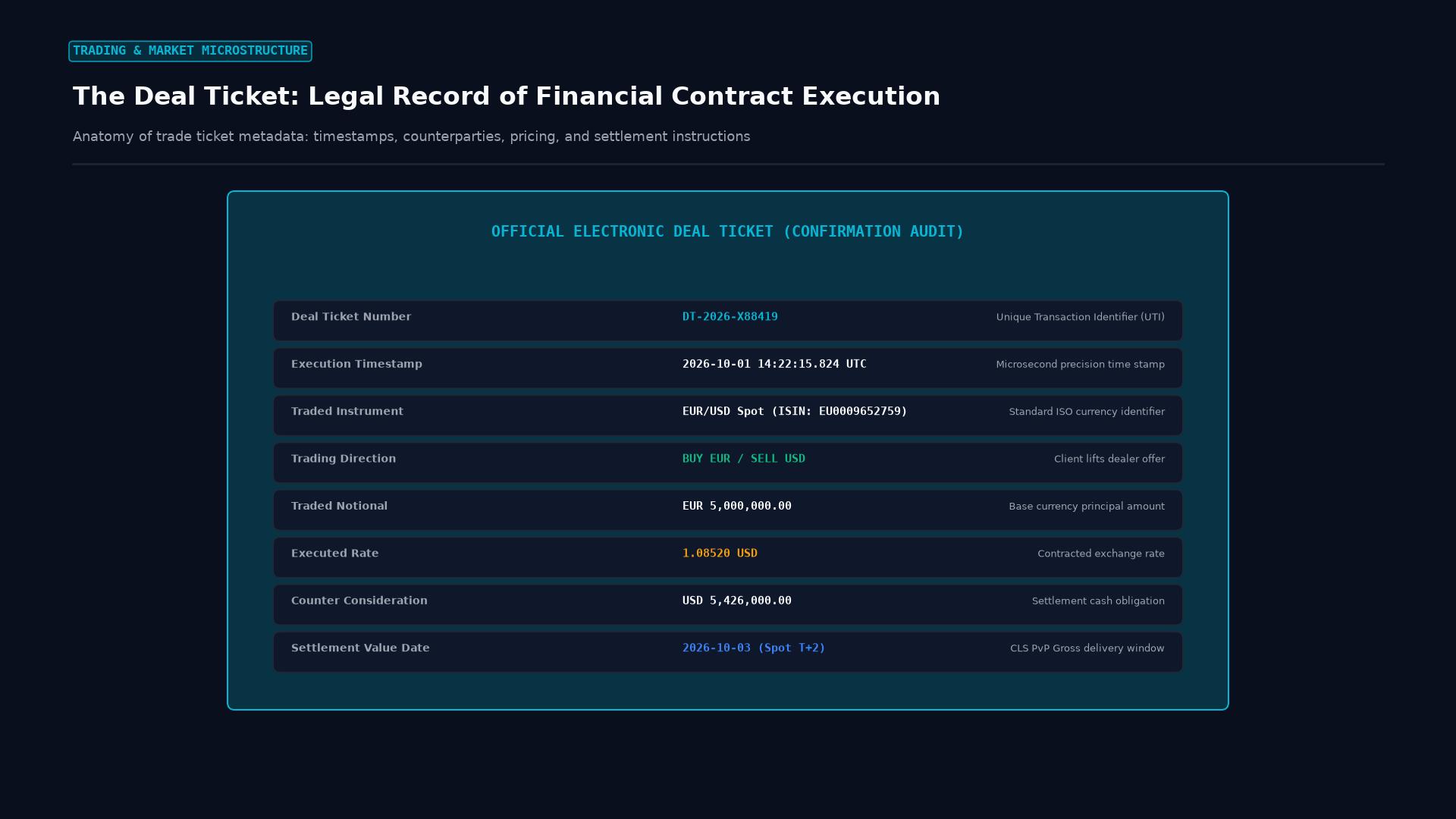 Figure: Anatomy of an electronic deal confirmation ticket: microsecond timestamps, Unique Trade Identifiers (UTI), currency pair notional, contracted rate, and settlement value dates.
Key Takeaways
- The Singular Transaction Record: While a deal blotter tracks hundreds of trades across an entire trading session, a deal ticket represents the isolated, comprehensive profile of one single executed contract.
- Mandatory Audit Parameters: A complete deal ticket must record the Unique Trade Identifier (UTI), trader and counterparty Legal Entity Identifiers (LEI), exact microsecond execution timestamp, instrument, volume, direction, and agreed price.
- Legal Precedence: In post-trade disputes or clerical discrepancies, the time-stamped parameters recorded on the electronic deal ticket take evidentiary priority under standard master agreements (e.g., ISDA).
- Straight-Through Processing (STP): Modern electronic deal tickets flow automatically through the firm’s middleware to generate confirmations (SWIFT MT300) without manual re-keying, drastically reducing operational settlement breaks.
Anatomical Components of a Foreign Exchange Deal Ticket
A complete institutional foreign exchange deal ticket contains precise data fields required by risk engines, clearinghouses, and regulatory repositories:
| Deal Ticket Field | Operational Purpose | Example Foreign Exchange Record |
|---|---|---|
| Ticket Reference ID | Unique internal transaction tracking number | TKT-FX-20260922-8491 |
| Unique Trade Identifier (UTI) | Global regulatory identification code | 103028491823749102938471 |
| Execution Timestamp | High-precision time of fill (UTC) | 2026-09-22 14:32:05.104218 |
| Trader / Desk ID | Identity of the individual trader or algorithmic model | DESK-G10-SPOT-TRD07 |
| Counterparty | Legal name and LEI of the opposite trading entity | Barclays Capital (LEI: 213800LBKZM12HX58F84) |
| Currency Pair | Base and counter (quote) currency | EUR/USD |
| Side (Direction) | Contractual action (Buy or Sell base currency) | BUY EUR / SELL USD |
| Base Currency Amount | Exact principal volume of the base currency | €10,000,000.00 EUR |
| Agreed Rate | Contracted execution price | 1.08540 |
| Countervalue Amount | Calculated cash settlement obligation | $10,854,000.00 USD |
| Value (Settlement) Date | Delivery date for the exchanged funds | 2026-09-24 (T+2 Spot) |
| Settlement Instructions | Beneficiary bank accounts (Standard Settlement Instructions) | Federal Reserve NY / Bundesbank Frankfurt |
Deal Ticket vs. Trade Confirmation vs. Deal Blotter
Market participants must distinguish between these three closely related post-trade records:
| Record Type | Temporal Sequence | Scope of Document | Primary Audience |
|---|---|---|---|
| Deal Ticket | Generated instantaneously at execution | Individual, single transaction details | Execution trader, risk management algorithms, internal audit |
| Deal Blotter | Aggregated continuously throughout the session | Multi-row table of all tickets executed across a desk or fund | Desk head, chief risk officer, real-time compliance |
| Trade Confirmation | Dispatched post-execution (within hours or $T+1$) | Bilateral legal document exchanged with the counterparty | Middle-office operations, counterparty clearing, custodian |
Retail Trading Deal Tickets: The Order Entry Window
For active retail forex and CFD traders, the term “deal ticket” also refers to the Order Entry Dialogue Box on retail trading terminals (MetaTrader, cTrader, TradingView):
Retail Trading Platform Deal Ticket Interface:
┌────────────────────────────────────────────────────────┐
│  NEW ORDER: EUR/USD Spot                               │
├────────────────────────────────────────────────────────┤
│  Volume: [ 1.00 Lot (100,000 Units) ]                  │
│  Stop Loss: [ 1.08200 ]       Take Profit: [ 1.09200 ] │
│  Order Type: [ Instant Execution / Market Order ]      │
├────────────────────────────────────────────────────────┤
│      [ SELL 1.08520 ]           [ BUY 1.08532 ]        │
│          Spread: 1.2 Pips | Pip Value: $10.00          │
└────────────────────────────────────────────────────────┘
When the retail trader clicks “Buy” or “Sell,” the software translates the user’s graphical inputs into a formatted digital deal ticket, assigns a unique server ticket number, validates available margin collateral, and routes the ticket to the broker’s execution bridge.
Real-World Case Study: Uncovering an Order Entry Keying Error
Prior to full electronic automation, manual keying errors on deal tickets—colloquially termed “fat-finger trades”—caused massive institutional losses.
The Scenario:
- A corporate foreign exchange dealer received an order from an import client to buy $5,000,000 USD against Japanese Yen at
155.00. - The execution clerk inadvertently typed an extra zero into the notional field of the digital deal ticket: entering $50,000,000 USD.
The Deal Ticket Interception:
- The firm’s pre-trade compliance filter instantly cross-referenced the deal ticket’s entered volume ($50M) against the client’s pre-approved single-order credit limit ($10M).
- The OMS flagged a Credit Limit Breach Exception, freezing the deal ticket before transmission to the interbank matching engine.
- The dealer reviewed the ticket parameters, identified the typographical error, corrected the volume back to $5,000,000, and released the order.
- Without automated digital deal ticket validation, the accidental $50M position would have moved the market, causing substantial execution slippage and exposing the brokerage to millions in unhedged currency risk.
Frequently Asked Questions
Why does every retail trade in MetaTrader have a unique ticket number?
In MetaTrader 4/5, every open position, pending order, and historical transaction is tagged with a distinct numeric Ticket Number (e.g., #74819203). This ticket number functions as the primary key in the broker’s SQL database, ensuring that stop-loss orders, take-profit triggers, and rollover swaps are applied exclusively to that specific contract.
Can a deal ticket be amended after it is executed?
The fundamental economic terms (trade date, rate, currency, volume) of an executed deal ticket cannot be unilaterally altered. If an error occurred, the original ticket must be formally cancelled or booked out with an equal and opposite reversal ticket, followed by the generation of a new, corrected ticket.
What is a “Block Deal Ticket”?
In institutional asset management, a portfolio manager frequently executes a single massive order (e.g., buying €100,000,000) on a Block Deal Ticket. Once executed, the block ticket is automatically allocated and subdivided into dozens of smaller sub-tickets across multiple individual pension funds and private wealth client accounts based on pre-set allocation ratios.
Ready to trade forex?
Open a free demo account with a regulated broker. Practice with virtual funds before risking real money.