Depositary Receipt
A negotiable financial certificate issued by a bank representing shares in a foreign company traded on a local stock exchange, enabling cross-border equity investment without direct foreign settlement hurdles.
What is a Depositary Receipt (DR)?
A depositary receipt (DR) is a negotiable financial certificate issued by a domestic depositary bank that represents a specified number of shares (or a fractional share) in a foreign publicly traded corporation. Quoted and traded on domestic stock exchanges in local currency, depositary receipts allow investors to purchase equity in foreign companies without opening offshore brokerage accounts, navigating foreign property laws, or managing cross-border currency conversions.
Introduced by J.P. Morgan in 1927 to enable American investors to purchase shares in the British retailer Selfridges, depositary receipts transformed global equity investment. Today, multitrillion-dollar multinational corporations from Europe, Asia, Latin America, and Africa (such as Taiwan Semiconductor Manufacturing Co., ASML Holding, Alibaba Group, and AstraZeneca) list on major global exchanges through depositary receipt programs, providing international investors with direct exposure to foreign corporate growth.
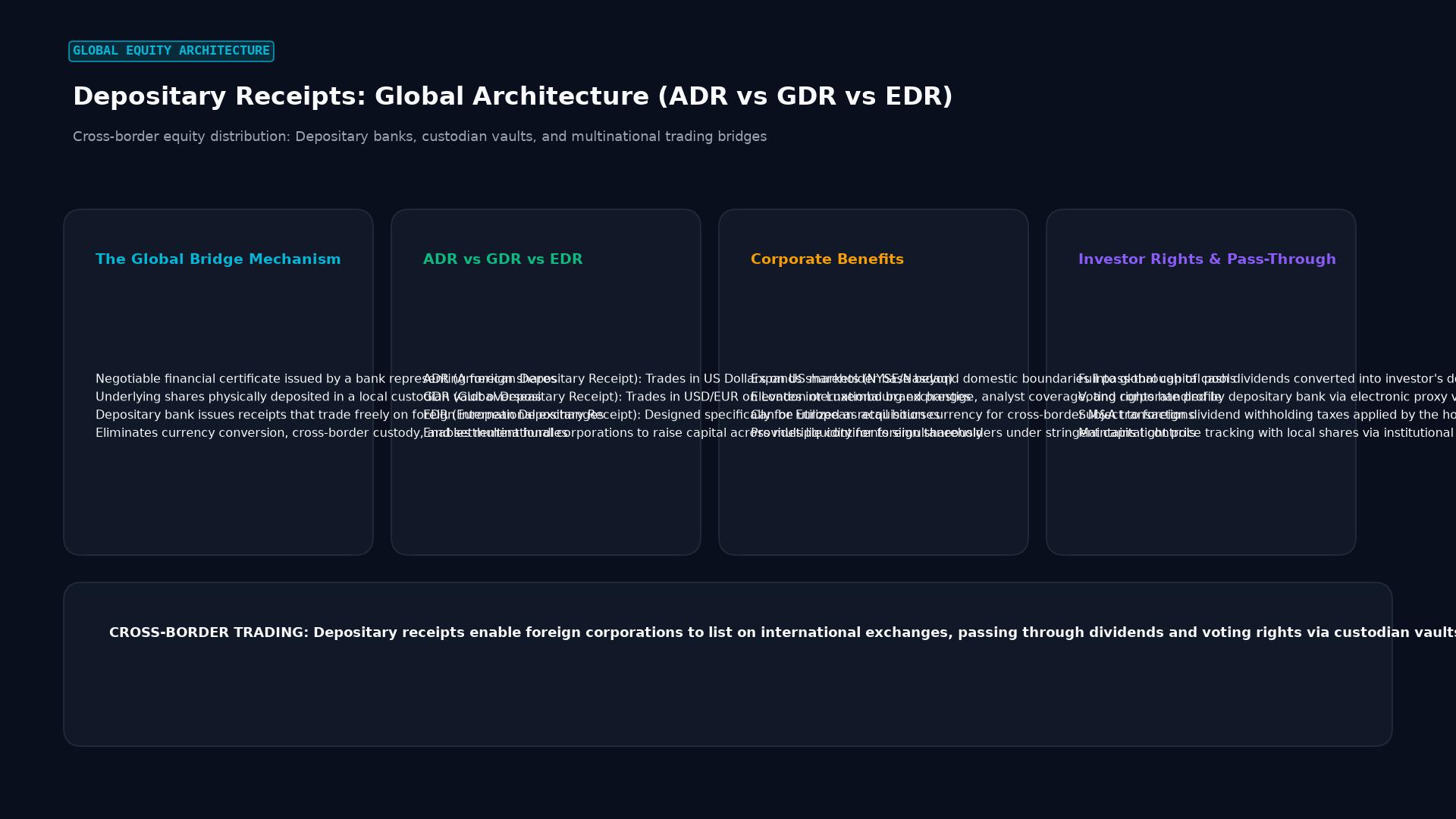 Figure: Cross-border equity distribution: Depositary banks, custodian vaults, and multinational trading bridges
Global Categories: ADRs, GDRs, and Regional Receipts
Depending on the trading venue and regulatory jurisdiction, depositary receipts fall into three primary categories:
+------------------------------------+------------------------------------+
| Depositary Receipt Category        | Trading Venue & Market Focus       |
+------------------------------------+------------------------------------+
| 1. American Depositary Receipts    | Traded exclusively in the United   |
| (ADRs): Denominated strictly in US | States (NYSE, Nasdaq, OTC). Regu-  |
| Dollars.                           | lated directly by the US SEC.      |
|                                    |                                    |
| 2. Global Depositary Receipts      | Traded across multiple inter-      |
| (GDRs): Typically denominated in   | national financial centers, most   |
| US Dollars or Euros.               | prominently on the London Stock    |
|                                    | Exchange and Luxembourg Exchange.  |
|                                    |                                    |
| 3. Specialized Regional Receipts:  | Enable foreign corporations to list|
| Tailored to specific national      | on emerging market exchanges       |
| securities laws.                   | (e.g., Chinese Depository Receipts |
|                                    | / CDRs; Indian Receipts / IDRs).   |
+------------------------------------+------------------------------------+
Sponsored vs. Unsponsored Programs
Depositary receipts are structured as either sponsored or unsponsored programs, dictating investor legal protections and company involvement:
Sponsored Depositary Receipts
A sponsored depositary receipt is created through a formal legal contract between the foreign issuing corporation and a single designated depositary bank (such as The Bank of New York Mellon, Citibank, or JPMorgan Chase).
- The foreign company initiates the program, pays administrative setup and custodial fees, and facilitates corporate governance rights (such as proxy voting materials translated into English).
- Sponsored DRs provide full corporate backing, dividend distribution guarantees, and regulatory compliance assistance.
Unsponsored Depositary Receipts
An unsponsored depositary receipt is established by a depositary bank or retail broker-dealer independently, without the formal involvement, request, or cooperation of the foreign corporation.
- Created to satisfy domestic retail and institutional investor trading demand for a popular foreign stock.
- Traded exclusively on over-the-counter (OTC) pink sheets.
- The foreign company assumes zero responsibility for regulatory filings, and multiple depositary banks can issue competing unsponsored receipts against the identical foreign stock.
Regulatory Tiers of American Depositary Receipts (ADRs)
In the United States, the Securities and Exchange Commission (SEC) regulates sponsored ADRs through three progressive tiers, balancing capital-raising capabilities with regulatory disclosure burdens:
  ADR Tier Level      Trading Venue                  SEC Filing Requirements      Capital Raising Ability
  ──────────────────────────────────────────────────────────────────────────
  Level I             Over-the-Counter (OTC Pink)    Form F-6; exempt from full   No capital raising;
                                                     reporting under Rule 12g3-2  secondary trading only

  Level II            Major Exchanges (NYSE, Nasdaq) Form F-6 + Form 20-F annual  No capital raising;
                                                     audited financial reporting  existing shares only

  Level III           Major Exchanges (NYSE, Nasdaq) Form F-6, Form 20-F, and     FULL PUBLIC OFFERING:
                                                     Form F-1 registration        Can issue new shares

  Rule 144A / Reg S   Private Placement (PORTAL)     Exempt from SEC registration Sold exclusively to QIB
                                                     under Rule 144A safe harbor  institutional buyers
A foreign corporation seeking only to establish brand visibility in the United States often registers a Level I program. Conversely, multinational giants seeking to raise billions of dollars from American institutional investors to fund acquisitions launch Level III offerings, committing to full SEC compliance.
Mathematical Valuation and Cross-Border Arbitrage
Depositary receipts do not necessarily trade on a 1:1 basis with underlying foreign shares. To ensure the domestic trading price matches standard institutional share price conventions (e.g., $20 to $100 per share), issuers establish an ADR Ratio:
$$\text{ADR Ratio} = \frac{\text{Number of Underlying Foreign Shares}}{\text{Number of Depositary Receipts}}$$
For example, if an Asian technology company ordinary shares trade locally at $2.00 each, the company might establish a 10:1 ADR ratio, where 1 ADR represents 10 underlying ordinary shares, pricing the ADR at roughly $20.00 on the NYSE.
The Law of One Price and Parity Pricing
Because depositary receipts are fully fungible with the underlying shares, their theoretical pricing is governed by the Law of One Price:
$$\text{Theoretical DR Price} = \text{Underlying Foreign Share Price} \times \text{DR Ratio} \times \text{Spot FX Rate}$$
Cross-Border Arbitrage (Issuance and Cancellation)
If market dislocations cause the ADR trading price on the NYSE to drift above its theoretical parity price in Tokyo or London, institutional market makers and quantitative hedge funds execute cross-border arbitrage:
- Buy Low in Home Market: The arbitrageur purchases undervalued ordinary shares on the foreign stock exchange.
- Deposit with Custodian: The shares are delivered to the local custodian bank in the home market.
- Mint New ADRs: The depositary bank in New York issues new ADRs against the deposited shares.
- Sell High on Domestic Exchange: The newly issued ADRs are sold immediately on the NYSE at the higher price, pocketing a risk-free arbitrage profit.
This continuous creation and redemption mechanism keeps depositary receipt prices synchronized with foreign home-market asset values.
Frequently Asked Questions
Do holders of depositary receipts have the right to vote at annual shareholder meetings?
Yes, for sponsored programs. The depositary bank mails proxy voting materials and English-language ballot cards to registered DR holders. The depositary votes the underlying physical shares in accordance with the instructions returned by the receipt holders. In unsponsored programs, voting rights are generally unavailable to receipt holders.
How are cash dividends distributed to depositary receipt holders?
When the foreign company pays a cash dividend, the local custodian collects the dividend in foreign currency. The depositary bank converts the funds into domestic currency (such as US Dollars) at prevailing institutional spot exchange rates and deposits the cash net of applicable foreign withholding taxes and nominal depositary pass-through service fees directly into the investor brokerage account.
Can an investor convert a depositary receipt into the underlying foreign stock?
Yes. An investor can instruct their broker to surrender depositary receipts to the depositary bank for cancellation. Upon paying standard depositary cancellation fees (typically $0.05 per share), the depositary releases the underlying ordinary shares from the local custodian vault directly into a local foreign brokerage account designated by the investor.
Ready to trade forex?
Open a free demo account with a regulated broker. Practice with virtual funds before risking real money.