Direct Cost
An operational expenditure that can be completely, economically, and unequivocally traced to a specific cost object, such as direct materials and direct manufacturing labor.
What is a Direct Cost?
A direct cost is an operational expenditure that can be identified, measured, and traced completely and economically to a specific cost object, such as an individual manufactured product, a specialized customer contract, an organizational department, or a clinical hospital procedure. In financial accounting, inventory valuation under US GAAP (ASC 330) and IFRS (IAS 2), and managerial cost analysis, direct costs form the foundation of product costing because they require zero subjective estimates, arbitrary allocation formulas, or intermediate cost pooling.
The defining test of a direct cost is cost-effective traceability. If an accounting system can verify via physical inspection, barcode scanning, bill of materials (BOM) specifications, or automated worker badge swipes that a specific dollar of raw material or labor was consumed exclusively by a single cost object, that expense is categorized as a direct cost. All other operational expenditures that benefit multiple cost objects simultaneously are classified as indirect costs (overhead).
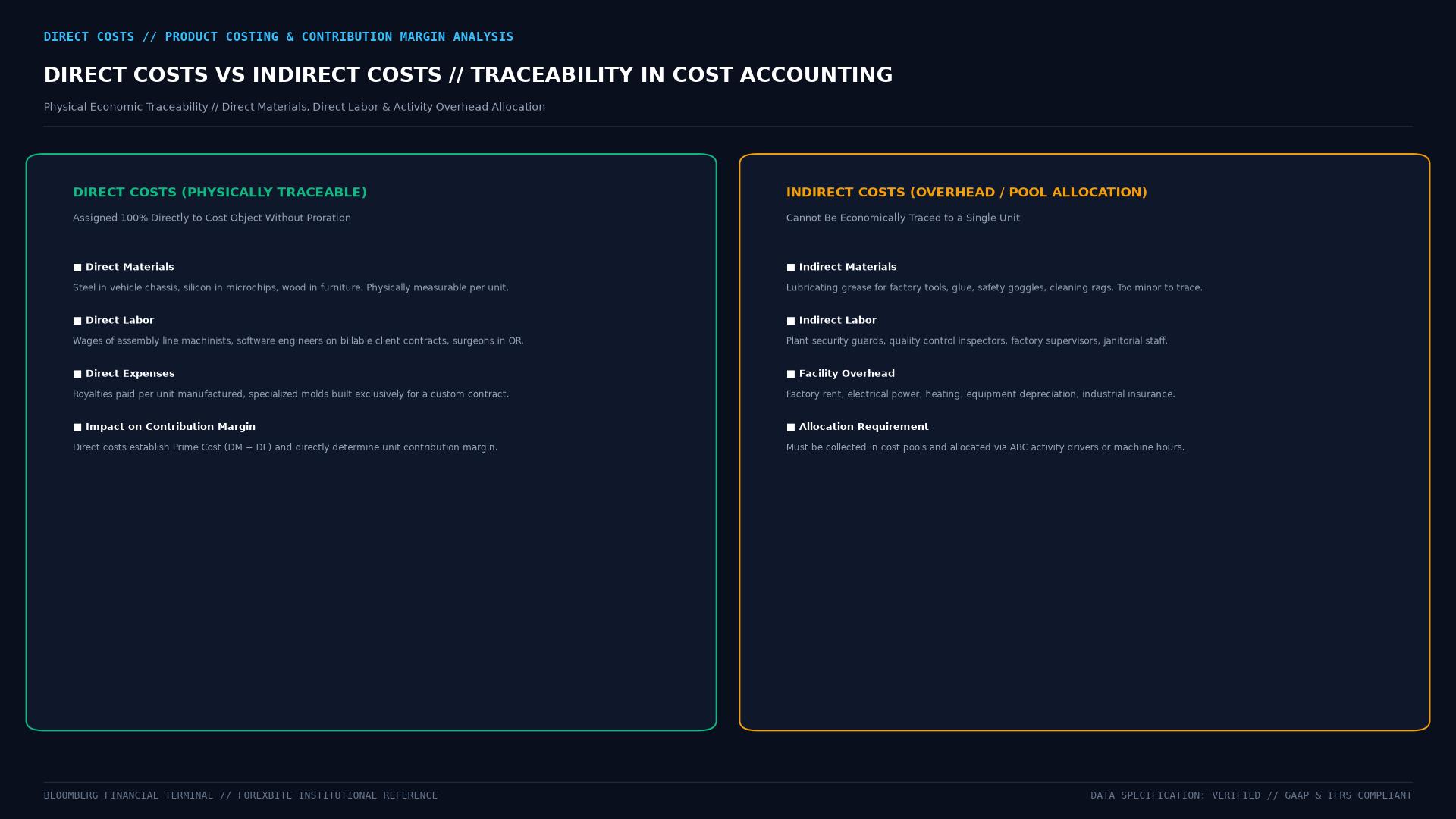 Figure: Cost classification framework categorizing Direct Costs (Direct Materials, Direct Labor) versus Indirect Overhead Costs, illustrating primary tracing techniques and product margin build-up.
The Components of Manufacturing Direct Costs: Prime Cost
In industrial manufacturing, direct costs are grouped into two primary categories, collectively referred to in cost accounting as Prime Cost:
$$\text{Prime Cost} = \text{Direct Materials} + \text{Direct Manufacturing Labor}$$
+------------------------------------+------------------------------------+
| Prime Cost Component               | Identification & Measurement Rules |
+------------------------------------+------------------------------------+
| 1. Direct Materials:               | Raw materials and subcomponents    |
| Physical inputs that become an     | that physically enter the finished |
| integral part of the finished good.| good (e.g., leather in luxury shoes|
|                                    | microprocessors in smartphones,    |
|                                    | sheet metal in automobile chassis).|
|                                    |                                    |
| 2. Direct Manufacturing Labor:     | Compensation paid to employees who |
| Labor hours applied directly to the| physically touch or machine the    |
| physical conversion of materials.  | raw materials into finished units  |
|                                    | (e.g., welders on an assembly line,|
|                                    | carpenters, precision machinists). |
+------------------------------------+------------------------------------+
Minor incidental materials (such as glue, standard screws, or thread) and incidental labor (such as janitorial cleanup or warehouse security) are excluded from direct costs, even if they physically touch the product. The administrative bookkeeping expense required to measure the exact fraction of a cent of glue used on a single pair of shoes exceeds the accounting accuracy gained; therefore, accounting standards treat these items as indirect materials and indirect labor, absorbed into general factory overhead.
Direct Cost vs. Variable Cost: A Critical Distinction
Corporate controllers and equity analysts often mistakenly treat “direct cost” and “variable cost” as perfect synonyms. While many direct costs are variable, the two classifications originate from fundamentally different analytical frameworks:
- Direct vs. Indirect: Reflects traceability to a specific cost object.
- Variable vs. Fixed: Reflects behavior in response to changes in operational activity volume.
  Cost Classification Matrix (Traceability vs. Cost Behavior)
  ──────────────────────────────────────────────────────────────────────────
                       DIRECT COST                       INDIRECT COST
  VARIABLE COST        Direct Materials consumed         Lubricating oil for shared factory
                       Direct Labor assembly hours       machines; electricity powering the
                       (Varies directly with units)      plant floor (Varies with activity)

  FIXED COST           Salary of a manager assigned      Factory building property tax;
                       exclusively to a single product;  salary of corporate CEO; general
                       lease of a dedicated mold tool    plant fire insurance policy
                       (Fixed regardless of volume)      (Fixed and shared across all goods)
A dedicated machine leased for $50,000 per year solely to produce Product Line Alpha is a direct cost with respect to Product Line Alpha (it can be traced with zero allocation error), yet it is a fixed cost (the $50,000 payment remains identical whether the plant produces 1 unit or 100,000 units).
Cost Object Context Dictates Directness
The classification of an expenditure as direct or indirect is never an absolute physical property of the expense; it depends entirely on the choice of the cost object.
Consider the annual salary of a factory maintenance supervisor:
- Cost Object = An Individual Product Unit: The salary is an indirect cost. The supervisor maintains machines that produce hundreds of different product models; tracing the supervisor salary to a single manufactured unit is impossible without arbitrary allocation.
- Cost Object = The Maintenance Department: The salary is a direct cost. The expense can be completely and unequivocally traced to the department ledger without any allocation formulas.
  Expense Line Item              Cost Object: Product SKU      Cost Object: Entire Plant Division
  ──────────────────────────────────────────────────────────────────────────
  Microchip CPU                  Direct Cost                   Direct Cost
  Assembly Worker Wages          Direct Cost                   Direct Cost
  Production Floor Rent          Indirect Cost                 Direct Cost
  Plant Manager Salary           Indirect Cost                 Direct Cost
  Corporate Legal Retainer       Indirect Cost                 Indirect Cost
Direct Costs in Managerial Decision-Making
Direct cost measurement is the foundation of multiple strategic financial calculations:
1. Contribution Margin Analysis
In cost-volume-profit (CVP) modeling, corporate leadership calculates the contribution margin to determine how much cash a product generates to cover corporate fixed costs and deliver operating profit:
$$\text{Unit Contribution Margin} = \text{Selling Price per Unit} - \text{Direct Variable Costs per Unit}$$
$$\text{Contribution Margin Ratio} = \frac{\text{Revenue} - \text{Total Variable Costs}}{\text{Revenue}} \times 100$$
Products with high direct variable costs require massive sales volumes to achieve corporate breakeven, whereas software products with negligible direct material costs deliver gross contribution margins exceeding 80% to 90%.
2. Special Order Pricing (Incremental Analysis)
When an enterprise possesses excess manufacturing capacity and receives a one-time special purchase order from an overseas distributor at a deeply discounted price, managers evaluate relevant direct costs:
- If the offered price exceeds the incremental direct costs (direct materials, direct labor, and variable shipping), accepting the order increases overall net operating profit.
- Sunk corporate overhead (such as executive salaries and corporate headquarters rent) is irrelevant to the decision because those fixed expenses persist whether the special order is accepted or rejected.
Frequently Asked Questions
Are employee benefits included in direct labor costs?
Under modern cost accounting best practices, labor-related fringe benefits (such as employer FICA taxes, workers’ compensation insurance, health insurance contributions, and mandatory pension funding) are treated as part of the total direct labor rate. If an assembly technician receives an hourly wage of $25.00 plus $10.00 in statutory benefits, the effective direct labor cost charged to the product is $35.00 per hour.
How does automation affect the proportion of direct costs in modern manufacturing?
Widespread industrial automation and robotics have transformed corporate cost structures. Historically, direct labor accounted for 30% to 50% of total manufacturing costs. In highly automated semiconductor fabrication plants and automotive assembly facilities, direct labor has dropped to under 5% of total costs, while indirect costs (depreciation of robotics, software engineering, and clean-room maintenance) have expanded dramatically.
Can direct costs be capitalized on the corporate balance sheet?
Yes. Under US GAAP and IFRS absorption costing rules, all direct manufacturing costs (materials and labor) incurred during the production cycle are capitalized as assets on the balance sheet inside Work in Process (WIP) and Finished Goods Inventory. These costs are not expensed on the income statement until the finished products are actually sold to customers, at which point they are recognized as Cost of Goods Sold (COGS).
Ready to trade forex?
Open a free demo account with a regulated broker. Practice with virtual funds before risking real money.