Indirect Cost
An indirect cost is an operating or manufacturing expenditure that supports enterprise activities but cannot be physically or economically traced to a specific cost object, requiring allocation via predetermined rates or activity drivers.
In cost accounting, managerial finance, and corporate valuation, an indirect cost (collectively referred to as manufacturing overhead, factory burden, or institutional operating support) is any expenditure that contributes to the ongoing production of goods or delivery of services, but cannot be physically, conveniently, or economically traced to an individual cost object through a direct cause-and-effect relationship. Unlike direct costs (such as raw aluminum in an aircraft wing or assembly line wages), indirect costs must be systematically allocated across products, business divisions, or contracts using predetermined allocation formulas or activity drivers. Under US GAAP and IFRS statutory accounting rules, accurately categorizing and absorbing indirect manufacturing costs into inventory dictates gross margin reporting, working capital valuation, and compliance with statutory absorption costing mandates.
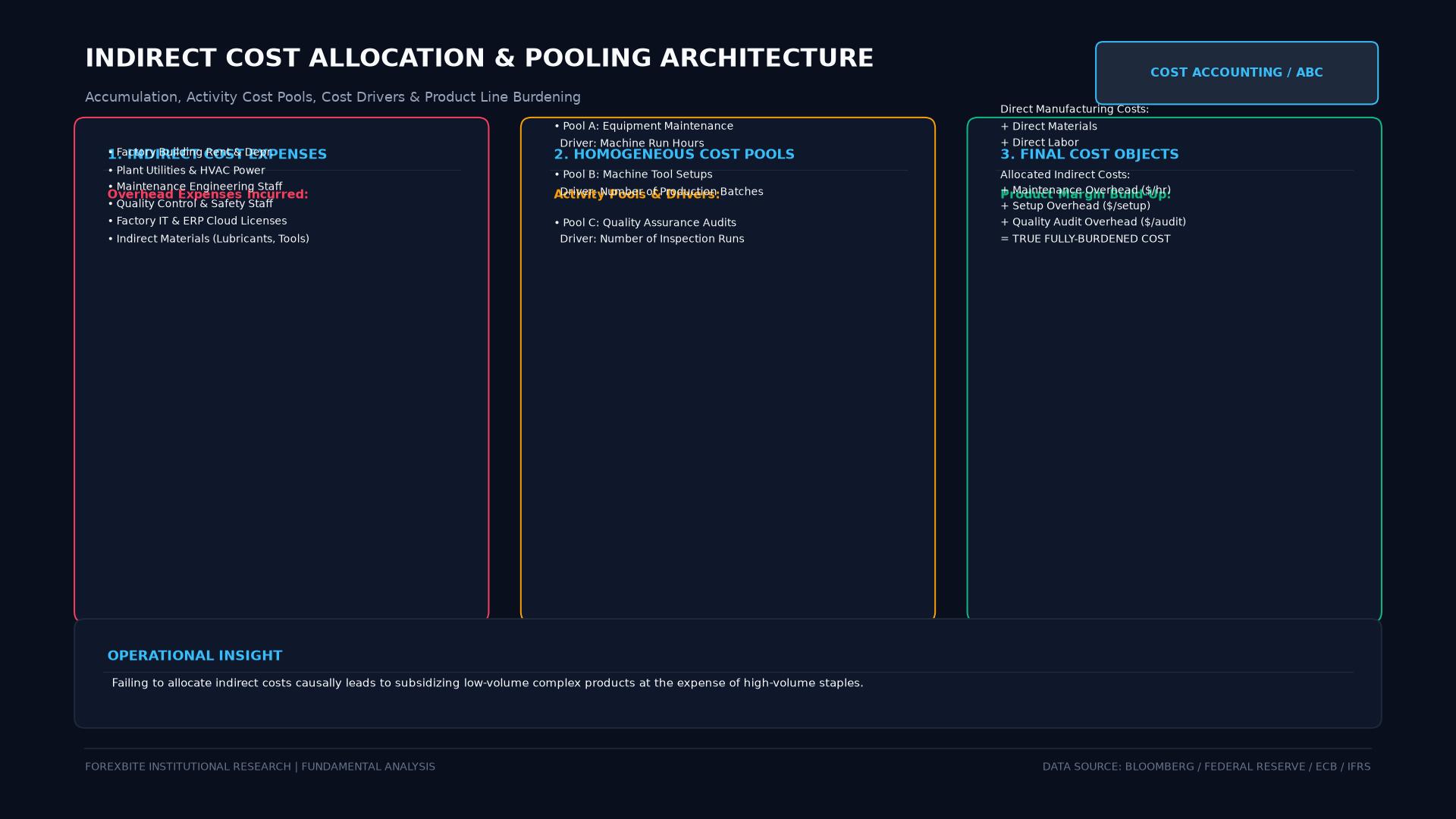 Figure: Multi-stage indirect cost allocation architecture, illustrating the accumulation of plant overhead into homogeneous activity cost pools before causal assignment to final cost objects.
The Three Components of Indirect Manufacturing Costs
In industrial manufacturing and engineering enterprises, indirect production costs are consolidated into Manufacturing Overhead (MOH), which comprises three operational categories:
1. Indirect Materials
Indirect materials represent physical consumables used in the production process that are either negligible in per-unit monetary value or impossible to measure on an individual unit basis without excessive administrative expense:
- Operational Examples: Lubricants and oils applied to high-speed CNC milling machines, industrial cleaning solvents, sandpaper, minor fasteners, glue, welding gases, and disposable safety gloves.
- The Traceability Test: While an automotive assembly plant uses thousands of gallons of hydraulic oil across its robotic presses, attempting to calculate the fraction of a cent of oil consumed by a specific passenger sedan chassis is economically impractical. The expenditure is therefore classified as an indirect material and pooled into overhead.
2. Indirect Labor
Indirect labor represents the wages, salaries, and payroll benefits paid to factory personnel who support, supervise, and maintain the production environment, but do not physically touch or transform raw materials into finished goods:
- Operational Examples: Plant maintenance mechanics, factory floor supervisors, quality assurance inspectors, forklift operators transporting materials between inventory racks, industrial tool room attendants, and factory security guards.
3. Indirect Facilities and Utilities
Facilities expenses encompass the capital amortization, maintenance, and utility infrastructure required to sustain the physical factory:
- Operational Examples: Depreciation of the physical factory building and heavy industrial equipment, factory property taxes, industrial casualty insurance premiums, electricity consumed by ambient plant lighting and ventilation systems, and municipal water and sewer charges for the production facility.
$$\text{Total Manufacturing Overhead} = \sum \text{Indirect Materials} + \sum \text{Indirect Labor} + \sum \text{Facility Overhead}$$
Allocation Methodologies: From POHR to Activity-Based Costing
Because indirect costs lack a direct physical link to individual units of output, cost accountants utilize structured mathematical models to assign overhead to products:
1. Traditional Plantwide Rate (Predetermined Overhead Rate - POHR)
In traditional volume-based cost accounting, a company estimates its total annual manufacturing overhead and selects a single volume-based allocation base (such as total direct labor hours or machine hours):
$$\text{POHR} = \frac{\text{Estimated Total Manufacturing Overhead Cost}}{\text{Estimated Total Units in Allocation Base}}$$
$$\text{Overhead Allocated to Product} = \text{POHR} \times \text{Actual Allocation Base Consumed}$$
While simple to administer, plantwide rates suffer from the “peanut-butter costing” flaw: spreading overhead evenly across all products regardless of the actual organizational complexity or machine setups consumed.
2. Departmental Overhead Rates
To improve accuracy, enterprises segment the factory into operating departments (such as Machining and Assembly), establishing distinct overhead rates for each department. The Machining department allocates overhead based on machine hours, while the Assembly department allocates based on direct labor hours.
3. Activity-Based Costing (ABC)
Activity-Based Costing represents the most rigorous managerial method for assigning indirect costs. Rather than aggregating all overhead into a single bucket, ABC identifies specific operational activities (such as machine setups, material handling, and purchase order processing), pools costs into discrete activity cost pools, and allocates costs using cause-and-effect activity drivers.
       ACTIVITY-BASED COSTING (ABC) ALLOCATION PIPELINE
       ================================================

   [ TOTAL INDIRECT OVERHEAD ]
                 |
                 +-----> SETUP POOL ($500,000) ---------> Setup Hours Driver
                 |
                 +-----> PROCUREMENT POOL ($300,000) ---> Purchase Orders Driver
                 |
+-----> INSPECTION POOL ($200,000) ----> Inspection Hours Driver| Cost Category | Direct Traceability? | Allocation Mechanism | Financial Reporting Classification |
|---|---|---|---|
| Direct Materials | Yes (physical bills of materials) | Direct Tracing | Capitalized into Inventory / COGS |
| Direct Labor | Yes (worker timecards per job) | Direct Tracing | Capitalized into Inventory / COGS |
| Manufacturing Overhead | No (shared production cost) | Allocated via POHR or ABC | Capitalized into Inventory / COGS |
| Corporate SG&A | No (non-manufacturing period cost) | Allocated for internal analysis | Expensed immediately as Period Cost |
Statutory GAAP/IFRS Absorption Costing Mandates
Under United States Generally Accepted Accounting Principles (ASC 330) and International Accounting Standard 2 (IAS 2), companies are legally required to utilize Full Absorption Costing for external statutory financial statements and tax reporting.
Under absorption costing:
- All manufacturing costs, both direct and indirect, must be attached to physical products and capitalized on the balance sheet within inventory accounts (Work-in-Process and Finished Goods).
- These indirect costs do not impact the Income Statement as expenses until the inventory is physically sold to an external customer, at which point they are recognized within Cost of Goods Sold (COGS).
- If a manufacturer produces 10,000 units but sells only 6,000, 40 percent of its indirect manufacturing overhead remains locked on the balance sheet as an asset, deferring expense recognition and temporarily inflating reported operating net income.
$$\text{Inventoriable Product Cost} = \text{Direct Materials} + \text{Direct Labor} + \text{Allocated Manufacturing Overhead}$$
By contrast, non-manufacturing indirect expenses, including corporate executive salaries, corporate headquarters rent, marketing campaigns, and legal retainers, are classified as period costs. These expenses must be expensed immediately on the Income Statement in the period incurred and can never be capitalized into inventory.
Managing Overhead Variances: Over- and Under-Applied Overhead
Because predetermined overhead rates are established at the beginning of the fiscal year based on forecasts, actual indirect costs incurred rarely match the overhead applied to production:
- Under-Applied Overhead (Actual Costs > Applied Costs): The company spent more on factory overhead than it allocated to products.
- Over-Applied Overhead (Actual Costs < Applied Costs): The company allocated more overhead to products than it actually spent.
At fiscal year-end, if the variance is immaterial, it is closed directly to Cost of Goods Sold. If the variance is material, US GAAP mandates that the variance be prorated across Work-in-Process, Finished Goods, and Cost of Goods Sold based on their ending balances.
Frequently Asked Questions
Can an indirect cost ever become a direct cost?
Yes. Technological advances frequently transform indirect costs into direct costs. Historically, tracking the exact electrical kilowatt-hours consumed by an individual machine job was unfeasible, making factory electricity an indirect cost. With modern internet-of-things (IoT) industrial smart meters attached to individual automated manufacturing cells, energy consumption can now be measured and directly traced to specific customer production runs, converting the utility expense into a direct cost.
How does the treatment of indirect costs differ between GAAP absorption costing and variable costing?
Under GAAP absorption costing, fixed indirect manufacturing overhead is capitalized into inventory and carried as an asset on the balance sheet until the product is sold. Under variable costing (used strictly for internal managerial decisions and break-even analysis), fixed indirect manufacturing overhead is treated as a period expense and deducted in full from revenue in the period incurred, regardless of sales volume.
Why do government defense contracts scrutinize indirect cost allocations?
Under federal cost-plus defense contracts, the United States Government reimburses contractors (such as Lockheed Martin or Boeing) for their allowable costs plus an agreed profit margin. The Defense Contract Audit Agency (DCAA) rigorously audits the contractor’s indirect cost allocation pools and forward-pricing rates to prevent commercial contractors from shifting unrelated commercial overhead expenses onto taxpayer-funded military contracts.
Ready to trade forex?
Open a free demo account with a regulated broker. Practice with virtual funds before risking real money.