Discount Spread
A discount spread (forward discount) in foreign exchange occurs when forward outright rates trade below the prevailing spot price, requiring negative swap points to be subtracted from spot to reflect interest rate parity.
What Is a Discount Spread?
In institutional foreign exchange trading and interest rate derivatives, a discount spread (commonly referred to as a forward discount or negative swap spread) describes a market condition where the forward outright exchange rate for a currency pair trades at a price lower than the current spot exchange rate ($F < S$).
Under the foundational economic law of Covered Interest Rate Parity (CIP), forward exchange rates do not reflect a speculative forecast of where a currency will trade in the future; rather, they are a pure mathematical function of the interest rate differential between the two sovereign nations. When the base currency carries a higher benchmark interest rate than the quote currency, the base currency is said to trade at a forward discount. To establish the forward outright price, dealing desks apply a discount spread: the forward swap points are negative and must be subtracted from the spot rate.
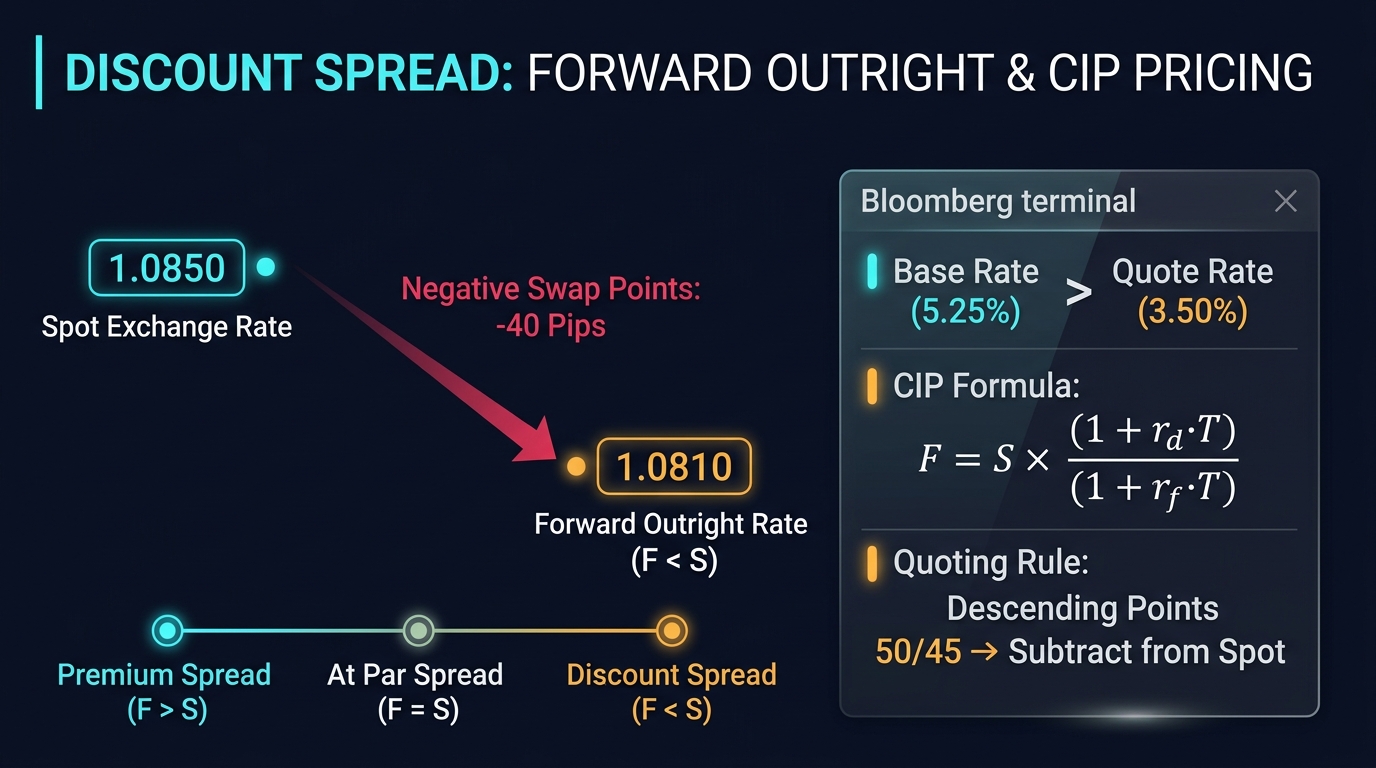
Forward Spread Market States:
A. PREMIUM SPREAD (Base Rate < Quote Rate):
   Spot: 1.0850  ──►  Forward Points: +30  ──►  Forward Outright: 1.0880 (F > S)

B. AT PAR SPREAD (Base Rate = Quote Rate):
   Spot: 1.0850  ──►  Forward Points: 0.0  ──►  Forward Outright: 1.0850 (F = S)

C. DISCOUNT SPREAD (Base Rate > Quote Rate):
   Spot: 1.0850  ──►  Forward Points: -40  ──►  Forward Outright: 1.0810 (F < S)
Key Takeaways
- Interest Rate Differential Driver: A currency trades at a forward discount when its domestic benchmark interest rate is higher than the foreign counter-currency’s interest rate.
- Elimination of Arbitrage: The forward discount ensures that an investor cannot borrow at a low foreign interest rate, convert to a high-yielding currency, earn free interest, and lock in a guaranteed riskless profit via a forward contract.
- Quoting Rule of Thumb: When forward swap points are quoted in descending order (e.g.,
50 / 45), the market is in a discount spread, and the points must be subtracted from the spot bid and ask. - Fixed Income Dimension: In debt capital markets, a discount spread (or discount margin) refers to the yield spread over reference benchmarks (such as SOFR or Euribor) required to price a Floating Rate Note (FRN) issued at a discount.
Mathematical Formulation: Covered Interest Rate Parity (CIP)
The theoretical forward exchange rate $F$ for an annual maturity fraction $T$ is determined by the spot rate $S$ and the sovereign interest rates:
$$F = S \times \left[ \frac{1 + r_d \cdot (T / 360)}{1 + r_f \cdot (T / 360)} \right]$$
Where:
- $S$ = Current spot exchange rate
- $r_d$ = Domestic (quote currency) interest rate
- $r_f$ = Foreign (base currency) interest rate
- $T$ = Days to settlement maturity (using international money market day-count conventions)
Condition for a Discount Spread:
A forward discount occurs on the base currency whenever: $$r_f > r_d \implies \left[ \frac{1 + r_d \cdot (T / 360)}{1 + r_f \cdot (T / 360)} \right] < 1.00 \implies F < S$$
$$\text{Forward Swap Points} = F - S < 0 \quad \text{(Negative Swap Points / Discount)}$$
Interbank Dealing: How Dealers Quote Discount Spreads
On interbank electronic dealing platforms (such as Refinitiv Matching and EBS), forward prices are quoted in shorthand swap points. Dealing desks identify whether points are a premium or a discount by the direction of the numbers:
| Quotation Rule | Swap Point Quote | Point Order | Operational Rule | Outright Calculation |
|---|---|---|---|---|
| Premium Spread | 15 / 20 |
Ascending (Bid < Ask) | ADD points to spot | Bid: Spot + 0.0015 / Ask: Spot + 0.0020 |
| Discount Spread | 35 / 30 |
Descending (Bid > Ask) | SUBTRACT points from spot | Bid: Spot - 0.0035 / Ask: Spot - 0.0030 |
Why Descending Points Must Be Subtracted:
To ensure the dealer’s bid-ask spread remains positive for the market maker:
Assume Spot is 1.2800 / 1.2802 and 3-Month Forward Points are quoted as 25 / 20 discount:
- Forward Outright Bid: $1.2800 - 0.0025 = \mathbf{1.2775}$
- Forward Outright Ask: $1.2802 - 0.0020 = \mathbf{1.2782}$
- Calculated Forward Spread: $1.2782 - 1.2775 = \mathbf{0.0007 \text{ (7 pips)}}$.
Notice: If an inexperienced clerk accidentally added descending points ($1.2800 + 0.0025 = 1.2825$ and $1.2802 + 0.0020 = 1.2822$), the bid would be higher than the ask—a crossed market that would allow counterparties to instantly arbitrage the desk.
Real-World Case Study: Corporate Treasury Hedging in a High-Yield Currency
Consider an American multinational corporation exporting agricultural equipment to Mexico:
The Setup:
- The Mexican buyer will pay 100,000,000 Mexican Pesos (MXN) in 6 months.
- The U.S. exporter wants to eliminate currency risk by locking in a forward contract to sell MXN and buy USD today.
- Spot Rate (USD/MXN):
18.0000(Direct quote: 1 USD = 18.00 MXN; or 1 MXN = $0.05555 USD). - Interest Rate Differential:
- Mexican Central Bank (Banxico) Policy Rate: 11.00%.
- U.S. Federal Reserve Benchmark Rate: 5.25%.
- Differential: Mexican rates are 5.75% higher than U.S. rates.
The Forward Pricing:
- Because the Mexican Peso has a significantly higher interest rate than the U.S. Dollar, the Peso must trade at a forward discount.
- Calculating 6-Month Forward Points: $$\text{Swap Points} \approx 18.00 \times (11.00% - 5.25%) \times \frac{180}{360} \approx +0.5175 \text{ Pesos per USD}$$
- The 6-Month Forward Outright rate is 18.5175 USD/MXN.
- In terms of U.S. Dollars per Peso, the forward rate is $0.05400 USD per MXN (a discount compared to the spot price of $0.05555).
- The U.S. exporter locks in the forward contract at 18.5175, receiving: $$\frac{100,000,000 \text{ MXN}}{18.5175} = $5,400,297 \text{ USD}$$ The discount spread mathematically offsets the interest income the exporter could have earned if they had held the pesos in a high-yielding Mexican bank account.
Frequently Asked Questions
Does trading at a forward discount mean the market expects the currency to fall?
No. This is a common misconception among retail traders. A forward discount reflects pure interest rate differentials, not market sentiment. Under empirical studies of the Forward Premium Puzzle, high-yielding currencies trading at a forward discount often appreciate in the spot market due to relentless carry trade inflows.
What is the difference between a forward discount and a spot discount?
A spot discount refers to an asset trading below its nominal par value in the secondary market (e.g., a $1,000 bond trading at $950). A forward discount refers to the relationship between the future settlement price and the current cash price in derivatives markets.
What happens to a discount spread if central banks cut interest rates?
If the central bank of the high-yielding currency cuts its benchmark interest rate, the interest rate differential between the two nations narrows. As a consequence, the forward swap discount contracts, pulling the forward outright rate closer to the spot rate (narrowing the discount spread).
Ready to trade forex?
Open a free demo account with a regulated broker. Practice with virtual funds before risking real money.