Forward Contract
A forward contract is a customized, over-the-counter (OTC) financial agreement between two counterparties to buy or sell an underlying asset or currency at an agreed-upon exchange rate on a specified future date.
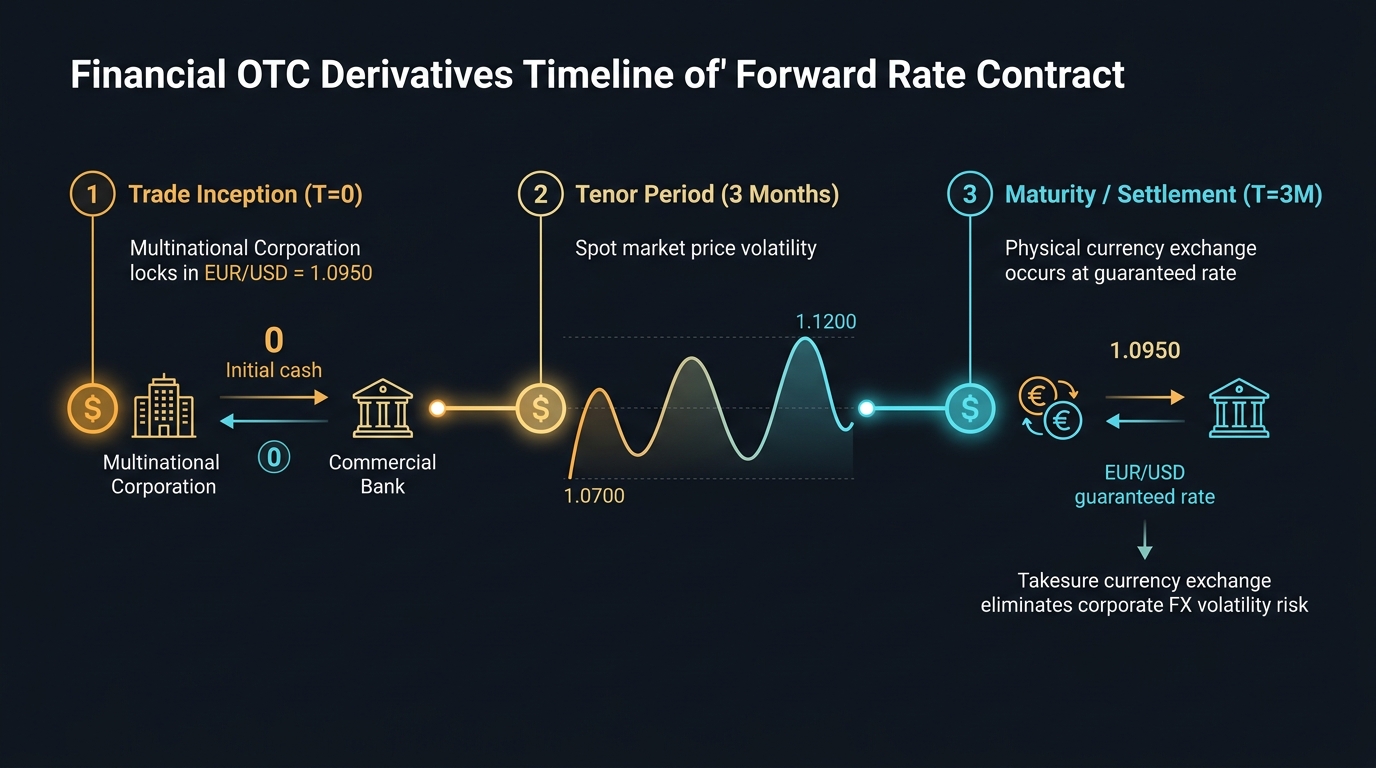
What Is a Forward Contract?
A forward contract is a private, legally binding agreement between two parties to purchase or sell an underlying asset (such as foreign currency, commodities, or interest rate instruments) at a fixed price on a predetermined date in the future. In the foreign exchange market, currency forwards constitute one of the most widely used instruments for corporate treasury hedging and institutional balance sheet management.
Unlike spot forex trades, which settle two business days after trade execution (T+2), a forward contract delays settlement to a future date that matches the counterparties’ commercial requirements. The settlement date can range from one week to several months, or even several years. Crucially, forward contracts are traded over-the-counter (OTC) directly between institutions or through commercial banks, meaning their terms—such as notional size, maturity date, and settlement structure—are tailored to the exact specifications of the buyer and seller.
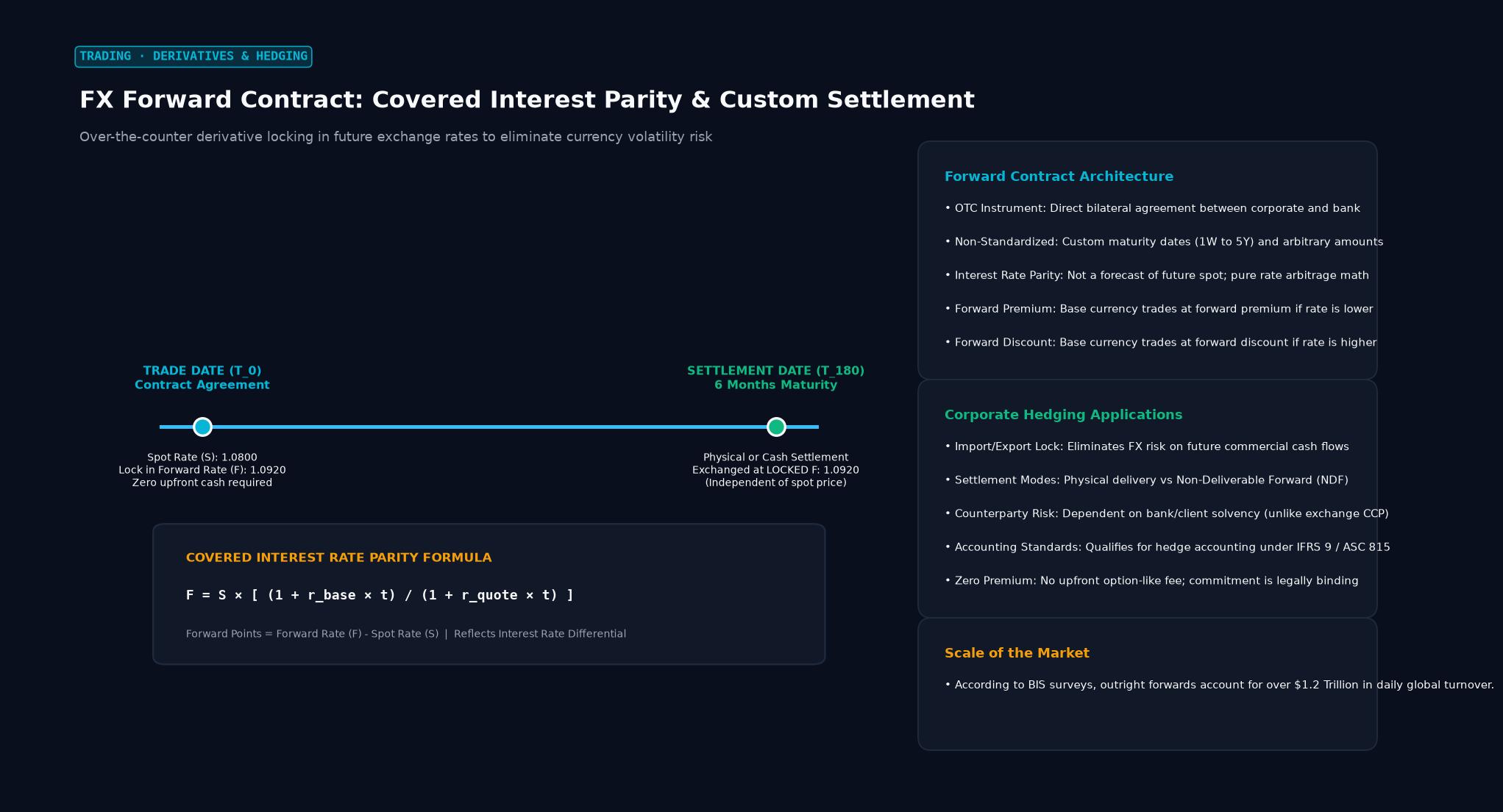 Figure: Over-the-counter derivative locking in future exchange rates to eliminate currency volatility risk
Pricing Mechanics: Covered Interest Parity
A common misconception among retail traders is that forward exchange rates reflect the market’s forecast of where currency prices will trade in the future. Forward pricing does not predict future direction. Instead, forward rates are calculated mathematically based on the spot exchange rate and the interest rate differential between the two national currencies over the life of the contract. This fundamental relationship is known as Covered Interest Rate Parity (CIP).
The theoretical forward rate is governed by the following formula:
$$F = S \times \frac{1 + (r_d \times \frac{t}{360})}{1 + (r_f \times \frac{t}{360})}$$
Where:
- F = Outright forward exchange rate
- S = Current spot exchange rate
- $r_d$ = Domestic interest rate (base quote currency)
- $r_f$ = Foreign interest rate (counter currency)
- t = Number of days to settlement (using actual/360 or actual/365 money market conventions)
The difference between the outright forward rate and the spot rate is expressed as forward points (or swap points):
$$\text{Forward Points} = F - S$$
When the foreign currency carries higher interest rates than the domestic base currency, the forward rate trades at a discount to spot, reflecting negative forward points. Conversely, when the base currency has a lower interest rate, forward points are added to the spot price, placing the forward rate at a premium.
Real-World Corporate Hedging Example
Consider a European industrial engineering firm based in Germany. On March 1, the firm orders specialized robotics components from an American supplier totaling $5,000,000 USD, payable in full on September 1 (a 6-month term, or 184 days).
The market parameters on March 1 are:
- Spot EUR/USD: 1.0850
- Eurozone Interbank Lending Rate (EURIBOR 6M): 3.50% per annum
- US Secured Overnight Financing Rate (SOFR 6M): 5.25% per annum
If the treasury team leaves the transaction unhedged, they face severe currency risk. A depreciation of the euro from 1.0850 down to 1.0200 would inflate their acquisition cost from €4,608,295 to €4,901,960, eroding €293,665 in operating profit.
To neutralize this volatility, the treasurer enters into an outright forward contract with their bank to buy $5,000,000 USD against EUR in 184 days:
$$\text{Forward Rate} = 1.0850 \times \frac{1 + (0.0525 \times \frac{184}{360})}{1 + (0.0350 \times \frac{184}{360})}$$
$$\text{Forward Rate} = 1.0850 \times \frac{1 + 0.026833}{1 + 0.017889} = 1.0850 \times \frac{1.026833}{1.017889} \approx 1.0945$$
The bank quotes an outright forward rate of 1.0945 EUR/USD (or approximately +95 forward points added to spot). On September 1:
- The German company receives $5,000,000 USD and delivers €4,568,296 (€5,000,000 / 1.0945).
- Regardless of whether the spot rate has climbed to 1.1500 or collapsed to 1.0000, the firm’s commercial cost is locked in, safeguarding budgeted operating margins.
Forward Contracts vs. Futures Contracts
While both forward and futures contracts allow market participants to fix future transaction prices, their structural characteristics differ fundamentally across execution, risk management, and settlement.
| Feature | Forward Contract | Futures Contract |
|---|---|---|
| Trading Venue | Over-the-Counter (OTC) private negotiation | Regulated public exchanges (e.g., CME, ICE) |
| Contract Sizing | Fully customized to odd amounts | Standardized lot sizes (e.g., €125,000 per CME Euro FX lot) |
| Maturity Dates | Any mutually agreed business day | Fixed quarterly expiration cycles (March, June, September, December) |
| Cash Settlement | Settled on maturity date; no daily cash flow | Daily mark-to-market variation margin |
| Credit Risk | Counterparty default risk managed via collateral (CSA) | Clearinghouse acts as central counterparty; minimal default risk |
| Secondary Market | Illiquid; requires unwinding with original issuer | Highly liquid secondary exchange order books |
Key Takeaways
- A forward contract fixes an exchange rate today for currency delivery and payment on an agreed future date.
- Forward rates are not price predictions. They are derived mathematically from interest rate differentials via Covered Interest Rate Parity.
- Primary participants are multinational corporations, institutional asset managers, and import-export businesses seeking to eliminate currency volatility.
- Because forwards are private OTC agreements, each counterparty bears credit risk unless secured by an International Swaps and Derivatives Association (ISDA) agreement and Credit Support Annex (CSA).
- Unlike exchange-traded futures, forwards do not require daily margin maintenance, preserving liquidity for corporate treasury operations until final maturity.
Frequently Asked Questions
Can a forward contract be cancelled or modified before maturity?
Forward contracts cannot be unilaterally cancelled. If a party needs to exit early, they must negotiate an offsetting forward transaction with the issuing bank or roll the contract to a later settlement date via a FX swap, closing out the pricing differential at current market rates.
What is a Non-Deliverable Forward (NDF)?
A Non-Deliverable Forward is a cash-settled forward contract used primarily for currencies with stringent capital controls or limited convertibility (such as the Indian Rupee, Brazilian Real, or South Korean Won). Instead of exchanging physical principal currencies, counterparties settle the difference between the agreed forward rate and prevailing spot rate in a convertible currency, typically US Dollars.
Do forward contracts require upfront capital?
Standard forwards do not require an upfront purchase fee or premium. However, commercial banks typically establish a credit facility or demand a initial margin deposit (often 3% to 10% of notional value) to mitigate counterparty default exposure.
Ready to trade forex?
Open a free demo account with a regulated broker. Practice with virtual funds before risking real money.