Discretionary Account
A discretionary account is a managed investment account where the client grants legal authorization via a Limited Power of Attorney to a professional manager to execute trades autonomously on their behalf.
What Is a Discretionary Account?
A discretionary account (commonly termed a managed account or discretionary mandate) is a specialized brokerage or wealth management account in which the client legally delegates full trading authority to a professional portfolio manager, registered investment adviser (RIA), or broker-dealer.
Under this legal framework, the appointed manager possesses complete discretion to determine which financial assets to buy or sell, the specific timing of entries and exits, the position sizing, and the execution venues—without requiring prior consultation or approval from the client before executing each individual trade. The manager’s authority is bound by a legally executed Limited Power of Attorney (LPOA) and governed by a customized Investment Policy Statement (IPS) that strictly codifies the client’s risk tolerance, return objectives, asset allocation constraints, and liquidity requirements.
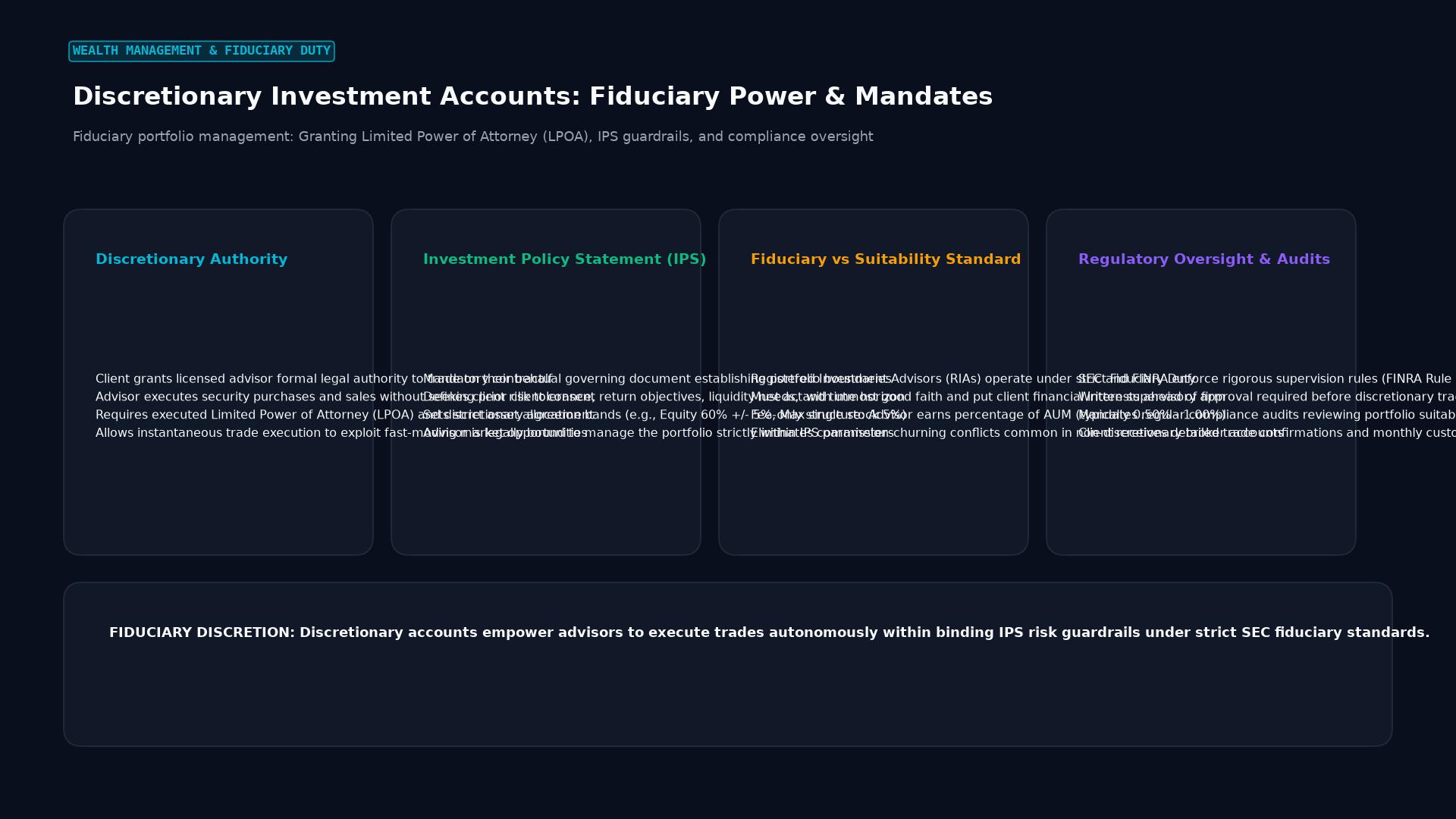 Figure: Fiduciary portfolio management: Granting Limited Power of Attorney (LPOA), IPS guardrails, and compliance oversight
Key Takeaways
- Autonomous Trade Authority: The manager executes market orders dynamically based on shifting market conditions without waiting for the client to answer telephone calls or review emails.
- The Limited Power of Attorney (LPOA): The legal contract that grants trading discretion to the manager while strictly prohibiting the manager from withdrawing, transferring, or misappropriating client capital.
- Fiduciary Legal Duty: In premier regulatory jurisdictions (such as the SEC in the U.S. and the FCA in the UK), discretionary managers are legally bound by a strict fiduciary standard, requiring them to put the client’s financial interests above their own at all times.
- Retail Forex Parallels: In retail foreign exchange, discretionary trading is facilitated through PAMM (Percentage Allocation Management Module) and MAM (Multi-Account Manager) architectures.
Discretionary vs. Non-Discretionary Accounts
Understanding the boundary between managed and advisory accounts is essential for investors evaluating wealth management services:
| Feature | Discretionary Managed Account | Non-Discretionary (Advisory) Account |
|---|---|---|
| Execution Authority | Professional manager executes autonomously | Client retains 100% final execution approval |
| Pre-Trade Consultation | None; trades are placed instantly as opportunities emerge | Mandatory; advisor must obtain explicit client consent |
| Legal Documentation | Requires a formal Limited Power of Attorney (LPOA) | Standard client brokerage terms of business |
| Execution Speed | Ultra-fast; vital for fast-moving currency and equity markets | Slow; delayed by client communication and availability |
| Fee Structure | Asset-based fee (% AUM) + optional performance fee | Transaction commissions, markups, or hourly advisory fees |
| Best Suited For | Busy executives, family offices, hands-off passive investors | Active investors who desire final veto power over every position |
The Legal Safeguard: The Limited Power of Attorney (LPOA)
To protect investors from unauthorized theft or embezzlement, discretionary mandates are governed by strict institutional firewalls:
$$\text{Trading Authority Granted} \quad \mathbf{\neq} \quad \text{Asset Transfer Authority}$$
What the LPOA Permits the Manager to Do:
- Execute buy, sell, limit, and stop orders across pre-approved asset classes.
- Allocate positions dynamically across underlying sub-accounts.
- Deduct pre-agreed advisory and performance management fees from account equity.
What the LPOA Strictly Forbids:
- No Third-Party Transfers: The manager cannot wire money to outside bank accounts or third-party entities.
- No Cash Withdrawals: All deposits and withdrawals can be initiated solely by the legal account owner to a verified bank account in the owner’s exact name.
- Independent Custody: Assets remain deposited in the client’s name at an independent, qualified custodian bank (e.g., Charles Schwab, Interactive Brokers, BNY Mellon).
Discretionary Trading in Retail Forex: PAMM and MAM Accounts
In the retail foreign exchange ecosystem, discretionary asset management is executed through specialized software modules:
PAMM Master Account Allocation:
                   ┌────────────────────────────────────────┐
                   │        MASTER MANAGER ACCOUNT          │
                   │        Trades 10 Standard Lots         │
                   └───────────────────┬────────────────────┘
                                       │
      ┌────────────────────────────────┼────────────────────────────────┐
      ▼ (50% Equity)                   ▼ (30% Equity)                   ▼ (20% Equity)
┌──────────────────────┐     ┌──────────────────────┐     ┌──────────────────────┐
│  INVESTOR A ($50,000)│     │  INVESTOR B ($30,000)│     │  INVESTOR C ($20,000)│
│ Automatically gets   │     │ Automatically gets   │     │ Automatically gets   │
│ 5.0 Lots Allocation  │     │ 3.0 Lots Allocation  │     │ 2.0 Lots Allocation  │
└──────────────────────┘ └──────────────────────┘ └──────────────────────┘- Percentage Allocation Management Module (PAMM): An automated pooling system where multiple retail investors connect their individual sub-accounts to a master money manager. When the manager executes 10 lots of EUR/USD, the trade is automatically subdivided proportionally across all connected accounts based on their percentage share of the total pool equity.
- Multi-Account Manager (MAM): A more flexible institutional system permitting discretionary managers to allocate trades using variable criteria—such as fixed lot ratios, risk percentages, or available free margin.
Regulatory Standards: Preventing Churning and Fee Abuse
Because discretionary managers control trade volume, regulatory bodies enforce strict compliance surveillance to prevent fraudulent practices:
- Prohibition of “Churning”: Churning is the illegal practice where a discretionary broker executes excessive, unnecessary trades solely to generate transaction commissions for themselves rather than profit for the client.
- The High-Water Mark Standard: In discretionary accounts with performance fees (e.g., a “20% performance fee”), the manager can only collect fees when the account equity surpasses its historical all-time high (High-Water Mark). If an account suffers a 15% drawdown, the manager cannot charge any performance fees until the entire 15% loss is fully recovered.
Frequently Asked Questions
Can an investor revoke a discretionary mandate at any time?
Yes. An investor can immediately revoke the Limited Power of Attorney (LPOA) in writing or via their online brokerage security dashboard. Upon revocation, the manager’s trading access is instantly terminated, and the investor resumes sole control over the account.
What is an Investment Policy Statement (IPS)?
An Investment Policy Statement (IPS) is a formal legal charter drafted between the client and the discretionary manager. It establishes the mandatory operating boundaries for the manager, such as: “Portfolio must hold at least 20% cash, maximum 5% allocation per single equity, zero unhedged exotic currency exposure, and maximum allowable portfolio drawdown of 10%.” If the manager violates the IPS, they face legal liability for damages.
How are discretionary managers compensated?
Discretionary managers typically operate under an “Assets Under Management” (AUM) fee model (e.g., charging 1.0% to 1.5% of total portfolio value annually, billed quarterly). In institutional hedge funds and high-performance forex PAMMs, managers often utilize the traditional “2 and 20” structure (2% annual management fee plus a 20% performance fee on net new profits).
Ready to trade forex?
Open a free demo account with a regulated broker. Practice with virtual funds before risking real money.