Dual Currency Investment (DCI)
A Dual Currency Investment (DCI), or Dual Currency Service, is a structured yield-enhancement product combining a money market deposit with an embedded short currency option, providing higher interest in exchange for currency conversion risk.
What Is a Dual Currency Investment (DCI)?
A Dual Currency Investment (DCI)—frequently marketed by private banks and institutional wealth management desks as a Dual Currency Service or Dual Currency Deposit (DCD)—is a structured financial product that links the return on a cash deposit to the exchange rate movements of two specified currencies.
At its core, a DCI combines two financial building blocks:
- A traditional money market time deposit in a base deposit currency.
- An embedded short foreign currency option (specifically, the investor sells an Out-of-the-Money put or call option to the issuing bank).
In exchange for selling this currency option, the investor receives an exceptionally high annualized interest yield (often 2x to 5x standard bank deposit rates). However, this enhanced return comes with a structural trade-off: on the fixing maturity date, if the exchange rate breaches the agreed strike rate, the bank exercises its option, repaying the investor’s principal and interest in the alternate linked currency at the pre-set strike price.
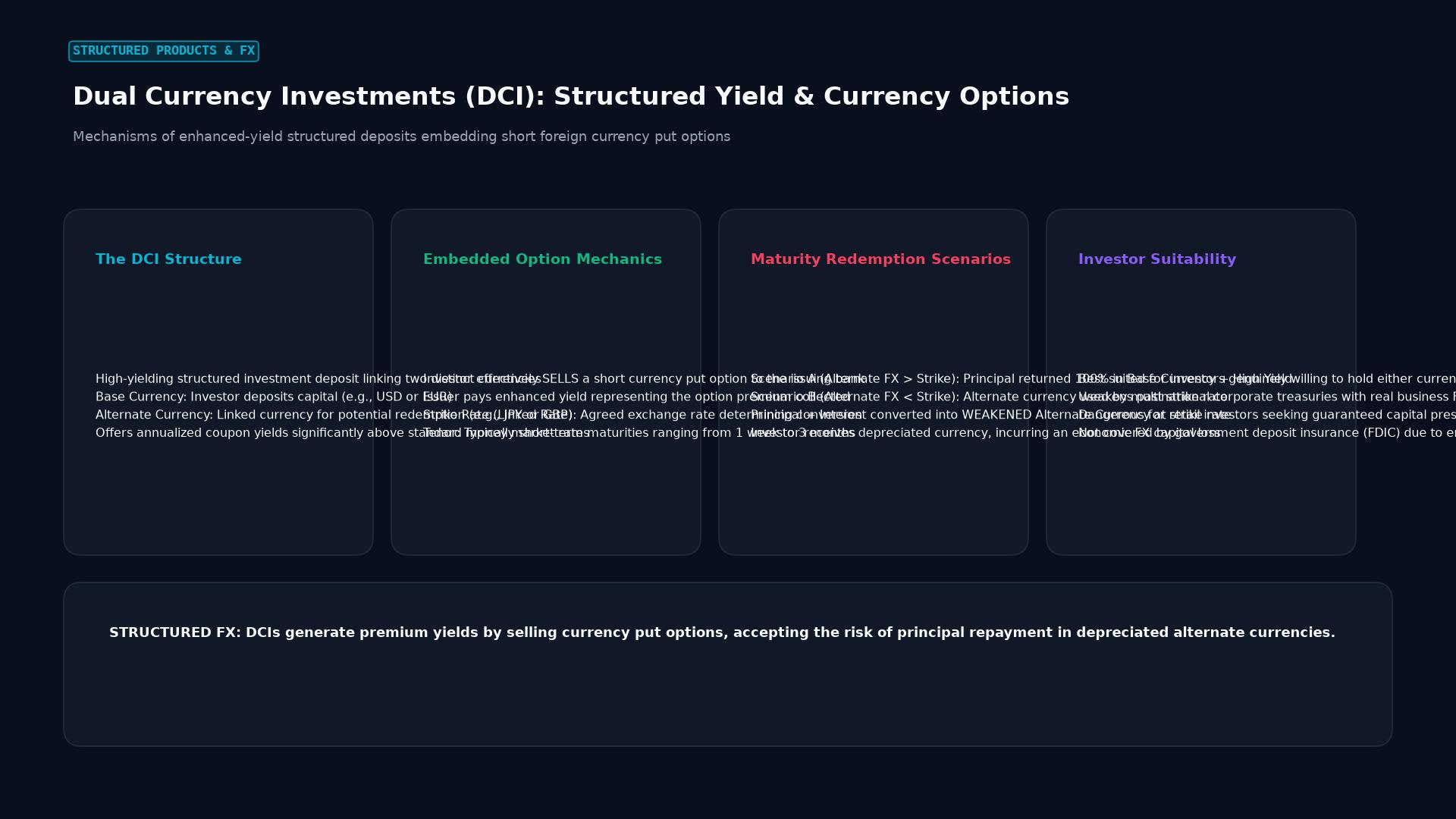 Figure: Mechanisms of enhanced-yield structured deposits embedding short foreign currency put options
Key Takeaways
- Yield-Enhancement Mechanism: DCIs are designed for investors seeking higher yields on idle cash balances who are comfortable holding either of two specific currencies.
- Embedded Short Option: The above-market return is not “free interest”—it is the cash option premium collected for selling downside currency protection to the bank.
- Principal at Risk (Currency Risk): DCIs do not guarantee the preservation of capital in original currency purchasing power terms. If the alternate currency depreciates sharply, the investor receives a depreciated asset.
- Target Audience: Ideal for corporate treasuries with multi-currency operational liabilities or high-net-worth individuals planning international real estate purchases, overseas tuition payments, or regular commercial foreign currency expenditures.
How a Dual Currency Investment Operates
When establishing a DCI contract with a private bank or liquidity broker, the investor selects four foundational parameters:
- Base (Deposit) Currency: The currency originally deposited (e.g., U.S. Dollars).
- Alternate (Linked) Currency: The secondary currency the investor is willing to receive at maturity (e.g., Euros).
- Maturity Tenor: Typically short-term, ranging from 1 week to 3 months.
- Strike (Linked) Rate: The pre-agreed exchange rate that dictates whether conversion occurs.
$$\text{Enhanced Annualized Yield} = \text{Money Market Benchmark Yield} + \left( \frac{\text{Option Premium Received}}{\text{Deposit Principal}} \times \frac{365}{\text{Tenor in Days}} \right)$$
Real-World Case Study: USD/EUR Dual Currency Deposit
A corporate investor holds $1,000,000 USD in idle cash. The current spot exchange rate is EUR/USD = 1.0850. A standard 1-month USD bank deposit yields an annualized 4.50%.
The DCI Setup:
- Deposit Principal: $1,000,000 USD
- Linked Currency: Euro (EUR)
- Tenor: 30 Days
- Agreed Strike Rate:
EUR/USD = 1.1000(The investor agrees to sell USD and buy EUR if EUR/USD strengthens to 1.1000). - Enhanced Annualized Yield Offered: 12.00% p.a. (yielding $10,000 USD for 30 days, compared to $3,750 on a standard deposit).
Maturity Outcome Scenarios:
| Market Scenario | Spot Rate at Expiry Fixing | Bank Action | Investor Receives at Settlement | Net Realized Outcome |
|---|---|---|---|---|
| Scenario 1: EUR Weakens / Flat | EUR/USD = 1.0750 | Option Expires Worthless | $1,010,000.00 USD | Principal returned in USD + $10,000 cash yield (12% p.a. earned) |
| Scenario 2: EUR Rallies Mildly | EUR/USD = 1.0950 | Option Expires Worthless | $1,010,000.00 USD | Principal returned in USD + $10,000 cash yield (12% p.a. earned) |
| Scenario 3: EUR Surges Sharply | EUR/USD = 1.1200 | Bank Exercises Option | €918,181.82 EUR | Converted at 1.1000: $($1,010,000 / 1.1000) \implies$ Worth $1,028,363 USD at spot |
Notice Scenario 3: If EUR/USD surges to 1.1500, the investor receives €918,181.82 EUR converted at 1.1000. While the investor received their 12% yield, they missed out on the massive open market rally from 1.0850 to 1.1500.
Structural Risk Analysis: Why DCIs Are Not Traditional Bank Deposits
Investors must evaluate three critical risk factors before executing a Dual Currency Service contract:
1. No Capital Protection in Domestic Terms
Unlike government-guaranteed bank deposits (e.g., FDIC insurance), a DCI is a structured investment product. If the linked currency plummets, the investor is delivered a falling asset.
2. Illiquidity and Zero Early Withdrawal
DCIs are fixed-term non-negotiable contracts. Investors cannot break, liquidate, or withdraw capital prior to the fixing maturity date without paying exorbitant unwinding penalties that cancel the embedded option.
3. Asymmetric Opportunity Cost
The investor’s upside is strictly capped at the enhanced interest yield. Conversely, their downside is unbounded if the alternate currency suffers a black-swan devaluation event.
Frequently Asked Questions
Who is the ideal candidate for a Dual Currency Investment?
The strategy is optimal for investors who maintain genuine bilateral currency needs. For example, a European importer who constantly needs U.S. Dollars to pay Chinese suppliers or Euros to pay local staff can execute DCIs with zero emotional friction, happily accepting repayment in whichever currency the market delivers.
Is the yield earned on a DCI taxable?
In most tax jurisdictions, the total return from a DCI is treated as ordinary interest income or a capital gain from derivative premiums. Investors should consult their tax advisor regarding the treatment of foreign currency conversion upon maturity.
Can DCIs be traded in retail cryptocurrency markets?
Yes. Major cryptocurrency exchanges offer structured Dual Investment products operating on the identical financial engineering: users deposit Bitcoin (BTC) or Tether (USDT), earning 20% to 50% APR by selling out-of-the-money call or put options against the exchange.
Ready to trade forex?
Open a free demo account with a regulated broker. Practice with virtual funds before risking real money.