Dual Currency Swap
A dual currency swap is an over-the-counter derivative engineered to hedge dual currency bonds, where ongoing interest coupon payments are made in one currency while final principal redemption occurs in another.
What Is a Dual Currency Swap?
A dual currency swap is a specialized, multi-currency derivative contract engineered by investment banks to hedge or synthesize the complex cash flows of Dual Currency Bonds. In a standard vanilla cross-currency swap, both the interest coupons and principal repayments are exchanged in the same pair of currencies at both inception and maturity. In a dual currency swap, however, the financial structure intentionally bifurcates: periodic interest coupon payments are denominated in one currency, while the final principal redemption is denominated in an entirely different currency.
This financial engineering tool emerged prominently in the international capital markets to facilitate “Uridashi” bond issuances in Japan and Eurobond offerings across Europe. It allows multinational corporations, sovereign development banks, and supranational agencies (such as the World Bank) to issue debt tailored to foreign retail investor appetites while completely eliminating currency and interest rate mismatches on their own corporate balance sheets.
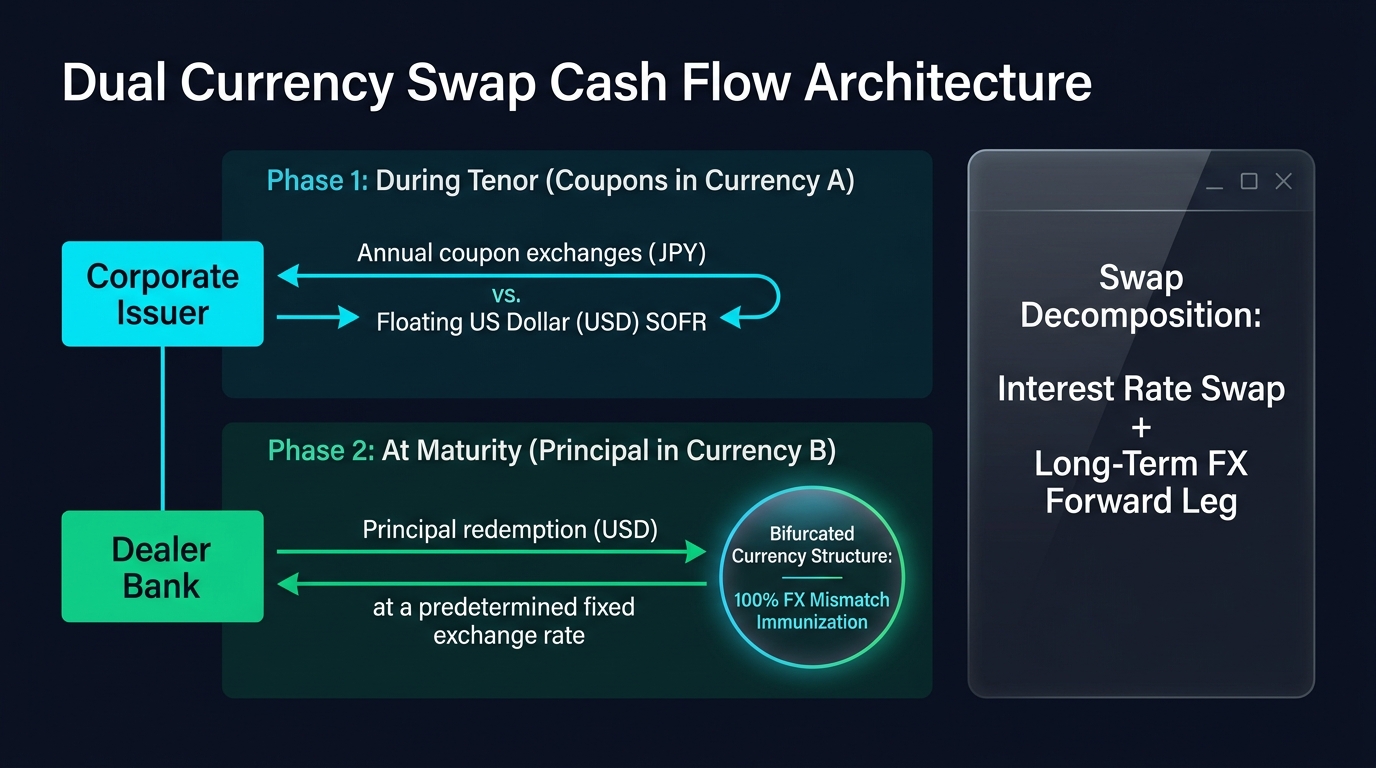
Dual Currency Swap Cash Flow Architecture:
DURING LIFE OF CONTRACT (Coupons):
┌──────────────────────────┐      Periodic Coupon Payments       ┌──────────────────────────┐
│ CORPORATE ISSUER         │ ──────────────────────────────────► │ DEALER BANK              │
│ (Pays Yen Coupons)       │ ◄────────────────────────────────── │ (Pays USD Floating SOFR) │
└──────────────────────────┘      Denominated in Currency A      └──────────────────────────┘

AT MATURITY (Principal Redemption):
┌──────────────────────────┐      Final Principal Redemption     ┌──────────────────────────┐
│ CORPORATE ISSUER         │ ──────────────────────────────────► │ DEALER BANK              │
│ (Pays USD Principal)     │ ◄────────────────────────────────── │ (Returns Target Capital) │
└──────────────────────────┘      Denominated in Currency B      └──────────────────────────┘
Key Takeaways
- Bifurcated Currency Structure: Interest coupons are paid in Currency A (e.g., Japanese Yen or Australian Dollars), while principal redemption is executed in Currency B (e.g., U.S. Dollars).
- Hedging Dual Currency Debt: The swap provides an exact mirror hedge for corporate borrowers who issue dual-currency retail debt abroad, immunizing the issuer from cross-border exchange rate volatility.
- Yield Arbitrage: Enables global borrowers to tap international pools of yield-hungry retail investors who seek high foreign-currency coupons while retaining capital repayment in their domestic legal tender.
- Embedded Forward Leg: Mathematically, a dual currency swap can be decomposed into an interest rate swap combined with a long-term forward exchange contract for the principal redemption.
The Mechanics of a Dual Currency Bond & Swap
To understand the swap, one must first examine the debt instrument it is designed to neutralize:
The Dual Currency Bond (e.g., Japanese “Uridashi” Issuance):
- Issuer: A U.S. corporate entity seeking to raise U.S. Dollars.
- Target Investors: Japanese retail savers facing near-zero domestic bank deposit rates.
- The Offering: The U.S. firm issues a 5-year bond in Tokyo:
- Investors buy the bond using Japanese Yen (JPY).
- The bond pays an attractive 5.00% annual coupon in U.S. Dollars (USD) or Australian Dollars (AUD).
- Upon maturity in Year 5, the bond repays the original principal in Japanese Yen (JPY) at a fixed, pre-set exchange rate.
The Issuer’s Currency Dilemma:
The U.S. company needs U.S. Dollars for its domestic operations, but it now faces liabilities in two separate currencies: paying periodic foreign coupons while owing a massive Yen principal redemption in five years.
The Dual Currency Swap Solution:
The issuer enters a simultaneous Dual Currency Swap with a global investment bank:
- The dealer bank takes the issuer’s Yen issuance proceeds and delivers U.S. Dollars immediately at spot.
- Over the 5 years, the dealer bank pays the issuer the exact coupon cash flows needed to satisfy the bondholders.
- At Year 5 maturity, the issuer pays the dealer bank U.S. Dollars, and the dealer delivers the exact Yen principal needed to redeem the maturing bonds.
- Result: The corporate issuer successfully converted a complex, multi-currency foreign retail bond into a simple, standard domestic U.S. Dollar debt obligation.
Cash Flow Decomposition Matrix
The operational mechanics of a 5-year dual currency swap between a Corporate Borrower and a Swap Dealer Bank are summarized below:
| Lifecycle Stage | Corporate Borrower Action | Swap Dealer Bank Action | Underlying Currency |
|---|---|---|---|
| Inception ($T_0$) | Delivers JPY bond issuance proceeds | Delivers equivalent USD principal at prevailing spot | JPY $\to$ USD Conversion |
| Years 1 through 5 (Annual Coupons) | Pays agreed floating USD benchmark (e.g., SOFR + Spread) | Delivers fixed coupon funds needed to pay bondholders | Currency A (USD or AUD) |
| Maturity ($T_5$) | Delivers USD principal repayment | Delivers contracted JPY principal to redeem bonds | Currency B (JPY) |
$$\text{Net Corporate Exposure} \equiv \text{Standard Domestic Floating-Rate USD Debt}$$
Real-World Case Study: Supranational Development Bank Financing
Supranational institutions like the World Bank (IBRD) frequently utilize dual currency swaps to lower funding costs for global humanitarian and infrastructure development:
Execution Parameters:
- Issuance: The World Bank issues a ¥50 Billion JPY Dual Currency Note in Japan.
- Coupon Structure: Annual coupon of 4.50% paid in Australian Dollars (AUD) to attract Japanese retail investors seeking commodity-currency yields.
- Redemption: 100% of the principal is redeemed in Japanese Yen (JPY) at Year 10.
- Swap Execution: The World Bank enters a dual currency swap with a Tokyo-based global investment bank.
- The Outcome: Through the swap, the World Bank eliminates all AUD and JPY exposure, converting the entire transaction into an ultra-low-cost, floating-rate U.S. Dollar liability at SOFR minus 25 basis points. The global bank manages the embedded forward foreign exchange risk across institutional derivatives markets.
Risk Factors: Counterparty and Basis Risk
While dual currency swaps eliminate market price risk for the debt issuer, they introduce specific institutional risks:
- Long-Term Counterparty Exposure: Because dual currency swaps extend across long maturities (5 to 15 years) and involve massive terminal principal exchanges, the credit risk of the dealer bank is substantial. Contracts mandate strict bilateral collateralization under an ISDA Credit Support Annex (CSA).
- Cross-Currency Basis Spread Shifts: The pricing of dual currency swaps fluctuates based on the cross-currency basis (the premium or discount demanded by banks to swap foreign currencies for U.S. Dollars in the interbank market). Shifts in the basis spread can widen or narrow the cost advantages of dual-currency issuance.
Frequently Asked Questions
What is the difference between a dual currency swap and a cross-currency swap?
In a standard cross-currency swap, all interest payments and principal repayments are denominated in the same two paired currencies throughout the trade. In a dual currency swap, the interest coupon currency is intentionally different from the principal redemption currency, matching the asymmetric cash flow profile of dual currency debt securities.
Why do investors purchase dual currency bonds?
Retail and institutional investors buy dual currency bonds to achieve higher coupon yields than those available on domestic sovereign debt while keeping their principal capital safely denominated in their home currency (or vice versa), matching long-term international liabilities.
What is a “Reverse Dual Currency Bond”?
In a standard dual currency bond, coupons are foreign and principal is domestic. In a Reverse Dual Currency Bond, the structure is inverted: the interest coupons are paid in the investor’s domestic currency, while the final principal redemption is paid in a foreign currency at a fixed exchange rate.
Ready to trade forex?
Open a free demo account with a regulated broker. Practice with virtual funds before risking real money.