Earnings Cap
An earnings cap is a statutory, contractual, or regulatory ceiling that establishes the maximum allowable amount of labor wages, executive compensation, or pension-creditable income that an individual or entity is permitted to earn or receive without incurring penalties, benefit clawbacks, or tax ceilings.
What Is an Earnings Cap?
In public finance, social insurance policy, and corporate compensation regulation, an earnings cap is a legally mandated, contractual, or statutory maximum threshold that limits the amount of income, wages, or commercial earnings that are subject to specific tax rates, benefit accruals, or regulatory clawbacks.
The term encompasses three primary institutional applications in economic governance:
- The Social Security Taxable Maximum (OASDI Wage Base): The federal statutory ceiling on annual wage income subject to the 6.20% Social Security payroll tax in the United States. Wage earnings above this statutory cap face a 0.0% Social Security tax rate.
- Retirement Earnings Test (RET) Caps: A statutory earnings ceiling imposed on early retirees collecting Social Security benefits prior to their Full Retirement Age (FRA). Earning wages above the limit triggers an immediate clawback of monthly retirement pension disbursements.
- Executive Compensation Tax Deduction Caps: Corporate tax rules—such as Section 162(m) of the US Internal Revenue Code—that cap the maximum corporate tax deduction for executive compensation at $1,000,000 per executive annually, penalizing excessive executive wage payouts.
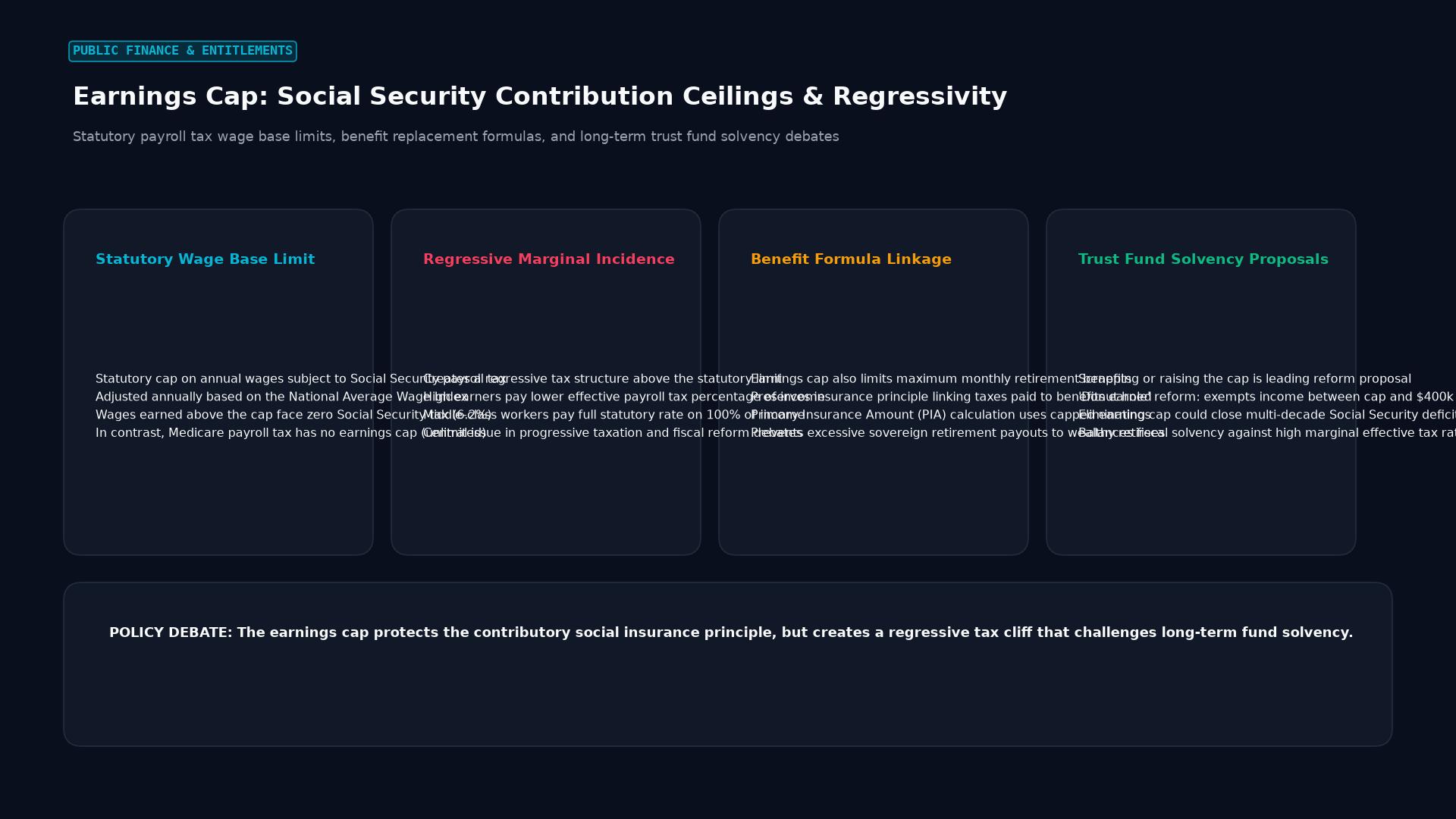 Figure: Statutory payroll tax wage base limits, benefit replacement formulas, and long-term trust fund solvency debates
Technical Mechanics & Social Security Benefit Formulas
The most prominent earnings cap in the global economy is the Social Security Contribution and Benefit Base, adjusted annually in the United States based on the National Average Wage Index (AWI):
1. The OASDI Tax Cap Mechanism
Let $Y$ represent a worker’s total annual gross earned wages, and $Y_{\text{cap}}$ represent the statutory taxable maximum ($168,600 in 2024):
$$\text{OASDI Tax Liability} = 0.062 \times \min\left( Y, Y_{\text{cap}} \right)$$
For every dollar earned beyond $Y_{\text{cap}}$ ($Y > Y_{\text{cap}}$), the marginal Social Security payroll tax rate drops to 0.0%, creating a regressive payroll tax structure for high earners. (In contrast, the Medicare tax of 1.45% carries zero earnings cap, applying infinitely to all wage earnings).
2. The Retirement Earnings Test (RET) Clawback Formula
If a citizen claims Social Security retirement benefits early (e.g., at age 62) while continuing to work, the government applies the Retirement Earnings Test:
$$\text{Annual Benefit Clawback} = \frac{\max\left( 0, Y_{\text{earned}} - \text{RET Threshold} \right)}{2}$$
For every $2.00 earned above the annual statutory exempt amount, $1.00 in Social Security monthly pension benefits is withheld and clawed back by the federal government.
Comparative Matrix: Macroeconomic Earnings Caps
| Policy Metric | Statutory Purpose | Impact on High Earners | Economic Elasticity Impact |
|---|---|---|---|
| Social Security Wage Cap | Limits max benefit liabilities | Exempts income above cap from 6.2% tax | May disincentivize wage structuring |
| Retirement Earnings Test (RET) | Discourages early benefit collection | Withholds $1 of pension for every $2 earned | Substantial labor supply reduction for seniors |
| IRC §162(m) Executive Cap | Curbs excessive corporate pay | Disallows corporate tax deductions >$1M | Shifts compensation into performance equity |
| Windfall Profits Tax Cap | Taxes excess commodity profits | Confiscates corporate revenues above price cap | Chokes off energy exploration investment |
Real-World Case Study: The Debate Over “Scrapping the Cap” (2020–Present)
The macroeconomic debate surrounding the Social Security earnings cap has become a central fiscal battleground in the United States Congress.
Anatomy of an Entitlement Funding Crisis:
1. The Problem: The Social Security Board of Trustees projected that the Old-Age and Survivors Insurance (OASI) Trust Fund would deplete its financial reserves by the mid-2030s, triggering an automatic 20% to 23% across-the-board benefit cut for all American retirees.
2. The Policy Proposal ("Scrap the Cap"): Congressional proposals (such as the Social Security Expansion Act) advocated applying the 6.20% payroll tax to all earned income exceeding $250,000 or $400,000 (creating a "donut hole").
3. The Actuarial Finding: The Social Security Chief Actuary calculated that eliminating the taxable maximum earnings cap entirely would generate hundreds of billions in annual tax receipts, ensuring total trust fund solvency for over 75 years without cutting a single retiree's benefits.
4. The Economic Counter-Argument: Business economists warned that eliminating the cap would push the top marginal income tax rate in states like California and New York above 55%, discouraging executive labor supply and accelerating capital flight into non-wage business distributions.
Frequently Asked Questions (FAQ)
What happens to Social Security payroll deductions once an employee reaches the annual cap?
Once an employee’s cumulative gross wages for the calendar year cross the statutory Social Security earnings cap, the corporate payroll software automatically shuts off the 6.20% Social Security tax deduction for the remainder of that year. The employee receives a noticeable bump in their take-home paycheck starting from that pay period until December 31. On January 1 of the following year, the deduction resets to 6.20% on all wages until the cap is reached again.
Does the Medicare payroll tax have an earnings cap?
No. Prior to 1994, the Medicare hospital insurance (HI) tax was subject to a statutory earnings cap similar to Social Security. However, the Omnibus Budget Reconciliation Act of 1993 repealed the cap entirely. Today, the 1.45% employee Medicare tax (and 1.45% employer match) applies to 100% of all earned wages without limit. Furthermore, wages exceeding $200,000 for single filers face an additional 0.90% Medicare surtax.
What is the “donut hole” in proposals to reform the Social Security earnings cap?
In tax policy reform proposals, a “donut hole” refers to a proposal that retains the existing lower earnings cap (e.g., $168,600), leaves income between the cap and a higher threshold (such as $400,000) untaxed, and then re-imposes the 6.20% Social Security payroll tax on all earnings exceeding $400,000. This structure is designed to shield upper-middle-class professionals from tax hikes while targeting ultra-high earners.
Ready to trade forex?
Open a free demo account with a regulated broker. Practice with virtual funds before risking real money.