Earned Benefit
An earned benefit is an accrued, legally vested right to compensation, pension income, or fringe benefits acquired by an employee through completed service and tenure under statutory labor laws or contractual corporate plans.
What Is an Earned Benefit?
An earned benefit is a legally enforceable right to future financial compensation, health coverage, or retirement annuity disbursements acquired by an employee or citizen through the completion of required employment service, tenure, or statutory payroll tax contributions.
Unlike discretionary fringe perks or conditional management bonuses (which an employer can reduce or eliminate at will), an earned benefit represents an accrued, vested entitlement. In Anglo-American labor and corporate law, earned benefits are protected by federal statutes—most prominently the Employee Retirement Income Security Act of 1974 (ERISA) in the United States.
Once an employee completes the contractual vesting schedule, the earned benefit becomes non-forfeitable property: the employer cannot revoke, diminish, or retroactively cancel the accrued value, even if the worker resigns, is terminated, or the employing corporation files for bankruptcy reorganization.
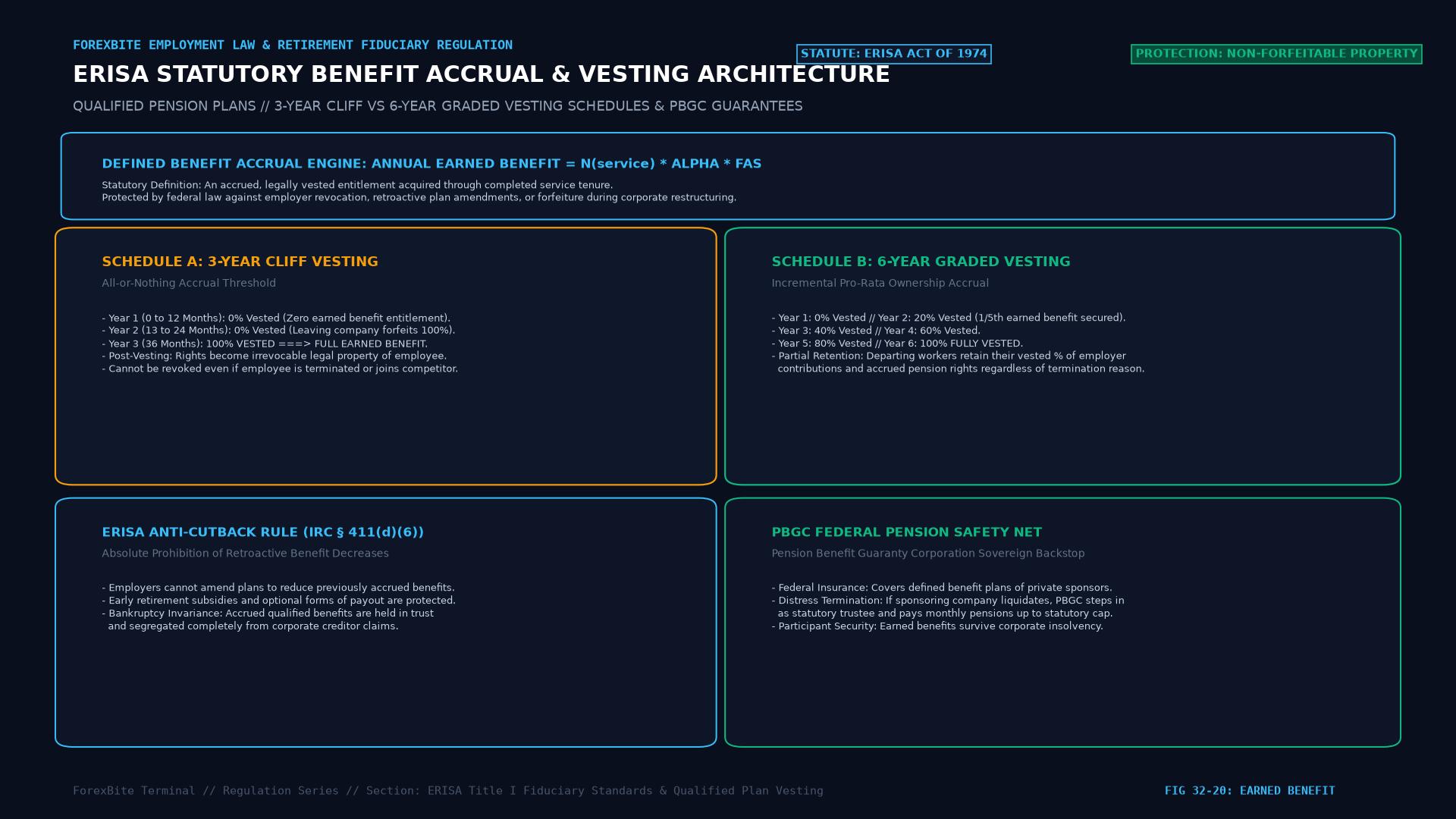 Figure: The statutory ERISA benefit vesting framework comparing 3-year cliff vs 6-year graded vesting schedules, protected by the anti-cutback rule and PBGC insurance backstop.
Technical Mechanics & Actuarial Pension Formulations
In traditional Defined Benefit (DB) pension plans, the monthly earned benefit annuity is calculated using an actuarial formula based on service tenure and compensation history:
Defined Benefit Pension Accrual Formula
$$\text{Annual Earned Benefit} = N_{\text{service}} \times \alpha \times \text{Final Average Salary (FAS)}$$
Where:
- $N_{\text{service}}$: Total credited years of continuous service completed by the employee.
- $\alpha$: Benefit accrual multiplier (typically $1.5%$ to $2.0%$ per year of service).
- $\text{FAS}$: The average annual gross compensation over the employee’s highest three or five consecutive earning years.
If an industrial worker completes 30 years of credited service under a 1.75% accrual formula with a final average salary of $90,000:
$$\text{Annual Earned Benefit} = 30 \times 0.0175 \times $90,000 = $47,250 \text{ per year}$$
Social Security as an Earned Benefit
Under the US Social Security system, retirement benefits are legally structured as earned entitlements funded through mandatory FICA payroll taxes. A worker must accumulate a minimum of 40 Social Security credits (representing roughly 10 years of taxable employment) to achieve fully insured status and earn the right to the Primary Insurance Amount (PIA) upon reaching retirement age.
Comparative Matrix: Corporate Compensation Tiers
| Benefit Category | Legal Nature | Vested Status | Employer Cancellation Rights | Insolvency Protection |
|---|---|---|---|---|
| Earned Benefit (Pension/401k) | Contractual / Statutory | 100% Vested | Legally Prohibited | Protected by PBGC / ERISA trust |
| Unvested Benefit | Contingent expectation | Unvested (0% to 80%) | Forfeited upon job departure | Lost upon bankruptcy |
| Discretionary Bonus | Voluntary incentive | Zero vesting | Discretionary; can be cancelled | Unsecured general claim |
| Stock Option Grant | Equity derivative right | Vests over 4 years | Cancelled if unexercised upon exit | Lost if firm enters insolvency |
Real-World Case Study: The Legacy Airline Pension Terminations (2004–2005)
The vulnerability of earned corporate pension benefits during catastrophic industry crises was illustrated during the bankruptcies of United Airlines and Delta Air Lines.
Anatomy of an Earned Benefit Insolvency:
1. The Crisis: The post-9/11 downturn combined with soaring fuel prices pushed legacy airlines into Chapter 11 bankruptcy with multi-billion-dollar pension deficits.
2. The Action: In 2004-2005, United and Delta petitioned federal bankruptcy courts to terminate their defined-benefit pension plans, shedding over $15 billion in unfunded earned benefit liabilities.
3. The PBGC Rescue: The federal Pension Benefit Guaranty Corporation (PBGC)—the statutory insurer of private defined-benefit plans—took over the pension obligations.
4. The Benefit Haircut: While rank-and-file workers receiving modest pensions retained 100% of their earned benefits, senior commercial airline pilots who had earned pensions exceeding $100,000 annually were subject to statutory PBGC maximum insurance caps (roughly $45,000 annually), suffering severe lifetime pension reductions.
The crisis accelerated the nationwide corporate transition away from defined-benefit pensions toward defined-contribution 401(k) accounts.
Frequently Asked Questions (FAQ)
What is the legal difference between an earned benefit and a discretionary perk?
An earned benefit is a legally binding obligation protected by contract and federal labor statutes (such as ERISA). Once an employee completes the required service or vesting milestones, the employer cannot eliminate or reduce the accrued value. A discretionary perk (such as annual holiday bonuses, commuter subsidies, or remote work allowances) is provided voluntarily at the employer’s discretion and can be modified, paused, or cancelled at any time without legal liability.
Can an employer retroactively reduce a worker’s earned pension benefits?
Under the Anti-Cutback Rule of ERISA Section 204(g) and Section 411(d)(6) of the Internal Revenue Code, an employer is strictly prohibited from amending a pension plan in any manner that retroactively reduces or eliminates benefits that participants have already earned and accrued through past service. An employer can freeze future accruals moving forward, but all past earned benefits remain legally inviolable.
What is the Pension Benefit Guaranty Corporation (PBGC)?
The Pension Benefit Guaranty Corporation (PBGC) is an independent agency of the United States federal government created under Title IV of ERISA in 1974. The PBGC functions as a safety-net insurer for private-sector defined-benefit pension plans. If a sponsoring corporation goes bankrupt and its pension fund is underfunded, the PBGC steps in, takes over the pension assets, and continues paying monthly earned benefits to retirees up to statutory maximum insurance limits.
Ready to trade forex?
Open a free demo account with a regulated broker. Practice with virtual funds before risking real money.