Wage Price Index (WPI)
The Wage Price Index (WPI) is a macroeconomic indicator that measures the pure rate of change in the price of labor services over time, holding the quality and quantity of work constant.
What Is the Wage Price Index (WPI)?
The Wage Price Index (WPI) is a principal macroeconomic metric designed to measure changes in the hourly price of labor services independently of shifts in the quality or quantity of work performed.
Unlike simpler labor metrics such as Average Weekly Earnings (which fluctuate when employees work overtime or when high-paying sectors expand), the WPI functions like a Consumer Price Index (CPI) for labor. It tracks a fixed basket of job roles over time, insulating the measurement from changes in occupational composition, employee turnover, hours worked, and employee performance upgrades.
Central banks and economic forecasters monitor the WPI closely to assess labor cost pressures, gauge the risk of wage-price spirals, and calibrate monetary policy.
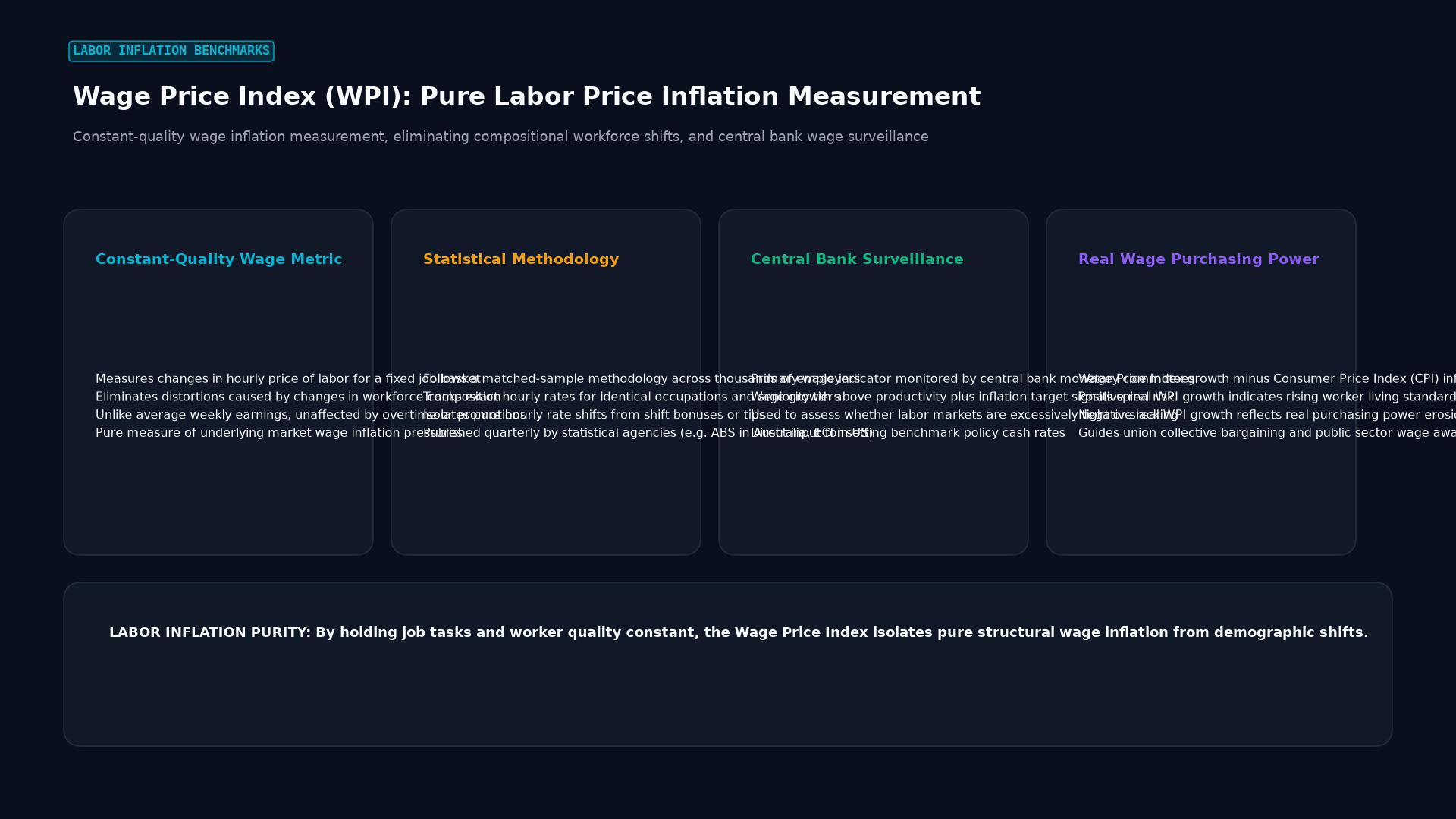 Figure: Constant-quality wage inflation measurement, eliminating compositional workforce shifts, and central bank wage surveillance
Mathematical Formulation: The Fixed-Basket Laspeyres Index
Statistical agencies (such as the Australian Bureau of Statistics or the US Bureau of Labor Statistics) construct the Wage Price Index using a chained Laspeyres index methodology:
$$WPI_t = \frac{\sum_{i=1}^{n} W_{i,t} \cdot Q_{i,0}}{\sum_{i=1}^{n} W_{i,0} \cdot Q_{i,0}} \times 100$$
Where:
- $W_{i,t}$: Hourly wage rate paid for specific job specification $i$ in current evaluation period $t$.
- $W_{i,0}$: Hourly wage rate paid for job specification $i$ in base period $0$.
- $Q_{i,0}$: Labor weighting (total hours worked or total employment share) assigned to job specification $i$ in the benchmark base period.
- $n$: Total number of sampled occupational positions within the national economy.
Key Methodological Adjustments
- Holding Quality Constant: If a worker receives a pay raise associated with a promotion or superior seniority, the increase is excluded from the pure index calculation because the quality of output has changed.
- Severance of Bonus Volatility: Ordinary WPI series isolate base hourly rates, excluding lump-sum performance bonuses, stock options, and unbundled overtime premiums.
Comparative Analysis of Labor Cost Indicators
| Indicator | Primary Focus | Compositional Bias Risk | Excludes Bonus & Overtime | Primary Policy Use |
|---|---|---|---|---|
| Wage Price Index (WPI) | Pure price of labor per unit of time | Zero / Minimal (Fixed job basket) | Yes (in core sub-indices) | Early detection of wage-push inflation |
| Average Hourly Earnings (AHE) | Cash earnings divided by total hours | High (Distorted by layoffs of low-wage workers) | No | Timely monthly labor market snapshot |
| Employment Cost Index (ECI) | Total employer cost (wages + benefits) | Low (Fixed occupational weights) | No (captures total non-wage compensation) | Primary metric utilized by the US Federal Reserve |
| Unit Labor Costs (ULC) | Labor cost per unit of real output | Moderate (Inversely tied to productivity) | No | Long-term sovereign competitiveness assessment |
Real-World Case Study: The Reserve Bank of Australia (RBA) Tightening Cycle (2022–2023)
Following the pandemic reopening, the Reserve Bank of Australia (RBA) identified the Australian Wage Price Index as the decisive guidepost for setting the sovereign Cash Rate.
Australian WPI vs. RBA Cash Rate (2021-2023):
- Q2 2021: WPI grew at an annualized rate of 1.7% (Cash Rate: 0.10%).
- Q4 2022: National unemployment fell to 3.5%; WPI surged to 3.3% YoY.
- Q3 2023: WPI reached 4.2% YoY (fastest wage growth in 14 years).
- Policy Response: RBA executed consecutive rate hikes, elevating the Official Cash Rate to 4.35%.
The RBA publicly stated that while a 3.5% WPI was consistent with its 2% to 3% medium-term inflation target (assuming labor productivity grew at 1.0%), wage growth climbing above 4.0% without matching productivity gains risked embedding second-round inflation expectations. The hawkish interest rate response sparked a sustained multi-month rally in the Australian Dollar (AUD) against the Japanese Yen and Euro.
Frequently Asked Questions (FAQ)
Why do central banks prefer the WPI or ECI over Average Hourly Earnings?
Average Hourly Earnings (AHE) suffer from severe compositional distortions during economic shocks. For example, during the onset of the 2020 pandemic, US AHE spiked dramatically, not because workers received raises, but because millions of lower-wage hospitality and service workers were laid off, leaving higher-paid professional workers in the statistical sample. The Wage Price Index eliminates this compositional bias by evaluating the exact same job specifications across consecutive quarters.
How does a higher-than-expected WPI release affect currency markets?
In foreign exchange trading, an upside surprise in the Wage Price Index typically triggers an immediate appreciation of the domestic currency. Above-trend wage growth signals persistent domestic inflation pressures, compelling the central bank to maintain higher policy rates for longer. This expands the yield advantage (carry) of the currency, attracting global capital inflows.
Can wages increase rapidly without generating consumer price inflation?
Yes, provided that wage growth is fully matched by labor productivity gains. If workers produce 4% more real goods and services per hour while their nominal wages increase by 4%, the employer’s labor cost per unit of output remains unchanged. Under these conditions, real wages expand, living standards rise, and corporate profit margins are maintained without forcing businesses to raise retail prices.
Ready to trade forex?
Open a free demo account with a regulated broker. Practice with virtual funds before risking real money.