Earned Income
Earned income is all taxable compensation received by an individual directly from active employment or self-employment, including wages, salaries, tips, bonuses, and professional commissions, distinguished from passive unearned investment income.
What Is Earned Income?
In economics, tax accounting, and public policy, earned income represents all financial compensation and gross revenues received by an individual in direct exchange for their active physical or mental labor, services rendered, or personal business operations.
Under national tax codes—including the United States Internal Revenue Code (IRC §32)—earned income is distinguished from unearned income (passive income derived from capital investments, dividends, bond coupon interest, royalties, and capital gains).
Earned income serves as the fundamental economic base upon which national social insurance programs (such as Social Security and Medicare in the United States, or National Insurance in the United Kingdom) are funded via mandatory payroll withholding taxes. Furthermore, eligibility for key government anti-poverty tax credits, as well as the legal right to contribute to personal retirement vehicles (such as Traditional and Roth IRAs), is strictly conditioned on having qualifying earned income.
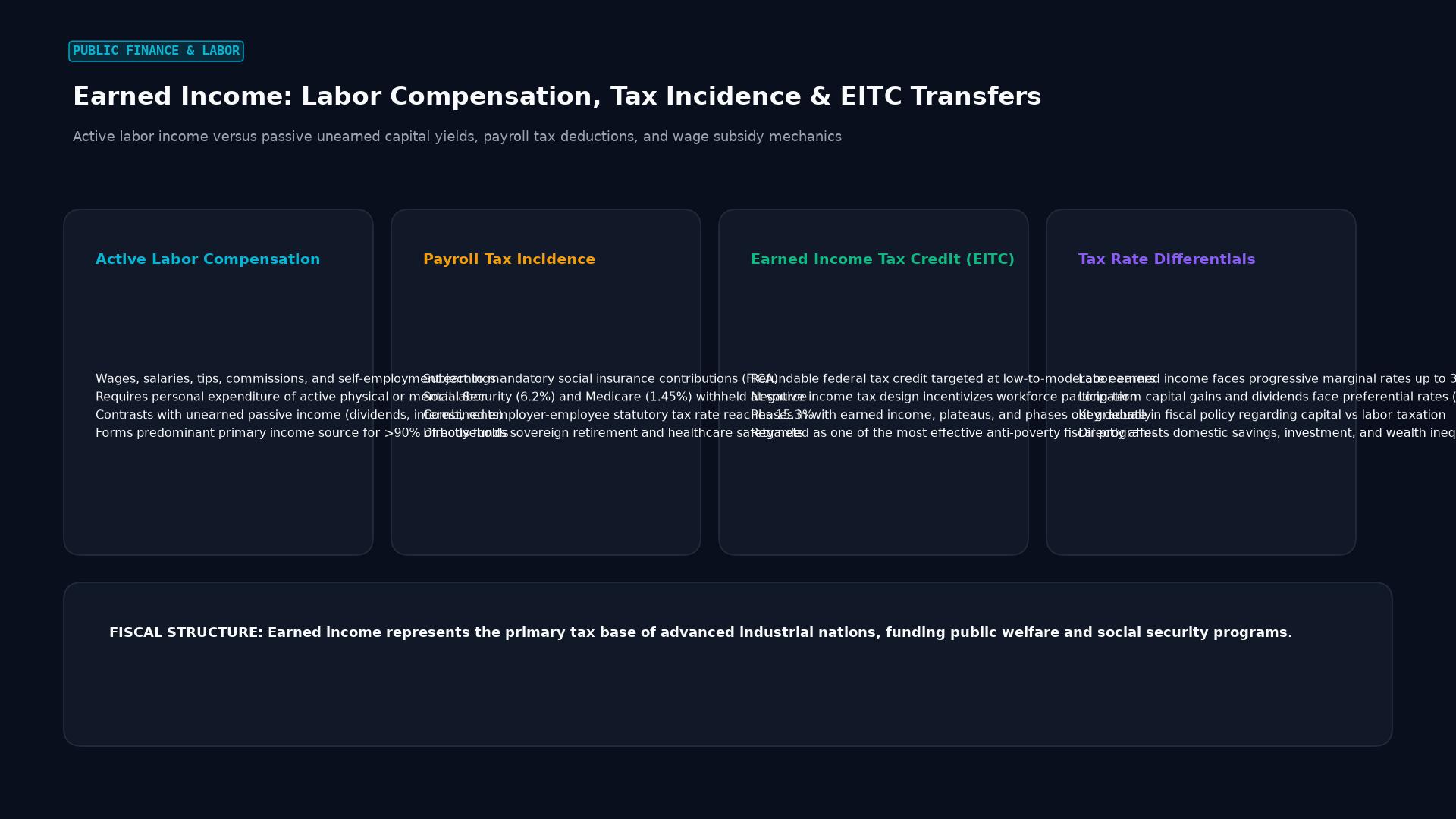 Figure: Active labor income versus passive unearned capital yields, payroll tax deductions, and wage subsidy mechanics
Technical Mechanics & Payroll Tax Modeling
Unlike unearned capital gains, earned income is subject to mandatory, non-negotiable social insurance taxes assessed at both the employee and employer tiers:
1. The FICA Tax Formulation (W-2 Employees)
Under the Federal Insurance Contributions Act (FICA), earned income is taxed at a combined statutory rate of 15.30%, split equally between employer and worker:
$$\text{Employee Withholding} = 6.20% \text{ Social Security (OASDI)} + 1.45% \text{ Medicare (HI)}$$
$$\text{Employer Match} = 6.20% \text{ Social Security} + 1.45% \text{ Medicare}$$
- The Social Security Wage Cap: The 6.20% Social Security tax applies strictly up to an annual statutory wage ceiling (indexed annually for inflation).
- The Additional Medicare Tax: Under the Affordable Care Act, high earners pay an additional 0.90% Medicare surtax on earned income exceeding statutory thresholds ($200,000 for single filers, $250,000 for married couples), which is not matched by the employer.
2. Self-Employment Tax (SECA)
Independent contractors, sole proprietors, and partners pay the full 15.30% under the Self-Employment Contributions Act (SECA) on net self-employment earnings, receiving an above-the-line federal income tax deduction for the 50% employer-equivalent share:
$$\text{SE Tax Base} = \text{Net Schedule C Earnings} \times 0.9235$$
$$\text{SECA Liability} = \text{SE Tax Base} \times 15.30%$$
Comparative Matrix: Income Typologies
| Dimension | Earned Income | Unearned (Portfolio) Income | Passive Business Income |
|---|---|---|---|
| Origin | Active personal labor, wages, tips | Capital gains, stock dividends, interest | Real estate rentals, silent partnerships |
| Subject to FICA / SECA? | Yes (15.30% payroll tax) | No (Zero payroll tax) | No (Zero payroll tax) |
| Subject to Net Investment Tax? | No | Yes (3.80% NIIT for high earners) | Yes (Subject to 3.80% NIIT) |
| Qualifies for IRA Contributions? | Yes (Mandatory requirement) | No (Cannot fund an IRA) | No |
| Eligible for EITC? | Yes (Primary benchmark) | No | No |
Real-World Case Study: The “Gig Economy” Classification Battles (California AB 5)
The structural boundary between independent contractor 1099 income and W-2 earned wages was exposed during the rise of ride-sharing and delivery platforms (such as Uber, Lyft, and DoorDash).
The Economic Battle Over Earned Income Classification:
1. The Platform Model: Gig economy giants treated millions of drivers as independent contractors (issuing 1099-NEC forms), bypassing employer FICA payroll taxes (saving 7.65% in corporate overhead) and avoiding statutory workers' compensation.
2. The Legislation (California AB 5): In 2019, California passed Assembly Bill 5, establishing the strict "ABC Test" to force gig companies to reclassify drivers as formal employees.
3. The Economic Stakes: Reclassification would have shifted billions of dollars from self-employed SECA revenue into traditional employer-matched W-2 payroll withholding taxes, while mandating minimum wage and overtime guarantees.
4. The Resolution (Proposition 22): The platforms spent over $200 million funding a historic 2020 ballot initiative (Prop 22), successfully exempting app-based drivers from AB 5 while creating a hybrid compensation structure.
Frequently Asked Questions (FAQ)
Why is earned income required to contribute to an IRA?
Congress created Traditional and Individual Retirement Accounts (IRAs) specifically to encourage active workers to save a portion of their labor compensation for retirement. Under IRS rules, an individual’s annual contribution to an IRA cannot exceed their total taxable earned income for that year. If an investor lives entirely on $100,000 in stock dividends and bond interest (unearned income) and has zero earned wages, they are legally prohibited from contributing to an IRA.
Does disability income or unemployment compensation count as earned income?
Generally, no. State unemployment compensation, workers’ compensation payouts, long-term disability insurance disbursements, social security payments, and military retirement pensions are categorized by the IRS as unearned income. They are not subject to FICA payroll taxes and cannot be used to claim the Earned Income Tax Credit (EITC) or fund retirement accounts.
How does the IRS verify reported earned income?
The IRS verifies earned income through automated computer cross-matching systems (the Information Returns Processing system). Employers and corporate clients are legally mandated to submit copies of employee Form W-2s and contractor Form 1099-NECs directly to the IRS and Social Security Administration. If an individual’s filed tax return fails to match the reported third-party employer data, the IRS’s automated underwriting system automatically issues a formal CP2000 under-reporting audit notice.
Ready to trade forex?
Open a free demo account with a regulated broker. Practice with virtual funds before risking real money.