Euro Interbank Offered Rate (Euribor)
Euribor is a reference interest rate published by the European Money Markets Institute (EMMI) reflecting the average interest rate at which prime Eurozone banks lend unsecured wholesale funds to each other across maturities from one week to twelve months.
What Is the Euro Interbank Offered Rate (Euribor)?
The Euro Interbank Offered Rate (Euribor) is the primary interest rate benchmark for the European wholesale and retail financial system. Administered and calculated daily by the European Money Markets Institute (EMMI) in Brussels, Euribor represents the average interest rate at which a representative panel of prime commercial banks in the European Union lend unsecured funds to one another in the wholesale money market.
Euribor serves as the reference index for trillions of euros in financial products, including interest rate swaps (IRS), forward rate agreements (FRAs), syndicated corporate credit facilities, residential floating-rate mortgages across southern and western Europe, and cross-currency forward swap curves against the U.S. Dollar.
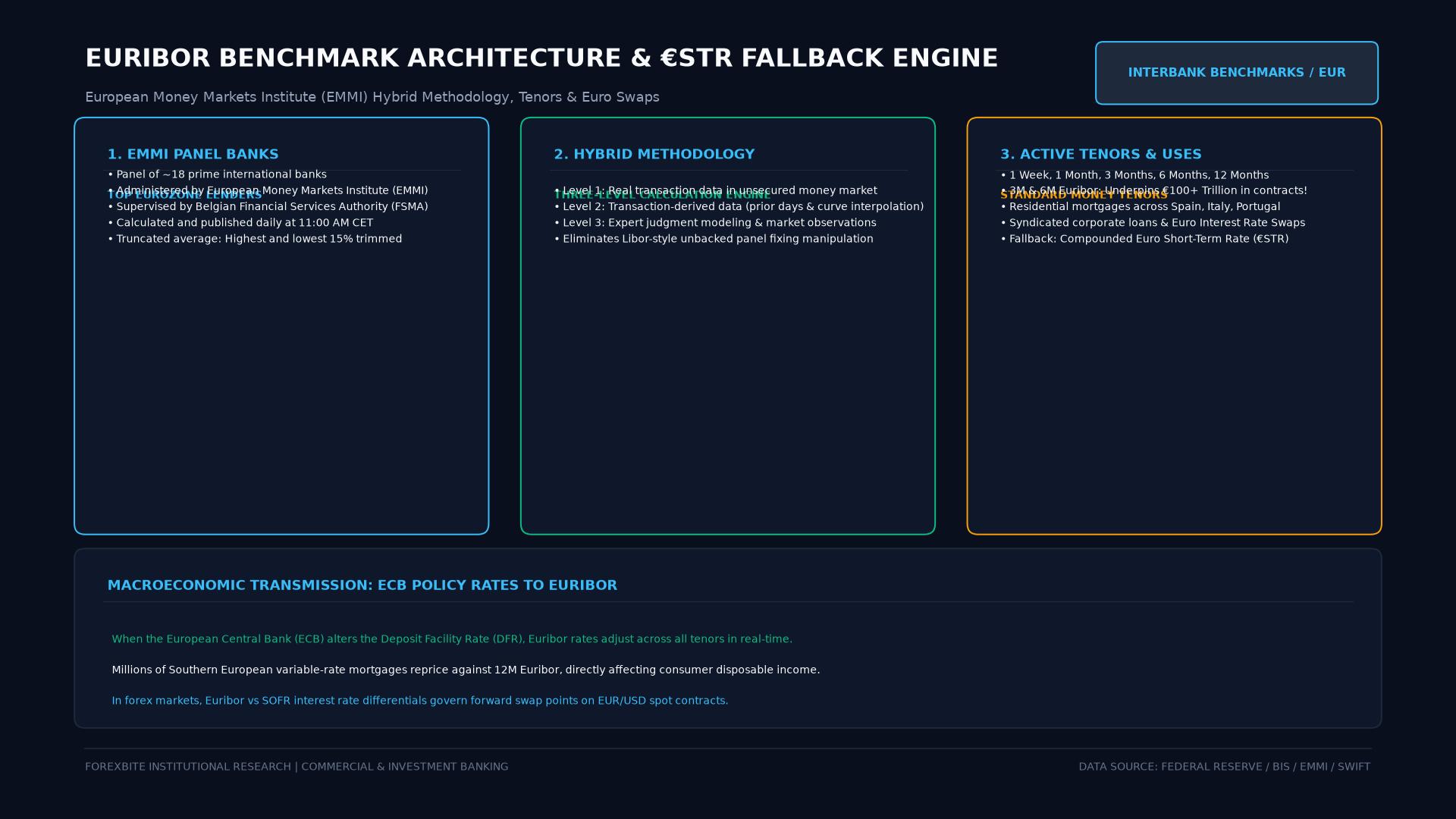 Figure: European Money Markets Institute (EMMI) hybrid calculation methodology: panel bank unsecured money market transactions and tenor fixings.
Key Takeaways
- Five Active Tenors: Euribor is calculated and published daily at 11:00 AM Central European Time (CET) for five distinct maturities: 1 week, 1 month, 3 months, 6 months, and 12 months.
- The Hybrid Methodology: Following global regulatory benchmark reforms (EU Benchmark Regulation - BMR), Euribor transitioned from subjective dealer quotes to a robust hybrid calculation methodology rooted primarily in real, verifiable money-market transactions.
- Retail & Derivative Anchor: The 3-month and 6-month Euribor rates serve as the standard reference benchmark for European commercial debt, interest rate futures, and retail floating-rate mortgages (particularly in Spain, Italy, and Portugal).
- Euribor vs. €STR: While Euribor represents forward-looking term rates (1 to 12 months) among private banks, the Euro Short-Term Rate (€STR) is an overnight risk-free rate calculated directly by the European Central Bank based on overnight unsecured interbank deposits.
Benchmark Tenors and Financial Uses
| Tenor | Primary Market Application | Typical Volatility & Sensitivity |
|---|---|---|
| 1-Week Euribor | Ultra-short liquidity adjustments, liquidity facilities | Highly sensitive to daily ECB open market operations |
| 1-Month Euribor | Commercial paper, short-term corporate liquidity | Reflects ECB meeting expectations within the current cycle |
| 3-Month Euribor | The flagship benchmark for Euro interest rate futures (Euronext) and commercial loans | Bridges short-term policy rates with medium-term liquidity expectations |
| 6-Month Euribor | Syndicated corporate credit, export trade finance | Widely used benchmark for consumer floating-rate home loans |
| 12-Month Euribor | Retail residential mortgages (Spain, Portugal), fixed-income derivatives | Reflects expected average ECB policy rate trajectory over the coming year |
Euribor vs. €STR vs. Historical LIBOR
With the global phase-out of the London Interbank Offered Rate (LIBOR), Euribor underwent fundamental restructuring rather than discontinuation:
| Dimension | Euribor | €STR (Euro Short-Term Rate) | Legacy Euro LIBOR (Retired) |
|---|---|---|---|
| Administrator | European Money Markets Institute (EMMI) | European Central Bank (ECB) | ICE Benchmark Administration (IBA) |
| Maturity Profile | Term rates: 1W, 1M, 3M, 6M, 12M | Overnight only (T+1 publication) | Historical term rates (Discontinued) |
| Market Nature | Unsecured wholesale term lending | Unsecured overnight borrowing deposits | London-centric interbank lending |
| Credit Risk Component | Reflects interbank term credit risk + liquidity premium | Near risk-free overnight rate | High bank credit risk component |
| Calculation Basis | Hybrid (Real trades + derived linear interpolation) | 100% empirical transaction data | Subjective dealer survey quotes |
How Euribor Influences Foreign Exchange Markets
In foreign exchange trading, Euribor is a critical variable governing the pricing of EUR/USD forward contracts and currency swap points:
- Covered Interest Rate Parity (CIP): Under CIP, forward exchange rates are calculated using the interest rate differential between two currencies. When 3-month Euribor rises relative to 3-month U.S. SOFR, the forward discount on the Euro expands, lowering the forward points: $$F = S \times \frac{1 + r_{\text{EUR}} \times (t/360)}{1 + r_{\text{USD}} \times (t/360)}$$
- Cross-Currency Basis Spreads: Large divergences between Euribor and other benchmark rates signal systemic funding stress or liquidity hoarding in European banks, impacting spot EUR/USD exchange rate volatility.
Frequently Asked Questions
Can Euribor rates be negative?
Yes. During the European Central Bank’s prolonged era of negative deposit facility rates (2014–2022), all Euribor tenors traded significantly below 0.00%, with the 3-month Euribor reaching historical lows below -0.55%. In European mortgage contracts, lenders introduced contractual “zero floors” to prevent banks from having to pay interest to borrowers.
What is the Euribor panel?
The Euribor panel consists of roughly 20 leading European and international commercial banks with premier credit ratings and active market-making operations in the Eurozone money market (e.g., BNP Paribas, Deutsche Bank, ING Bank, Santander, Société Générale).
What caused the Euribor manipulation scandal?
Prior to 2013, Euribor was based entirely on subjective survey estimates submitted by bank traders (“What rate would you be offered?”). Traders at several global banks colluded to submit artificial quotes to profit from their open interest rate derivatives positions. This led to massive regulatory fines and the mandatory creation of the current transaction-based Hybrid Methodology under EU regulation.
Ready to trade forex?
Open a free demo account with a regulated broker. Practice with virtual funds before risking real money.