Forward Rate Agreement (FRA)
A Forward Rate Agreement (FRA) is an Over-the-Counter derivative contract between two parties that determines an interest rate to be paid or received on a future value date for an agreed notional principal, settling in net cash at the start of the loan period.
What Is a Forward Rate Agreement (FRA)?
A Forward Rate Agreement (FRA) is an Over-the-Counter (OTC) interest rate derivative contract between two counterparties designed to lock in an interest rate for a future borrowing or lending period. An FRA allows corporate treasurers, banks, and institutional asset managers to hedge against adverse fluctuations in benchmark interest rates—such as the Secured Overnight Financing Rate (SOFR) or the Euro Interbank Offered Rate (Euribor)—without committing to an actual loan or exchanging physical principal capital.
Unlike a standard forward loan where principal cash is physically disbursed and repaid, an FRA is purely cash-settled. On the settlement date, only the net financial difference between the contracted fixed FRA rate and the prevailing market reference interest rate is transferred between the buyer and the seller.
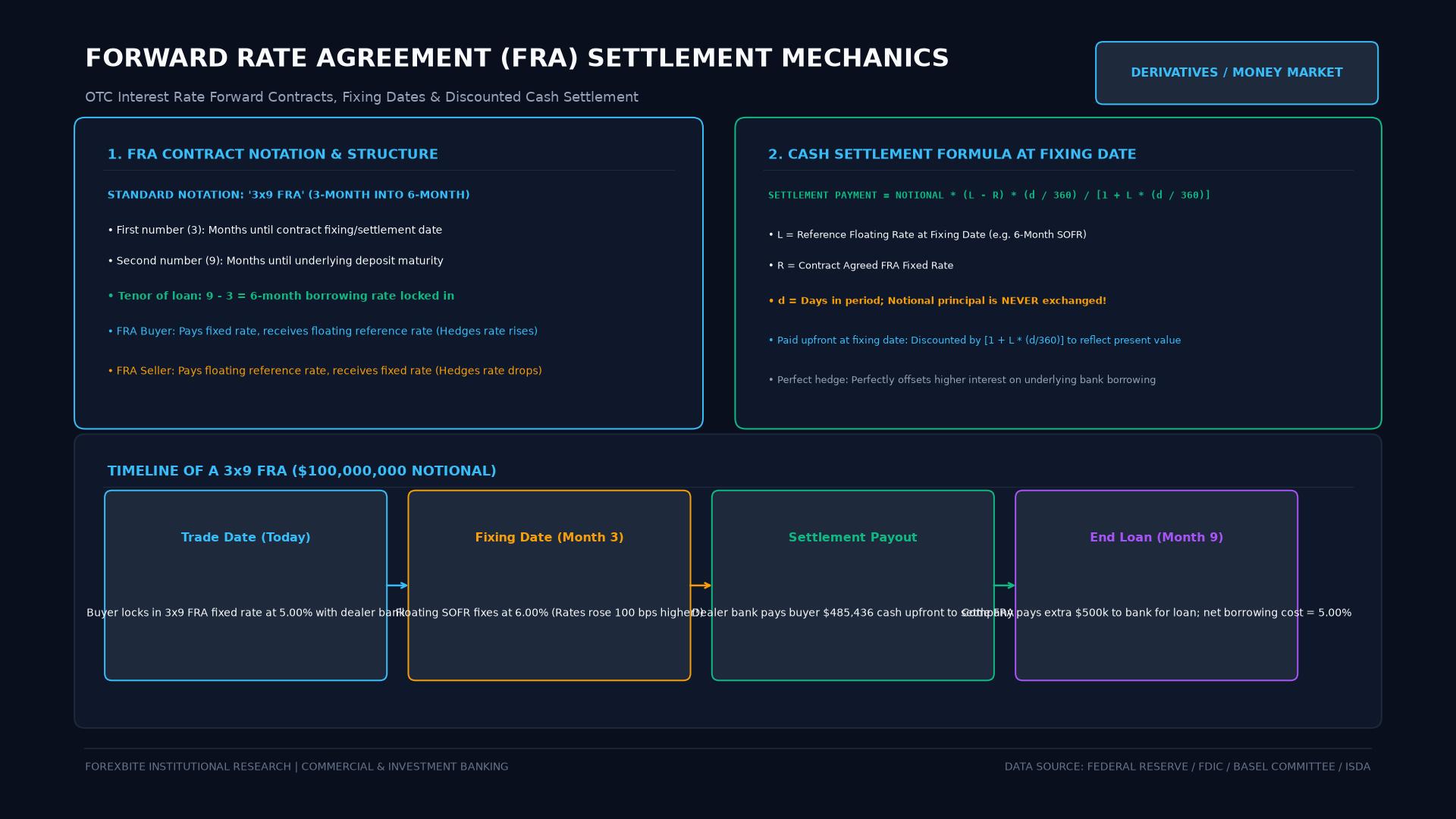 Figure: OTC interest rate derivative settlement: discounted cash payout formula based on the interest differential between the agreed FRA rate and the fixing rate at reset.
Key Takeaways
- Standard Market Notation: FRAs use the notation $A \times B$, where $A$ represents the number of months until the settlement date, and $B$ represents the total number of months until the end of the hypothetical loan period (e.g., a $3 \times 6$ FRA covers a 3-month loan starting 3 months from today).
- Advance Cash Settlement: Uniquely, FRAs settle at the beginning of the forward interest period, requiring the settlement payout to be discounted back to present value using the prevailing floating interest rate.
- Pure Off-Balance-Sheet Hedging: Because notional principal is never borrowed or exchanged, an FRA does not expand a corporation’s balance sheet leverage or impact debt-to-equity ratios.
- Buyer vs. Seller Obligations: The FRA Buyer pays the fixed rate and receives floating (hedging against rising rates); the FRA Seller pays floating and receives fixed (hedging against falling yields).
Mathematical Mechanics: The FRA Settlement Formula
Because the settlement payment occurs on the settlement date (at the start of the loan period) rather than at maturity (when loan interest would normally be paid), the payment is discounted to present value:
$$\text{Settlement Payout} = \frac{(R_{\text{Reference}} - R_{\text{Fixed}}) \times L \times \left(\frac{d}{\text{Basis}}\right)}{1 + \left[ R_{\text{Reference}} \times \left(\frac{d}{\text{Basis}}\right) \right]}$$
Where:
- $R_{\text{Reference}}$ is the actual floating market benchmark rate on the fixing date.
- $R_{\text{Fixed}}$ is the contracted fixed FRA rate agreed on trade date.
- $L$ is the notional contract principal.
- $d$ is the actual number of days in the forward borrowing period.
- $\text{Basis}$ is the annual money market day count convention (360 days for USD/EUR, 365 days for GBP).
Numerical Example: Corporate $3 \times 6$ FRA Hedge
A corporate treasurer knows the firm must issue $20,000,000 in commercial paper in 3 months for a 90-day period. To lock in borrowing costs, the treasurer buys a $3 \times 6$ FRA at 4.00%:
- Notional Principal ($L$): $20,000,000
- Contracted Fixed Rate ($R_{\text{Fixed}}$): 4.00%
- Day Count ($d / 360$): $90 / 360 = 0.25$
- Fixing Date Outcome: After 3 months, 3-month SOFR fixes at 5.00% (a 1.00% interest rate spike).
$$\text{Numerator} = (0.05 - 0.04) \times $20,000,000 \times 0.25 = $50,000$$
$$\text{Denominator} = 1 + (0.05 \times 0.25) = 1 + 0.0125 = 1.0125$$
$$\text{Settlement Payout} = \frac{$50,000}{1.0125} = $49,382.72$$
The bank pays the corporate treasurer $49,382.72 in cash. When the corporation subsequently issues its commercial paper at the higher 5.00% market rate, this cash payment perfectly offsets the additional interest expense, locking in an effective 4.00% borrowing rate.
Common FRA Tenor Structures
| Notation | Time to Settlement ($A$) | Loan End Date ($B$) | Duration of Underlying Loan |
|---|---|---|---|
| $1 \times 4$ FRA | 1 Month | 4 Months | 3-Month Money Market Deposit |
| $3 \times 6$ FRA | 3 Months | 6 Months | 3-Month Money Market Deposit |
| $6 \times 9$ FRA | 6 Months | 9 Months | 3-Month Money Market Deposit |
| $6 \times 12$ FRA | 6 Months | 12 Months | 6-Month Commercial Facility |
| $12 \times 24$ FRA | 12 Months | 24 Months | 1-Year Wholesale Funding Facility |
Frequently Asked Questions
What is the difference between an FRA and an Interest Rate Swap (IRS)?
An FRA is a single-period forward contract that settles once. An Interest Rate Swap is essentially a multi-period series of FRAs, featuring recurring periodic exchange dates spanning several years.
How did benchmark reforms impact FRAs?
Prior to 2021, FRAs were priced against forward term LIBOR. Following LIBOR’s global cessation, dealer markets transitioned to trading backward-looking compounded overnight risk-free rates (such as SOFR in the U.S. and SONIA in the UK) or forward-looking term rates like reformed Euribor.
Can an FRA be cancelled before the settlement date?
An FRA cannot be unilaterally cancelled. However, a participant can neutralize market risk by executing an offsetting FRA with identical maturity terms or requesting a bilateral cash termination (unwind) with the dealer bank at current market replacement value.
Ready to trade forex?
Open a free demo account with a regulated broker. Practice with virtual funds before risking real money.