Interbank Rates
Interbank rates are the wholesale interest rates and foreign exchange rates at which Tier-1 multinational commercial and investment banks lend, borrow, and trade currencies with one another in the global Over-the-Counter interbank market.
What Are Interbank Rates?
The interbank rate represents the wholesale pricing tier of the global financial system. It encompasses both the benchmark interest rates at which large international commercial banks extend short-term credit to each other and the raw wholesale foreign exchange (FX) rates at which these institutional giants swap currencies.
Operating in a decentralized, Over-the-Counter (OTC) network rather than on a physical exchange, the interbank market forms the apex of global financial liquidity. Only the world’s largest credit institutions—such as JPMorgan Chase, Citigroup, Deutsche Bank, HSBC, and UBS—trade directly at interbank rates. All other market participants, including multinational corporations, retail brokerages, and individual currency traders, trade at prices derived from interbank rates with added dealer markups.
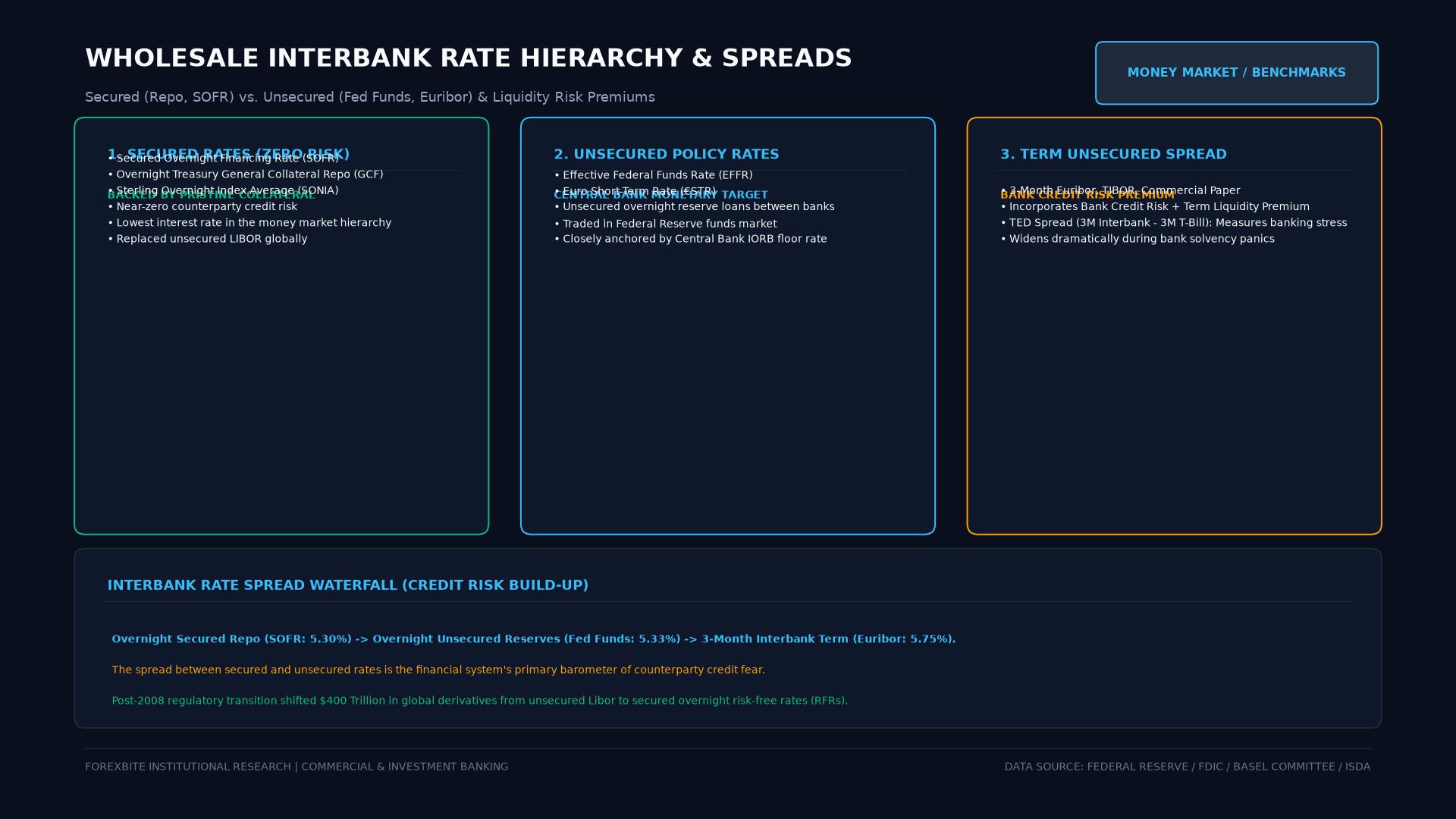 Figure: Global wholesale interbank benchmark matrix: risk-free overnight rates (SOFR, SONIA, TONAL, €STR) versus forward-looking term reference rates.
Key Takeaways
- The Wholesale Baseline: Interbank foreign exchange rates feature the tightest bid-ask spreads in the world, frequently narrowing to 0.0 to 0.1 pips on major currency pairs.
- Dual Financial Definition: The term refers to both Interbank Lending Rates (money market borrowing costs like Euribor or the Federal Funds Rate) and Interbank Exchange Rates (wholesale spot FX quotes).
- Creditworthiness Constraint: Banks trade at pure interbank rates only because they maintain multi-billion-dollar bilateral credit lines with each other established under ISDA Master Agreements.
- Electronic Communications Networks: Wholesale interbank orders are matched electronically on institutional platforms such as EBS Market and LSEG Refinitiv FXall.
The Two Pillars of Interbank Rates
1. Interbank Foreign Exchange Rates (Spot FX)
In currency dealing, the interbank rate is the top-of-book market clearing price where dealer banks trade standard multi-million-dollar blocks (typically $1 million to $10 million per ticket):
- Spread: Razor-thin (e.g., EUR/USD quoted at 1.08200 / 1.08201).
- Price Transparency: Retail traders rarely access pure interbank rates directly; retail brokers aggregate feeds from several liquidity providers, adding a 0.5 to 1.5-pip spread markup or charging a fixed round-turn commission to generate revenue.
2. Interbank Lending Rates (Money Markets)
In banking, interbank rates are the short-term interest rates charged on unsecured or secured loans between banks to manage daily regulatory reserve requirements:
- Overnight Risk-Free Rates: The Secured Overnight Financing Rate (SOFR) in the U.S. and the Euro Short-Term Rate (€STR) in Europe.
- Term Reference Rates: The Euro Interbank Offered Rate (Euribor) for 1-month to 12-month European loans.
Interbank Wholesale Rates vs. Retail Broker Rates
| Parameter | Interbank Institutional Tier | Retail Forex Broker Tier |
|---|---|---|
| Minimum Ticket Size | $1,000,000 to $10,000,000+ | Micro Lots ($1,000) or Mini Lots ($10,000) |
| Bid-Ask Spread | 0.0 to 0.2 pips on major currency pairs | 0.6 to 2.0 pips (markup added by broker) |
| Access Channel | Dedicated EBS / Refinitiv terminals; direct FIX API | Retail GUI platforms (MetaTrader 4/5, cTrader, Web) |
| Settlement Method | Continuous Linked Settlement (CLS) via central banks | Internalized broker cash sweep; rolling margin swaps |
| Credit Backing | Bilateral credit lines, ISDA CSAs, Tier-1 balance sheets | Pre-funded margin collateral deposited with broker |
The Role of Continuous Linked Settlement (CLS)
Because interbank currency trading involves immense sums crossing sovereign borders, banks historically faced severe settlement credit risk (Herstatt risk)—the danger that one bank delivers its currency in London, but the counterparty defaults before delivering the offsetting currency in New York.
In 2002, the world’s major central banks and commercial dealer banks created CLS Bank International:
- CLS operates a Payment-versus-Payment (PvP) settlement mechanism.
- Both legs of an interbank foreign exchange transaction are settled simultaneously in central bank funds.
- If one bank fails to deliver its currency, the transaction is safely aborted, eliminating systemic counterparty default risk across the interbank market.
Frequently Asked Questions
Can a retail trader trade directly at the interbank rate?
Retail traders cannot trade directly on interbank platforms like EBS or Refinitiv Dealing because doing so requires tens of millions of dollars in balance-sheet capital, sovereign banking licenses, and direct membership in CLS Bank. However, trading through a true ECN / STP broker routes your orders to an electronic aggregator that mirrors interbank rates with minimal markup.
What is the “Interbank Spread”?
The interbank spread is the difference between the wholesale price at which a Tier-1 bank will buy a currency and the price at which it will sell it. During liquid trading sessions in EUR/USD, the interbank spread is often as narrow as 0.00001 (0.1 pip).
Why do airport currency kiosks offer rates so much worse than the interbank rate?
Airport currency booths and retail physical foreign exchange counters operate with high physical overhead (vault security, shipping paper cash, airport rental fees). They widen the interbank rate by 5% to 15% as a retail profit markup.
Ready to trade forex?
Open a free demo account with a regulated broker. Practice with virtual funds before risking real money.