Earning Asset
An earning asset is any financial security, commercial loan, mortgage, or investment held by a banking or financial institution that generates direct, continuous cash income through interest, dividends, fees, or lease royalties.
What Is an Earning Asset?
In commercial banking, institutional asset-liability management (ALM), and corporate finance, an earning asset is any income-generating asset recorded on an institution’s balance sheet that produces direct, recurring cash cash-flow returns through interest payments, dividend yields, lease rentals, or finance fees.
For depository institutions (such as commercial banks and credit unions), earning assets constitute the core engine of corporate profitability. A commercial bank generates revenue by capturing a spread between the yield earned on its earning assets (commercial loans, consumer auto loans, residential mortgages, and sovereign bond portfolios) and the borrowing interest rate paid on its liabilities (customer checking, savings, and certificate of deposit balances)—a profitability spread measured as the Net Interest Margin (NIM).
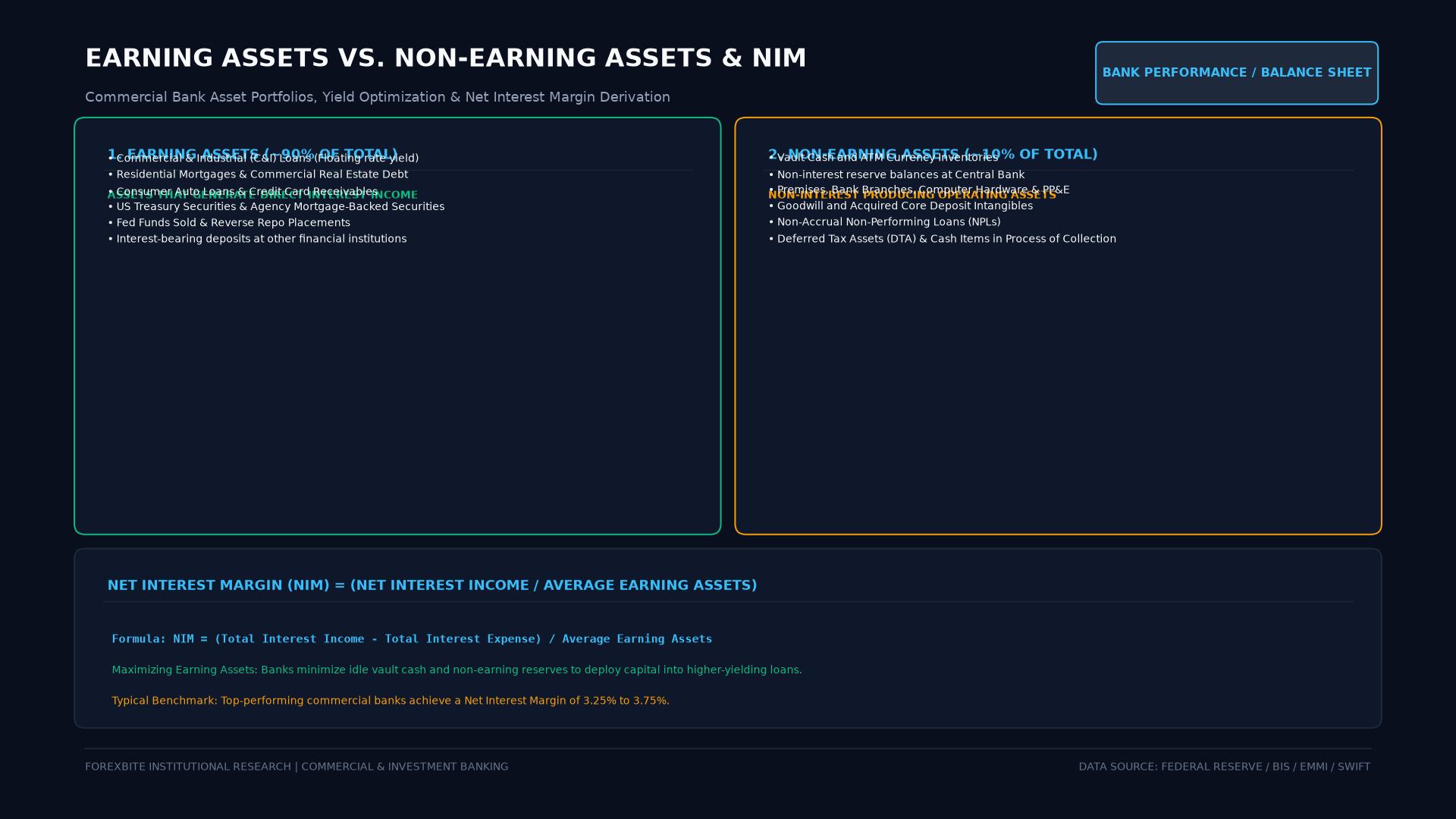 Figure: Bank balance sheet productivity breakdown: yield-generating loans and investments versus non-earning required reserves and fixed property.
Technical Mechanics & Core Banking Ratios
Financial analysts evaluate bank management efficiency by tracking the productivity and yield generated by the earning asset portfolio:
1. Net Interest Margin (NIM) Formula
$$\text{NIM} = \left( \frac{\text{Gross Interest Income} - \text{Total Interest Expense}}{\text{Average Total Earning Assets}} \right) \times 100$$
Where:
- $\text{Gross Interest Income}$: Total revenue received from loans, bonds, and securities.
- $\text{Total Interest Expense}$: Total interest disbursed to depositors and wholesale repo lenders.
- $\text{Average Total Earning Assets}$: Average volume of active income-generating assets deployed over the fiscal period.
2. Return on Earning Assets (ROEA)
$$\text{ROEA} = \left( \frac{\text{Net Interest Income}}{\text{Average Total Earning Assets}} \right) \times 100$$
A healthy commercial bank in an ordinary yield curve environment typically targets a Net Interest Margin between 3.0% and 4.25%. When the yield curve inverts (short-term deposit rates exceed long-term lending yields), NIM contracts sharply, squeezing bank earnings.
Comparative Matrix: Earning vs. Non-Earning Bank Assets
| Balance Sheet Item | Asset Classification | Income Generation Mechanism | Regulatory Role |
|---|---|---|---|
| Commercial Term Loans | Primary Earning Asset | Floating / Fixed interest rate | Core economic credit creation |
| Sovereign Treasuries / MBS | Liquid Earning Asset | Semi-annual bond coupon yield | Tier 1 High-Quality Liquid Asset (HQLA) |
| Interbank Call Money | Short-Term Earning Asset | Overnight interbank interest rate | Day-to-day liquidity buffer |
| Physical Vault Cash | Non-Earning Asset | Zero (0.0% interest) | Fulfilling daily branch withdrawals |
| Central Bank Reserves | Non-Earning / Low Earning | Statutorily 0% in many regimes | Mandatory reserve compliance (CRR) |
| Non-Performing Loans (NPLs) | Distressed Asset | Zero (Accrual suspended) | Requires equity capital write-offs |
Real-World Case Study: Silicon Valley Bank’s Earning Asset Duration Trap (2023)
The catastrophic failure to manage interest rate risk across a bank’s earning asset portfolio was demonstrated during the collapse of Silicon Valley Bank (SVB) in March 2023.
Anatomy of an Earning Asset Duration Disaster:
1. The Deposit Boom (2020-2021): SVB received over $100 billion in zero-cost tech startup deposits.
2. The Allocation Mistake: Seeking higher yield, SVB deployed $91 billion into long-duration earning assets—purchasing 10-year US Treasuries and 30-year fixed-rate Mortgage-Backed Securities yielding a meager 1.63% to 1.79%, classifying them as "Held to Maturity" (HTM).
3. The Rate Shock (2022-2023): The Federal Reserve hiked benchmark rates by 500 basis points. Long-term bond yields spiked, triggering massive mark-to-market paper losses on SVB's fixed-rate earning assets.
4. The Run: By early 2023, SVB's earning assets had suffered $15 billion in unrealized losses—completely wiping out the bank's entire tangible common equity. When tech founders initiated bank runs withdrawing $42 billion in 24 hours, SVB was forced to sell its earning assets at a massive realized loss, triggering immediate FDIC receivership.
Frequently Asked Questions (FAQ)
What percentage of a commercial bank’s balance sheet consists of earning assets?
In well-run commercial banks, earning assets typically comprise 85% to 92% of total assets. The remaining 8% to 15% consists of non-earning assets required for regulatory compliance and physical infrastructure: mandatory cash reserves held at the central bank (CRR), physical vault currency, corporate headquarters and branch real estate, goodwill from past acquisitions, and non-performing loans where interest accrual has been suspended.
How does an inverted yield curve affect a bank’s earning assets?
Commercial banks fundamentally “borrow short and lend long.” They fund themselves using short-term deposits and commercial paper, and deploy those funds into longer-duration earning assets (mortgages, 5-year business loans). When the yield curve inverts (short-term rates rise above long-term rates), the bank’s cost of funding deposits rises faster than the yield it receives on its existing earning assets, severely compressing Net Interest Margins (NIM) and depressing bank stock valuations.
When does an earning asset become a non-earning asset?
An earning asset transitions into a non-earning asset when a borrower fails to service their debt for an extended period—typically 90 consecutive days of missed interest or principal payments. At that threshold, banking regulators mandate that the loan be placed on non-accrual status. The bank is legally prohibited from recording theoretical interest income on the loan, transforming it into a non-earning, non-performing loan (NPL) that requires immediate capital reserve write-downs.
Ready to trade forex?
Open a free demo account with a regulated broker. Practice with virtual funds before risking real money.