Face Rental Rate
The face rental rate (also called the nominal or asking rent) is the published, unadjusted gross rent per square foot that a commercial or residential landlord advertises for a property, before any tenant concessions, free-rent periods, or effective-rate reductions are applied.
What Is the Face Rental Rate?
In commercial real estate brokerage, property investment analysis, and corporate lease negotiations, the face rental rate (also designated as the nominal rent, asking rent, or headline rent) is the gross, unadjusted rent per square foot per annum published by a building landlord or property owner as their official quoted price for lease occupancy.
The face rental rate represents the starting point of all commercial lease negotiations. However, because competitive real estate markets routinely involve significant landlord concessions — including rent-free abatement periods, fit-out construction allowances, and below-market renewal options — sophisticated corporate tenants and their tenant-representative brokers analyze the Effective Rental Rate (ERR) rather than the face rate.
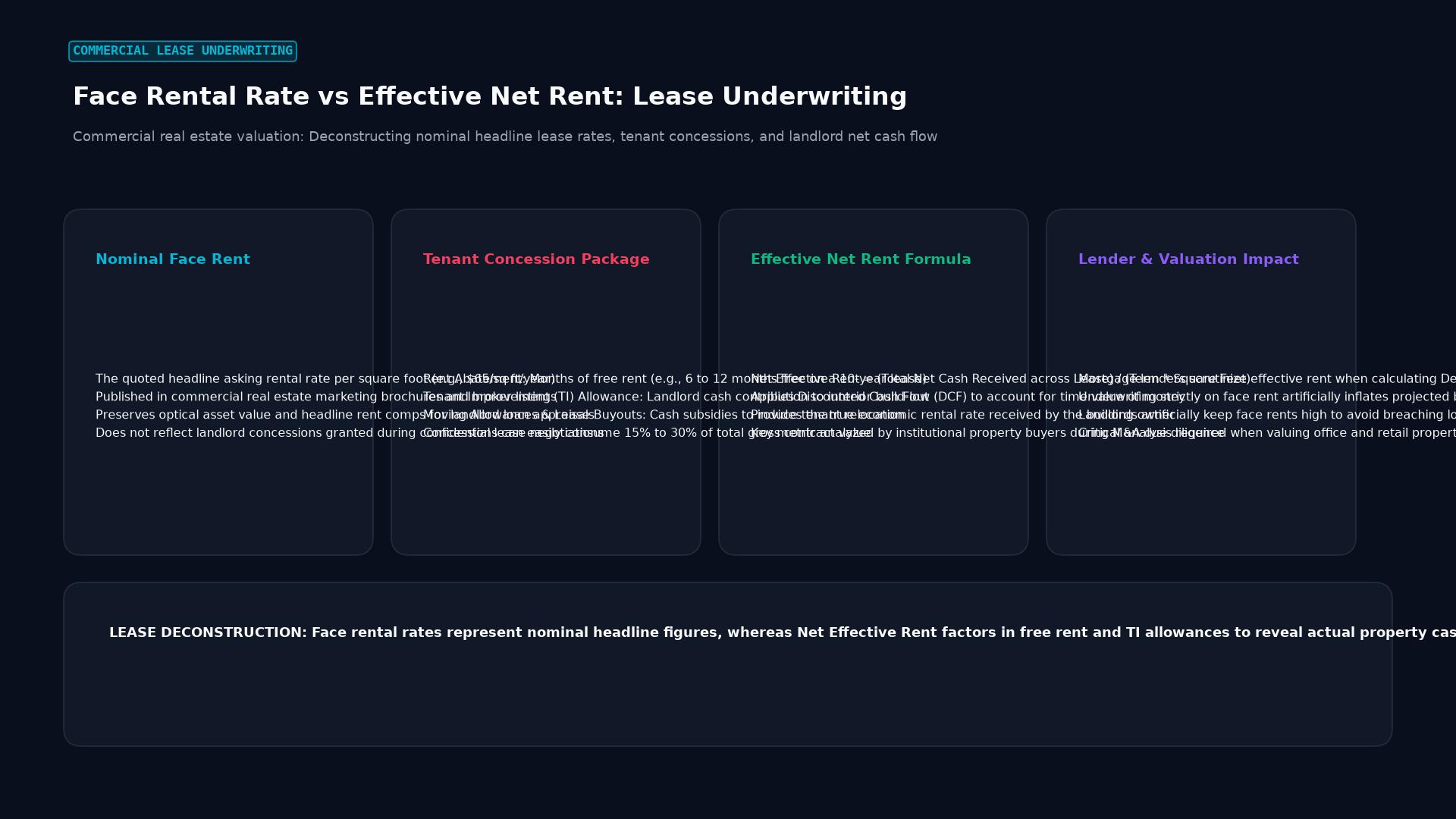 Figure: Commercial real estate valuation: Deconstructing nominal headline lease rates, tenant concessions, and landlord net cash flow
Technical Mechanics: Net Effective Rent Calculation
The Net Effective Rent (NER) Formula
For institutional investors and REIT portfolio managers, the economically meaningful metric is:
$$\text{NER} = \text{Face Rate} - \left( \frac{\text{PV(Free Rent Months)} + \text{Tenant Improvement Allowance}}{\text{Lease Term (Years)} \times \text{Square Footage}} \right)$$
Where all concession values are discounted to present value using the landlord’s weighted average cost of capital (WACC) as the discount rate.
Face-Rate Spread as a Market Stress Indicator
Commercial real estate analysts calculate the Face-to-Effective Rate Spread to gauge market vacancy pressure:
$$\text{Concession Spread} = \text{Face Rate} - \text{Effective Rate}$$
A widening concession spread (face rents rising while effective rents fall) typically signals rising vacancy and landlord desperation — a leading indicator of commercial property market distress.
Comparative Matrix: Rental Rate Metrics
| Metric | Included in Calculation | Primary Use Case | Key Audience |
|---|---|---|---|
| Face Rental Rate | Gross nominal published rent | Marketing, initial negotiation | Tenants, listing services |
| Net Effective Rate | Concession-adjusted economic rent | DCF valuation, REIT reporting | Investors, analysts |
| Triple-Net (NNN) Rate | Base rent only (tenant pays OpEx) | Retail/industrial net leases | Net lease investors |
| Gross Rate | Rent inclusive of landlord-paid OpEx | Office/multifamily comparisons | Tenant reps, appraisers |
Real-World Case Study: Manhattan Office Leasing Post-COVID (2020–2024)
The dramatic divergence between face and effective rents was laid bare during the post-pandemic commercial office crisis.
The Great Office Lease Deception:
1. Face Rate Stability: Manhattan Class A office landlords maintained published face rents of $90 to $140 per sq ft throughout 2020 to 2023.
2. Effective Rate Collapse: Desperate for tenants amid 20%+ vacancy, the same landlords were simultaneously offering 12 to 24 months of rent-free abatement and $150/sq ft tenant improvement packages on 10-year deals.
3. The Market Signal: The CoStar face-to-effective rent spread ballooned to record levels, signaling that the "stable" headline rents were a statistical fiction propped up by unsustainable landlord generosity.
4. The Investment Implication: Investors analyzing net operating income (NOI) based on face rents drastically overestimated commercial real estate asset valuations, leading to massive forced write-downs when office buildings were refinanced or sold.
Frequently Asked Questions (FAQ)
Why do landlords maintain high face rental rates even when offering massive concessions?
Landlords maintain elevated face rental rates for several self-reinforcing financial reasons: (1) Appraisal standards use asking rent comparables to establish asset valuations — high face rents support higher appraised values for loan collateral. (2) Debt covenants often stipulate minimum per-square-foot rental rates that lenders monitor for compliance. (3) Institutional credibility — reducing a building’s official face rent signals distress and can trigger negotiation leverage for all existing tenants seeking rent relief.
How does a tenant negotiate from face rate to effective rate?
Corporate tenant-representative brokers counter-offer to landlords by presenting a comprehensive analysis of competing available properties. Instead of demanding a face-rate reduction (which landlords resist for the reasons above), sophisticated tenants negotiate for tenant improvement allowances (cash for renovations), rent-free abatement periods (months of zero rent), below-market renewal option pricing, and flexible termination provisions — all of which reduce the economic cost without formally lowering the published face rate.
Does the face rental rate appear on official government property statistics?
Most national commercial real estate indices — including the CBRE cap rate surveys, JLL market reports, and CoStar vacancy data — report both face rents and effective rents as separate data series. Government statistical agencies (such as the US Bureau of Labor Statistics for the CPI Owners’ Equivalent Rent component) track effective rental costs adjusted for actual concession trends rather than nominal face rates.
Ready to trade forex?
Open a free demo account with a regulated broker. Practice with virtual funds before risking real money.