Fair Market Value Lease (FMV Lease)
A fair market value lease is an equipment lease contract in which the lessee gains operating use of an asset for a fixed term, with the option at lease expiration to purchase the asset at its then-current fair market value, return it, or renew the lease at prevailing market rental rates.
What Is a Fair Market Value Lease?
A fair market value (FMV) lease — also commonly referred to as an operating lease, true lease, or tax-oriented lease — is a commercial equipment financing arrangement under which the lessor (the leasing company or financing institution) retains legal ownership of the physical asset throughout the lease term, while the lessee (the business or end user) obtains exclusive operational use of the asset in exchange for periodic rental payments.
At the conclusion of the fixed lease term, the FMV lease grants the lessee three distinct contractual options:
- Purchase the asset at fair market value (not a pre-fixed bargain price — the asset’s actual current appraised market value at lease expiration).
- Return the asset to the lessor with no further financial obligation.
- Renew the lease at prevailing market rates for a mutually agreed additional term.
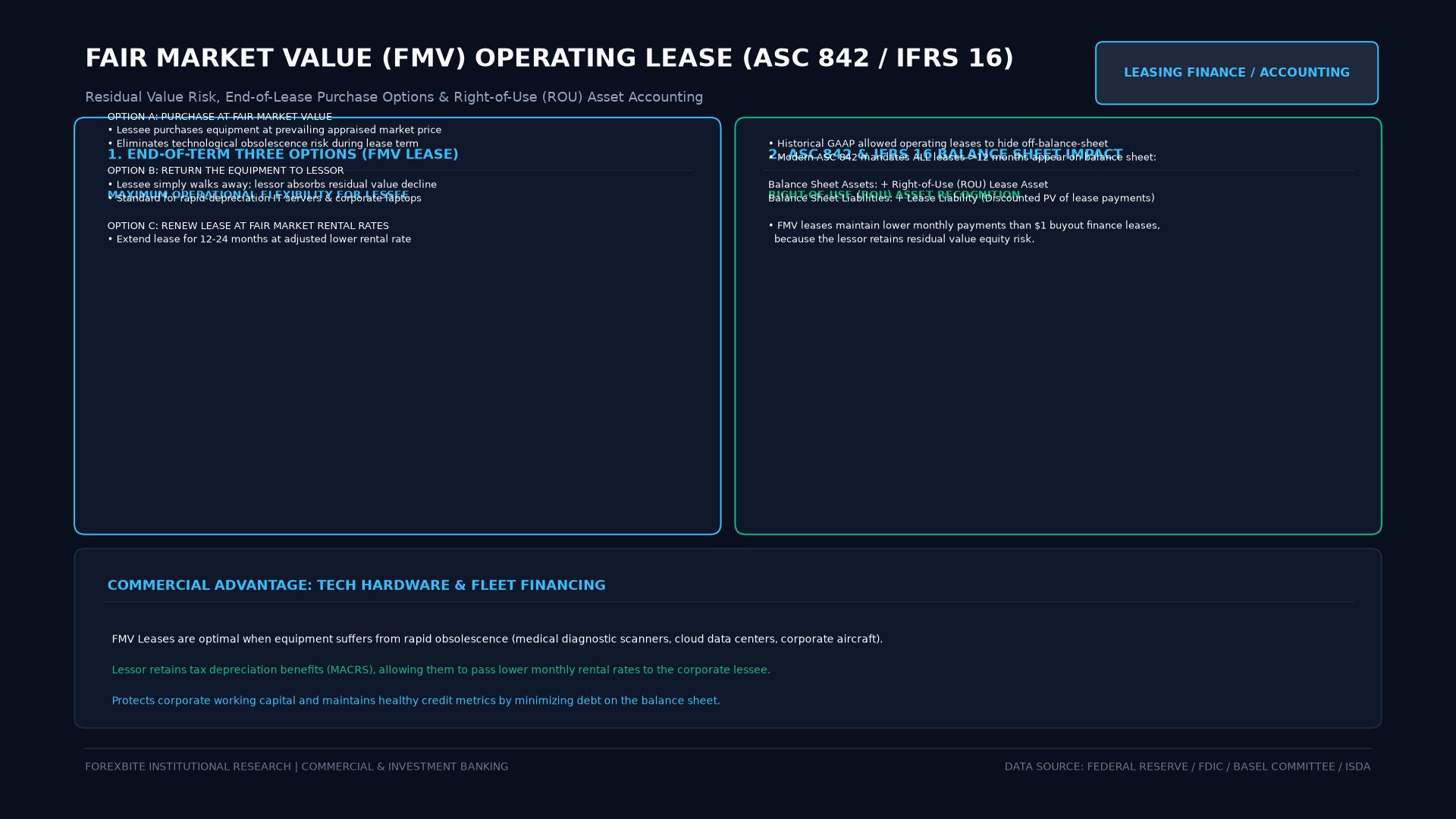 Figure: Equipment operating lease structure: off-balance sheet operating expense treatment and end-of-term buyout, renewal, or asset return choices.
Technical Mechanics: ASC 842 Lease Classification Tests
Under ASC 842 (FASB Accounting Standards Codification), adopted from January 2019 for US public companies, leases are classified as Operating (analogous to FMV leases) or Finance (analogous to capital leases) based on five classification criteria:
A lease is classified as a Finance Lease if ANY of the following criteria are met:
- Ownership Transfer: Title transfers to the lessee at end of term.
- Bargain Purchase Option: Lessee has option to purchase at below-FMV price.
- Lease Term Test: Lease term ≥ 75% of the asset’s estimated remaining economic useful life.
- Present Value Test: PV of minimum lease payments ≥ 90% of the asset’s fair value at commencement.
- Specialized Nature: Asset is so specialized it has no alternative use to the lessor at end of term.
$$\text{PV Test: } \sum_{t=1}^{n} \frac{MLP_t}{(1 + r)^t} \geq 90% \times \text{FMV}_{\text{asset}}$$
If none of these criteria are met, the lease qualifies as an Operating Lease (FMV Lease).
Comparative Matrix: Equipment Financing Options
| Structure | Monthly Cost | Balance Sheet Impact | Residual Risk | Best For |
|---|---|---|---|---|
| FMV Operating Lease | Lowest | Off-balance sheet (pre-842) | Lessor | Tech/equipment with rapid obsolescence |
| Finance Lease ($1 Buyout) | Highest | On-balance sheet | Lessee | Long-lived, strategic assets |
| Outright Purchase (Cash) | N/A (CapEx) | On-balance sheet | Lessee (full) | Assets with high residual value |
| Bank Term Loan + Purchase | Medium | On-balance sheet | Lessee | Assets with collateral value |
Real-World Case Study: Airline Industry FMV Leasing (Sale-Leaseback)
The most capital-intensive application of FMV lease structures exists in the global commercial aviation industry.
The Aircraft Sale-Leaseback Mechanism:
1. The Transaction: Airlines routinely sell newly delivered commercial aircraft to Aircraft Leasing Companies (ALC, Air Lease Corporation, SMBC Aviation Capital) and simultaneously execute 12-year FMV lease arrangements.
2. The Financial Logic: A Boeing 737 MAX costs approximately $135 million list price. Instead of tying up $135 million in owned fleet assets, the airline pays monthly FMV lease rents of ~$400,000 to $500,000 — freeing massive capital for operations, debt repayment, or shareholder returns.
3. The Residual Value Hedge: Airlines face severe residual value risk — a narrow-body jet may be worth $30 million or $70 million after 12 years depending on fuel prices, regulatory changes, and new technology. FMV leases transfer this unpredictable residual risk to specialist aviation lessors who own diversified fleets.
4. Industry Scale: By 2024, approximately 50% of the world's 30,000+ commercial aircraft were leased under FMV arrangements, representing roughly $450 billion in outstanding aircraft lease receivables.
Frequently Asked Questions (FAQ)
Why are FMV lease payments typically lower than capital lease payments?
In an FMV lease, the lessor retains the residual value of the asset at lease expiration — the value remaining after the lease term ends. The lessee’s monthly payments only need to cover the depreciation experienced during the lease term, plus a return on the lessor’s invested capital. In a capital (finance) lease or loan purchase, the lessee must fund the entire purchase price across the term, resulting in substantially higher periodic payments.
How does the IRS determine whether a lease qualifies as a “true lease” for tax purposes?
The Internal Revenue Service applies a “true lease” determination to confirm the lessor genuinely retains the economic risks and benefits of asset ownership. Key IRS safe harbor factors (Revenue Procedure 2001-28) include: the lessor must retain genuine residual value risk (at least 20% of original cost at end of term), the lessee’s purchase option must be at FMV (not a nominal $1 amount), and the lessor must maintain a minimum 20% equity investment at-risk in the transaction. If the arrangement fails these tests, the IRS reclassifies the “lease” as a conditional sales contract.
What happens to the FMV purchase price determination if the lessee and lessor disagree at lease expiration?
Most FMV lease contracts contain a Fair Market Value Appraisal Mechanism. If the lessor and lessee cannot agree on the asset’s FMV at expiration, both parties commission independent certified appraisals from credentialed appraisers. If the two appraisals differ by more than 10%, a mutually agreed-upon third independent appraiser is appointed as umpire, and their determination is contractually binding on both parties.
Ready to trade forex?
Open a free demo account with a regulated broker. Practice with virtual funds before risking real money.