Absolute Advantage
Absolute advantage is an economic concept describing a country's ability to produce a good or service more efficiently than another country — using fewer resources or less time per unit produced. In international trade theory, absolute advantage explains why countries specialize in producing what they're best at, though comparative advantage (not absolute advantage) is what actually drives international trade patterns and has more direct implications for currency valuations.
Understanding Absolute Advantage
Adam Smith introduced the concept of absolute advantage in The Wealth of Nations (1776). The principle: a country should specialize in producing goods it can make more efficiently than its trading partners, then trade for goods other countries produce more efficiently. This mutual specialization increases global output compared to each country trying to be self-sufficient.
A simple example: Suppose the US can produce 10 units of wheat per hour of labor, while France can produce 6 units. The US has an absolute advantage in wheat production — it’s simply more efficient. Meanwhile, France can produce 8 units of wine per hour while the US can produce only 4. France has an absolute advantage in wine.
Under Smith’s framework: the US should specialize in wheat; France should specialize in wine; they trade. Both end up with more of both goods than if each tried to produce everything domestically.
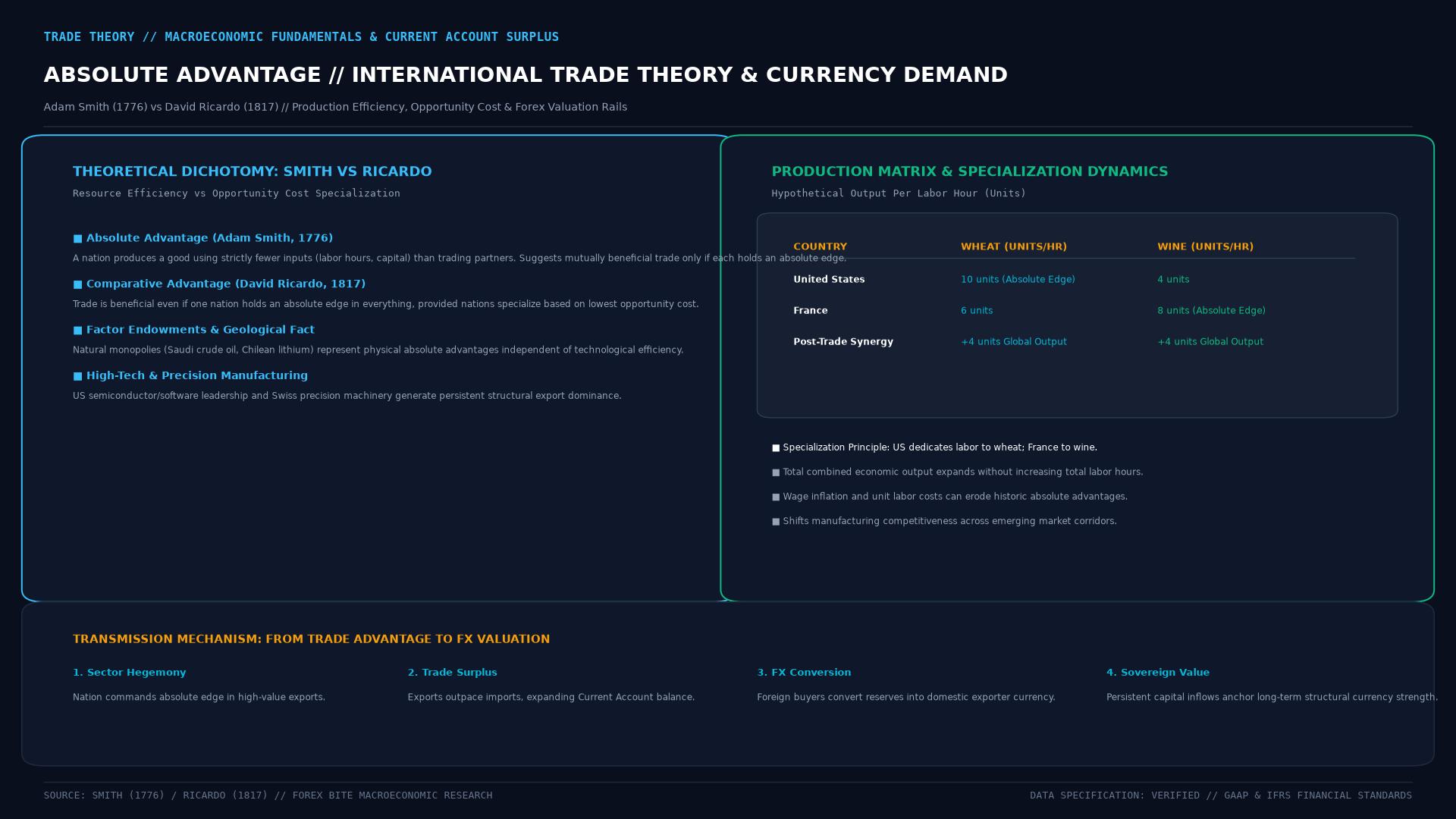 Figure: Theoretical comparison of Absolute Advantage (Adam Smith, 1776) versus Comparative Advantage (David Ricardo, 1817), showing production specialization matrices, global output expansion, and the long-term transmission mechanism to current account balances and foreign exchange valuation.
Absolute Advantage vs. Comparative Advantage
The more important concept for international trade is comparative advantage, introduced by David Ricardo in 1817. It explains why trade is mutually beneficial even when one country has an absolute advantage in everything.
The distinction: Comparative advantage looks at opportunity cost — what you give up to produce one unit. A country should produce what it gives up least to make, even if it’s absolutely less efficient than its trading partner at everything.
Why it matters for forex: Comparative advantage explains more of real-world trade patterns than absolute advantage. A developed economy like Germany doesn’t trade with Vietnam because each has different absolute advantages — they trade because each has comparative advantages in different products (precision machinery vs. low-cost manufacturing). Understanding these comparative advantages helps forecast trade flows and, by extension, currency demand patterns.
Absolute Advantage in Modern Contexts
While the pure academic concept has limited direct forex application, the underlying logic appears in several relevant contexts:
Technology leadership: The US has an absolute advantage in certain technology sectors (semiconductors, software, aerospace, financial services). This advantage drives exports that support the current account and create persistent dollar demand.
Natural resources: Saudi Arabia has an absolute advantage in oil production — geological fact, not efficiency. This drives persistent current account surpluses and the petrodollar system.
Skilled labor: Switzerland has an absolute advantage in certain precision manufacturing and pharmaceutical research. These sectors drive Swiss export competitiveness and the CHF’s persistent current account surplus.
Wages and cost: China had an absolute advantage in labor-intensive manufacturing for decades due to dramatically lower wages. As Chinese wages rose, this advantage partially shifted to Vietnam, Bangladesh, and other lower-cost producers — directly affecting their currencies’ competitiveness.
From Trade Theory to Currency Valuation
The chain from absolute/comparative advantage to currency:
- Country has strong absolute advantage in high-value export sector
- Exports generate persistent trade and current account surpluses
- Surpluses create structural demand for domestic currency (exporters converting foreign earnings)
- Currency tends to strengthen or remain well-bid over the long run
This explains why manufacturing export powerhouses (Germany, Japan, South Korea, Switzerland) tend to have stronger currencies than countries with less competitive export sectors.
Key Takeaways
- Absolute advantage: producing a good more efficiently than trading partners (fewer resources/time)
- Adam Smith’s concept from 1776; forms the foundation of comparative advantage theory (Ricardo, 1817)
- Comparative advantage — not absolute — is what actually drives international trade specialization
- Absolute advantage in high-value sectors (technology, natural resources, precision manufacturing) creates current account surpluses that support currency demand
- Rising wages can erode absolute advantages in labor-intensive sectors, shifting competitiveness
FAQ
Does a country with absolute advantage in everything always have a strong currency? Not necessarily. Currency strength depends on the relative trade balance, capital flows, interest rate differentials, and many other factors. A country could have absolute advantages in production but still run large current account deficits through excessive domestic consumption or capital outflows.
Is absolute advantage useful for day trading? Not directly. It’s a long-run structural concept operating over years and decades. For shorter timeframe trading, interest rate differentials, economic data surprises, and technical factors are far more relevant. Absolute advantage is useful context for understanding why certain currencies tend to be structurally strong or weak over multi-year periods.
Ready to trade forex?
Open a free demo account with a regulated broker. Practice with virtual funds before risking real money.