Factor Portfolio
A factor portfolio, or factor-mimicking portfolio, is an engineered, diversified investment portfolio constructed to possess a unit beta exposure of 1.0 to a single targeted risk factor while maintaining zero exposure to all other systematic factors and negligible idiosyncratic variance.
What Is a Factor Portfolio?
In quantitative asset management and multi-factor pricing theory, a factor portfolio (often termed a pure factor portfolio or factor-mimicking portfolio) is a mathematically constructed portfolio of securities designed to isolate and harvest the return premium of exactly one systematic risk factor.
Under Arbitrage Pricing Theory (APT) and modern empirical asset pricing models, achieving pure exposure to a specific factor—such as Value, Momentum, Quality, or Low Volatility—requires neutralizing exposures to all other co-existing systematic risks. A pure factor portfolio has a beta of exactly $1.0$ with respect to the target factor, a beta of $0.0$ to every other known risk factor, and maximizes cross-asset diversification to drive non-factor idiosyncratic residual variance as close to zero as possible.
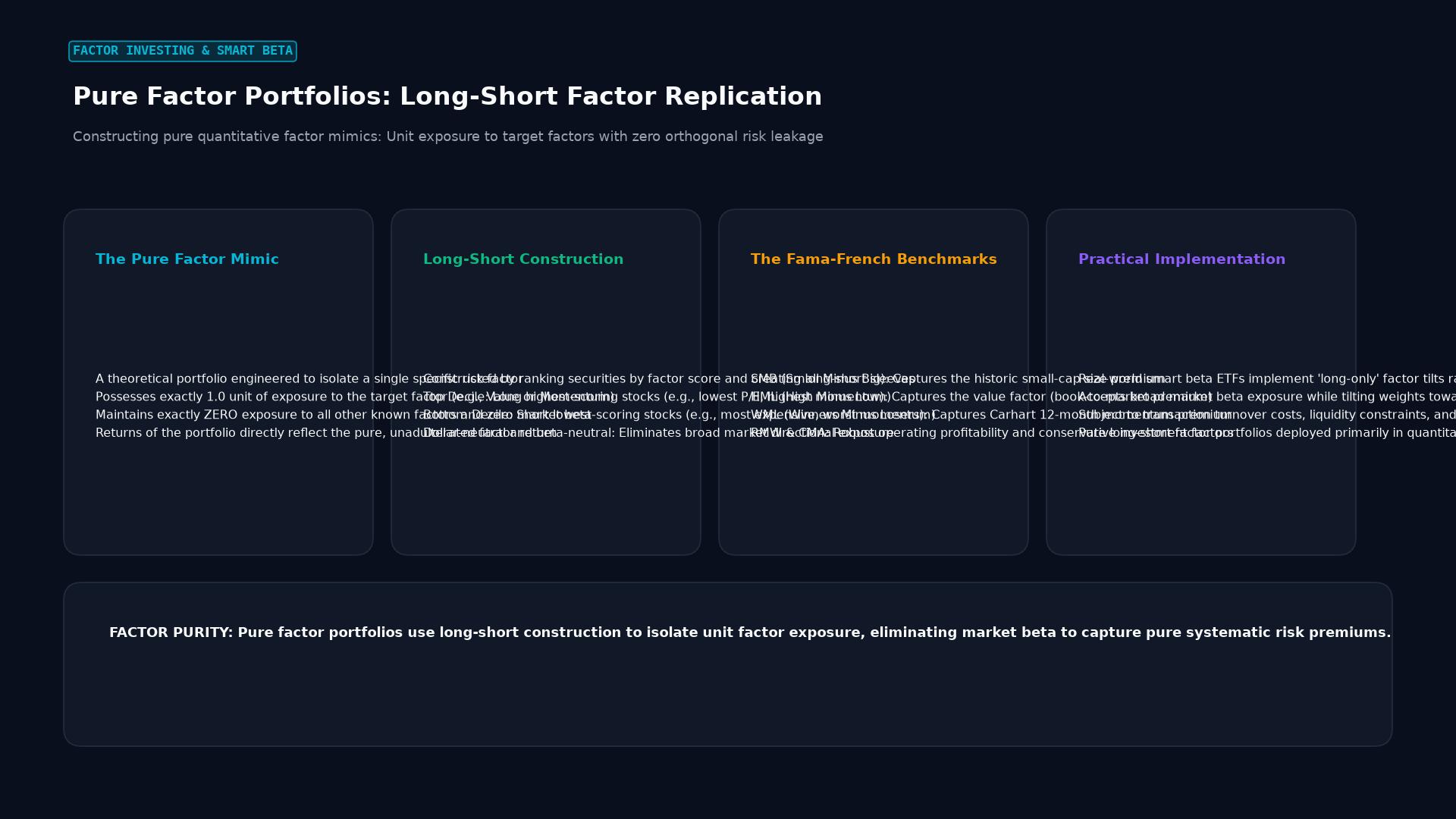 Figure: Constructing pure quantitative factor mimics: Unit exposure to target factors with zero orthogonal risk leakage
Mathematical Construction via Quadratic Optimization
In institutional quantitative finance, pure factor portfolio weights are derived through constrained quadratic optimization. Given an asset universe with factor loading matrix $\Lambda \in \mathbb{R}^{N \times K}$ and idiosyncratic asset covariance matrix $\Psi = \text{diag}(\sigma_{\varepsilon,1}^2, \dots, \sigma_{\varepsilon,N}^2)$:
Optimization Objective
The objective is to find a weight vector $w_k \in \mathbb{R}^N$ for factor $k$ that minimizes specific portfolio variance:
$$\min_{w_k} \frac{1}{2} w_k^T \Psi w_k$$
Subject to the Linear Constraints:
$$\Lambda^T w_k = e_k$$
Where $e_k = [0, \dots, 0, 1, 0, \dots, 0]^T$ is a unit vector with a value of $1$ at the $k$-th position (the target factor) and $0$ for all other $K-1$ factors.
Closed-Form Solution
Using the method of Lagrange multipliers, the analytical weight vector for the pure factor portfolio is:
$$w_k = \Psi^{-1} \Lambda \left( \Lambda^T \Psi^{-1} \Lambda \right)^{-1} e_k$$
The return generated by this portfolio $r_{F,k} = w_k^T R$ represents the direct, pure factor return used in institutional factor attribution models (such as MSCI Barra, Axioma, or Bloomberg PORT).
Long/Short “Pure” vs. Long-Only “Smart Beta” Factor Portfolios
Investors access factor portfolios through two primary mechanisms:
-
Academic / Institutional Long/Short Portfolios (Hedge Funds):
- Takes long positions in the top decile/quintile ranking on the factor and simultaneously sells short the bottom decile/quintile.
- Self-financing (dollar-neutral) and market-neutral ($\beta_{\text{Market}} = 0$).
- Yields clean empirical factor premiums with zero market correlation, but requires short borrowing capacity, leverage, and ongoing margin management.
-
Long-Only “Smart Beta” Factor Portfolios (ETFs & Mutual Funds):
- Tilts standard capitalization-weighted indices toward high-scoring factor stocks while remaining 100% invested.
- Retains high market beta ($\beta \approx 1.0$), capturing both general market equity returns and a modest positive factor tilt.
- Highly accessible to retail investors and restricted institutional funds (e.g., public pensions) that cannot engage in short-selling.
Comparative Matrix: Factor Portfolio Variations
| Portfolio Structure | Target Factor Beta | Market Beta ($\beta_{\text{Mkt}}$) | Net Leverage | Dollar Neutral? | Typical Vehicle |
|---|---|---|---|---|---|
| Pure Factor Portfolio | Exactly 1.0 | Exactly 0.0 | High (requires shorting) | Yes (100% Long / 100% Short) | Quantitative Hedge Funds, Risk Attribution Engines |
| Smart Beta Factor ETF | Moderate (+0.3 to +0.6) | ~1.0 | 1.0x (Long only) | No (100% Net Long) | BlackRock iShares, Vanguard Factor ETFs |
| Broad Market Index | Zero (neutral on style) | Exactly 1.0 | 1.0x (Long only) | No (100% Net Long) | S&P 500 (SPY), MSCI World |
| Multi-Factor Long/Short | Multi-target (+1.0 on 2-3 factors) | Exactly 0.0 | 2.0x - 4.0x Gross | Yes | Quantitative Equity Market Neutral (QMN) Funds |
Real-World Case Study: Constructing an Institutional Quality Factor Portfolio
An asset manager running a $1.5 billion equity market neutral fund sought to capture the Quality factor (high return on equity, low leverage, stable earnings growth) without taking accidental bets on industry sectors or market direction:
- Unconstrained Naive Sorting: Simply buying the top 20% highest-ROE stocks resulted in an accidental 60% over-allocation to Mega-Cap Technology stocks, introducing massive unintended exposure to the Size and Growth factors.
- Pure Factor Optimization: By applying the constrained quadratic formula $w_{\text{Quality}} = \Psi^{-1} \Lambda (\Lambda^T \Psi^{-1} \Lambda)^{-1} e_{\text{Quality}}$, the optimizer selected long and short weights across 400 stocks that explicitly neutralized the portfolio’s industry weights and drove Size, Value, and Momentum betas to $0.00 \pm 0.02$.
- Outcome: During the 2022 market downturn, when speculative growth equities crashed 30%, the pure Quality factor portfolio delivered a steady +6.4% uncorrelated alpha, completely immunizing the fund against broader index volatility.
Frequently Asked Questions (FAQ)
What is factor crowding in factor portfolios?
Factor crowding occurs when a massive volume of capital converges into the same factor portfolio holdings (e.g., hundreds of quant hedge funds simultaneously buying the same Momentum stocks). When market volatility forces one or more mega-funds to liquidate positions, the rapid unwinding can cause severe price cascading, leading to sharp factor drawdowns known as a “quant crunch.”
Why can’t a simple single-sort portfolio serve as a pure factor portfolio?
Single-sort portfolios (e.g., sorting the S&P 500 by Price-to-Book and buying the cheapest quintile) suffer from severe factor contamination. In reality, value stocks often exhibit high financial leverage, smaller market capitalization, and negative momentum. Without explicit mathematical orthogonalization, a naive value portfolio is simultaneously betting on small cap, high beta, and distressed debt risks.
What is the difference between a factor portfolio and a hedge portfolio?
While both utilize long and short positions to neutralize unwanted risks, a factor portfolio is designed to isolate and harvest positive expected returns from a known risk premium. In contrast, a hedge portfolio is constructed purely as risk insurance to offset an existing exposure, often accepting a zero or slightly negative expected return in exchange for downside variance protection.
Ready to trade forex?
Open a free demo account with a regulated broker. Practice with virtual funds before risking real money.