Factor Model
A factor model is a quantitative financial framework that decomposes an asset's expected return into systematic exposures to a defined set of common risk factors plus an idiosyncratic residual term, enabling portfolio managers to precisely measure, attribute, and hedge portfolio risk.
What Is a Factor Model?
In quantitative portfolio management, institutional risk attribution, and financial econometrics, a factor model is a mathematical framework that explains the return of any individual asset — stock, bond, commodity, or currency — as a linear combination of systematic exposures to a defined set of common risk factors, plus an uncorrelated, company-specific idiosyncratic residual term.
Factor models provide the institutional architecture for virtually all modern portfolio risk management systems deployed by hedge funds, pension funds, and asset managers. By decomposing complex portfolio returns into factor exposures, risk managers can identify the precise sources of portfolio performance, hedge unwanted systematic risk, and construct portfolios with deliberate, targeted factor tilts.
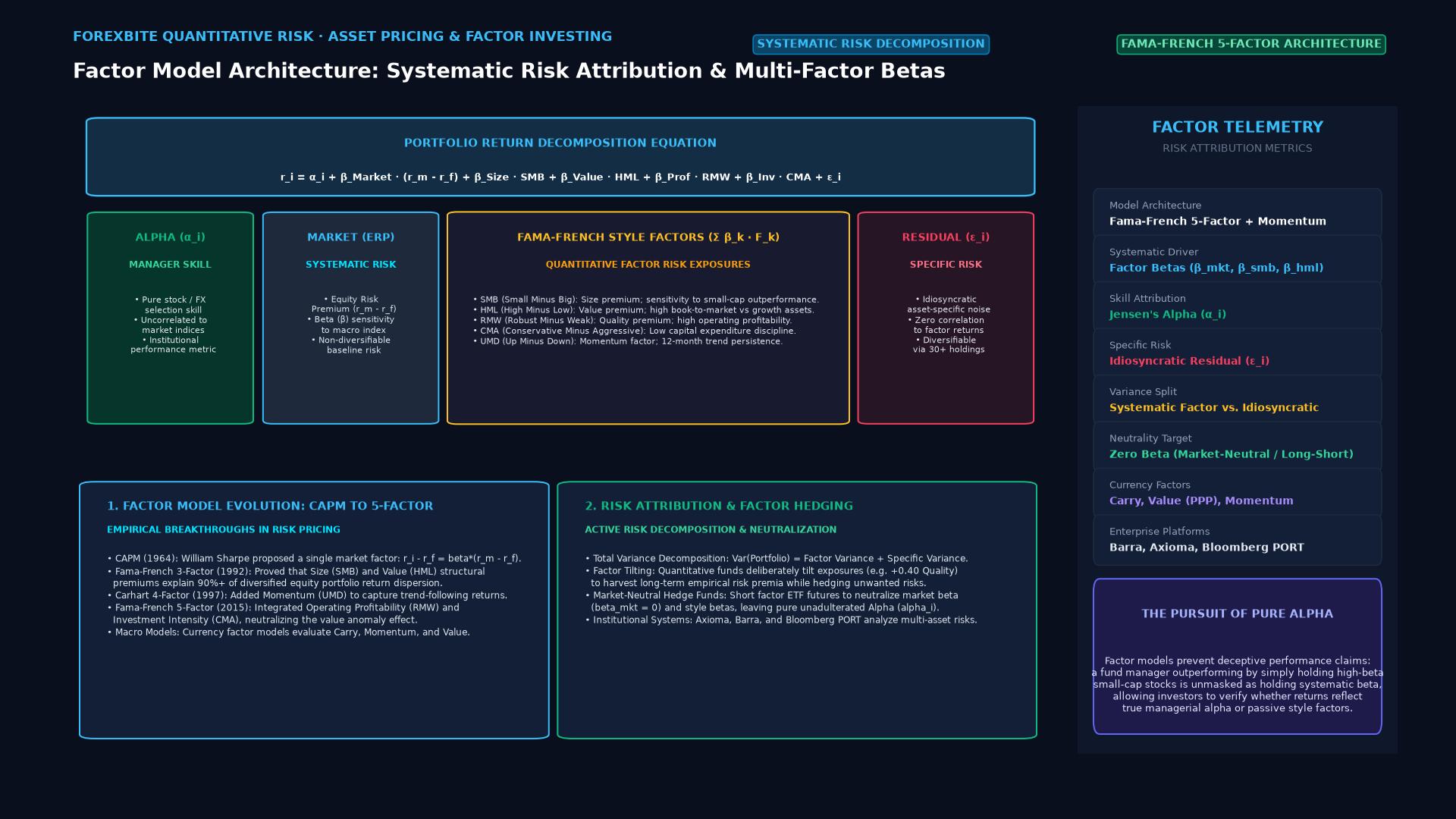 Figure: Factor model return decomposition showing alpha, systematic market risk, Fama-French style factors, and idiosyncratic residual.
The Evolution of Factor Models
1. The CAPM: Single-Factor Market Model (1964)
Developed by William Sharpe, the Capital Asset Pricing Model (CAPM) represents the foundational single-factor model:
$$r_i = r_f + \beta_i \cdot \left( r_m - r_f \right) + \varepsilon_i$$
Where $r_f$ is the risk-free rate, $\beta_i$ measures market sensitivity, and $(r_m - r_f)$ is the Equity Risk Premium.
2. The Fama-French Three-Factor Model (1992)
Eugene Fama and Kenneth French demonstrated that two additional systematic risk factors explained the cross-section of stock returns beyond CAPM:
$$r_i - r_f = \alpha_i + \beta_i^{mkt}(r_m - r_f) + \beta_i^{SMB} \cdot SMB + \beta_i^{HML} \cdot HML + \varepsilon_i$$
- SMB (Small Minus Big): The return spread between small-cap and large-cap stocks.
- HML (High Minus Low): The return spread between high book-to-market (value) and low book-to-market (growth) stocks.
3. The Fama-French-Carhart Four-Factor Model (1997)
Mark Carhart added momentum (UMD) — the persistence of recent relative performance:
$$r_i - r_f = \alpha_i + \beta^{mkt}(r_m - r_f) + \beta^{SMB} \cdot SMB + \beta^{HML} \cdot HML + \beta^{UMD} \cdot UMD + \varepsilon_i$$
4. The Fama-French Five-Factor Model (2015)
The state-of-the-art academic model adds Profitability (RMW) and Investment (CMA):
$$r_i - r_f = \alpha + \beta^{mkt}(r_m - r_f) + \beta^{SMB} \cdot SMB + \beta^{HML} \cdot HML + \beta^{RMW} \cdot RMW + \beta^{CMA} \cdot CMA + \varepsilon$$
Comparative Matrix: Factor Model Generations
| Model | Factors | R² Explanatory Power | Primary Application |
|---|---|---|---|
| CAPM (1964) | Market Beta (1) | ~70% for diversified portfolios | Basic cost of equity estimation |
| Fama-French 3F (1992) | Market, Size, Value (3) | ~88% | Academic return attribution |
| Carhart 4F (1997) | + Momentum (4) | ~90% | Mutual fund alpha evaluation |
| Fama-French 5F (2015) | + Profitability, Investment (5) | ~93% | Factor investing strategies |
| Barra / Axioma Multi-Factor | 50–100+ factors | ~95–98% | Institutional risk management |
Real-World Case Study: AQR Capital’s Factor Investing Revolution
The commercial triumph of applied factor modeling was embodied by AQR Capital Management, co-founded by Clifford Asness.
The Factor Investing Alpha Machine:
1. The Foundation: AQR built institutional factor models identifying four key alternative risk premia generating persistent excess returns: Value, Momentum, Carry, and Defensive.
2. The Strategy: Rather than relying on stock-picking skill (alpha), AQR systematically harvested premia from these proven factors across global equities, fixed income, commodities, and currencies.
3. The Scale: By 2018, AQR managed over $226 billion in assets, making it one of the world's largest quantitative hedge funds — built entirely on systematic, academically validated factor model exploitation.
4. The Industry Transformation: AQR's publicly accessible research democratized factor investing, triggering an explosion of "smart beta" and "factor ETF" products (including BlackRock's iShares Edge and Vanguard's Factor ETFs) that collectively manage over $1 trillion in assets based on factor model tilts.
Frequently Asked Questions (FAQ)
What is the difference between a factor model’s “beta” and a stock’s “beta”?
In a single-factor CAPM, a stock’s beta ($\beta$) measures its sensitivity to the overall market return. In a multi-factor model, each asset has multiple distinct factor betas ($\beta_{i,k}$): one for the market, one for the size factor, one for value, one for momentum, and so on. This multi-dimensional beta decomposition reveals, for example, that a stock might have a low market beta but a high momentum factor beta — meaning it is relatively insensitive to broad market moves but extremely sensitive to trend-reversal risk.
What is the difference between a fundamental factor model and a statistical factor model?
In a fundamental factor model (such as Barra’s USE4 model), factors are defined based on observable economic and financial characteristics — such as book-to-price ratios, earnings yields, and industry sector classifications. Betas are estimated through cross-sectional regression. In a statistical factor model (using Principal Component Analysis - PCA), factors are extracted purely from patterns in historical return covariances, without any pre-specified economic interpretation. Fundamental models are more interpretable; statistical models potentially capture hidden risk dimensions.
What does a positive “alpha” in a factor model actually mean?
In a factor model, alpha ($\alpha_i$) represents the portion of an asset’s return that cannot be explained by its systematic factor exposures. A positive, statistically significant alpha implies that the asset generates returns beyond fair compensation for the risks it takes — the holy grail of active portfolio management. However, in highly efficient equity markets, persistent positive alpha is extremely rare; most apparent alpha disappears when the model includes additional risk factors.
Ready to trade forex?
Open a free demo account with a regulated broker. Practice with virtual funds before risking real money.