Fail Position
A fail position is an operational condition in capital markets settlement occurring when a broker-dealer fails to deliver purchased securities (Fail to Deliver) or fails to remit required payment funds (Fail to Receive) by the contractual settlement deadline.
What Is a Fail Position?
In institutional post-trade clearing, securities operations, and brokerage accounting, a fail position arises whenever a completed trade fails to settle on its contractual settlement date (such as $T+1$ in US and European equity and bond markets). Under standard Delivery versus Payment (DVP) settlement conventions, ownership of securities is transferred simultaneously with the transfer of cash.
When one side of the transaction cannot fulfill its operational or contractual commitment, the trade enters a fail state, recorded on broker-dealer balance sheets in one of two reciprocal ledger entries:
- Fail to Deliver (FTD): The selling broker owes securities to the central clearing corporation (such as DTCC/NSCC) or a counterparty but has not delivered them.
- Fail to Receive (FTR): The purchasing broker has not received the expected securities from the clearinghouse and has consequently not remitted cash settlement funds.
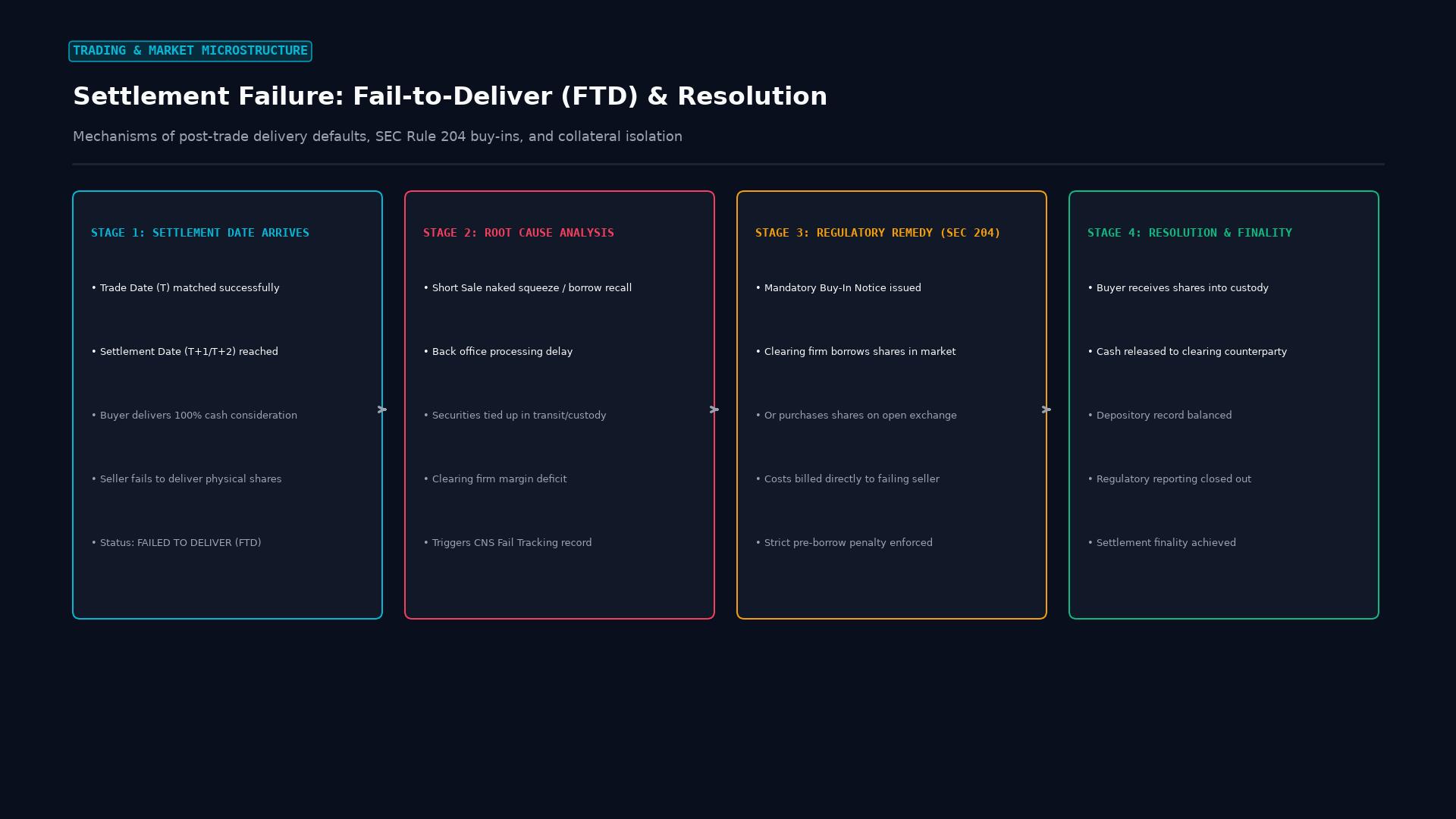 Figure: Post-trade settlement failure mechanics: seller delivery defaults, continuous net settlement fail tracking, and mandatory regulatory buy-ins under SEC Rule 204.
Causes & Regulatory Mechanics (Reg SHO)
Fail positions rarely stem from outright insolvency; instead, they typically result from operational friction, securities lending bottlenecks, or aggressive short selling:
1. Root Causes of Settlement Fails
- Operational & Custodial Delays: Administrative errors, mismatched trade allocation instructions, or international time-zone delays between global custodians.
- Securities Lending Recalls: When an institutional lender recalls loaned shares, the borrower may struggle to locate substitute shares in the open market before the delivery cutoff.
- Naked Short Selling: Selling shares without having borrowed or arranged to borrow the underlying equity prior to trade execution.
2. SEC Regulation SHO & Mandatory Buy-Ins
To prevent systemic risk and manipulative short selling, regulatory bodies enforce strict fail-resolution protocols. Under SEC Rule 204 of Regulation SHO:
- Broker-dealers with an FTD position in an equity security resulting from a long sale must close out the fail position by purchasing or borrowing securities no later than the opening of trading on $T+3$.
- For short sales resulting in an FTD, the firm must close out the fail before market open on $T+1$ after settlement ($T+2$ total).
- If a security experiences persistent, aggregate fail positions of 10,000 shares or more (and equal to at least 0.5% of the issuer’s total shares outstanding) for five consecutive settlement days, it is placed on the Threshold Securities List, triggering mandatory pre-borrow requirements for future short sales.
Financial Penalties & The Treasury Fails Charge
In sovereign debt markets, settlement fails carry direct economic costs governed by market associations. Under the Treasury Market Practices Group (TMPG) Fails Charge Rule, a party failing to deliver US Treasuries is assessed an annualized fee:
$$\text{TMPG Fails Charge} = \max \left( 0, 3.0% - \text{Fed Funds Target Rate} \right)$$
This formula ensures that when benchmark interest rates are low, selling institutions have an active economic incentive to borrow bonds and clear the fail rather than keeping the fail position open as an interest-free source of financing.
Comparative Matrix: Settlement Discrepancy Types
| Discrepancy State | Securities Delivered? | Cash Settled? | Primary Regulatory Risk | Resolution Mechanism |
|---|---|---|---|---|
| Fail to Deliver (FTD) | No | No (funds withheld) | Reg SHO violation; threshold listing | Open market buy-in / securities borrowing |
| Fail to Receive (FTR) | No | No | Capital charge / margin requirement | Counterparty demand notice / cash claim |
| DK (Don’t Know) Trade | No | No | Operational error | Matching trade terms / clearing rejection |
| Settlement Default | No | No | Counterparty insolvency | Central Counterparty (CCP) default waterfall |
Real-World Case Study: The GameStop (GME) Short Squeeze & FTD Explosion
During the historic “meme stock” short squeeze in January 2021, trading in GameStop Corp. (NYSE: GME) generated an unprecedented surge in fail positions:
- Extreme Trading Velocity: Retail and institutional trading volumes surged past 150 million shares per day, exhausting available market liquidity and overwhelming brokerage settlement infrastructure.
- FTD Spike: SEC data revealed that aggregate Fail to Deliver positions in GME spiked to several million shares in late January, representing tens of millions of dollars in unresolved deliveries.
- Clearinghouse Margin Calls: The sudden accumulation of massive fail positions and extreme price volatility prompted the National Securities Clearing Corporation (NSCC) to demand billions of dollars in collateral deposits from retail brokerage firms (such as Robinhood), forcing temporary trading restrictions on retail purchases.
- Mandatory Buy-Ins: As institutional short sellers were forced to execute mandatory open-market buy-ins under Rule 204 to extinguish their fail positions, this forced buying created a feedback loop that propelled the stock price even higher.
Frequently Asked Questions (FAQ)
Does a retail investor notice when an institutional trade results in a fail position?
No. In modern centralized clearing systems (such as the DTC), the central counterparty novates and guarantees trades. A retail buyer’s brokerage account will typically show the purchased shares immediately on settlement date, allowing them to trade or hold as normal, while the broker’s operations department resolves the FTD/FTR ledger balance behind the scenes.
What is a “buy-in” in the context of a fail position?
A buy-in is a mandatory enforcement action where the buyer (or clearing corporation) executes a purchase of the overdue securities on the open market at the prevailing price. Any price difference—as well as associated execution costs and fees—is charged directly to the failing seller.
How does the move from T+2 to T+1 settlement impact fail positions?
The global transition to $T+1$ settlement (implemented in North America in May 2024) significantly compresses the timeline available for post-trade processing, trade affirmation, and securities lending recalls. While $T+1$ reduces systemic counterparty credit risk across clearinghouses, it initially elevates operational fail rates until firms fully automate their post-trade matching pipelines.
Ready to trade forex?
Open a free demo account with a regulated broker. Practice with virtual funds before risking real money.