Callable Loan (Demand Loan)
A callable loan (or demand loan) is a credit facility that features no fixed maturity date and must be repaid in full immediately upon the lender's demand, granting the financing institution absolute control over its credit exposure.
What Is a Callable Loan?
A callable loan (frequently designated in commercial banking as a demand loan or call loan) is a financing agreement that does not have a predetermined, fixed amortization schedule or terminal maturity date. Instead, the lending financial institution retains the unconditional legal prerogative to demand the immediate, full repayment of the outstanding loan balance, along with accrued interest, at any time (“on demand” or “upon call”).
In exchange for assuming this severe liquidity risk, the borrower typically receives a more favorable borrowing interest rate than would be available on a committed term loan. Callable loans are commonly utilized in commercial business lines of credit, inventory financing, bridge facilities, and stock brokerage margin loans extended to retail and institutional equity traders.
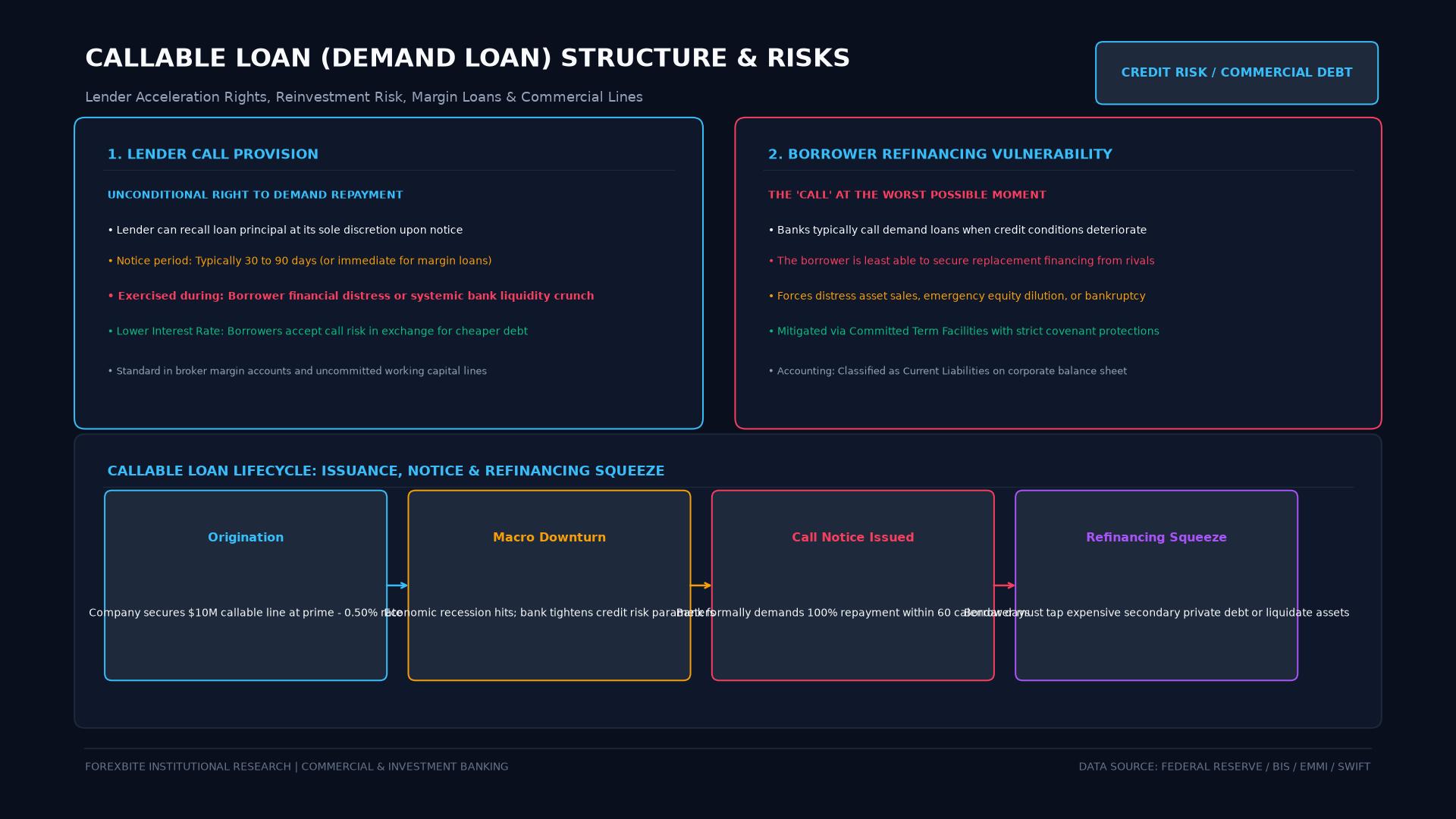 Figure: Lender call option mechanics: demand repayment triggers, debt service covenant breaches, and borrower emergency refinancing risks.
Technical Mechanics & Liquidity Risk Transmission
From a bank balance sheet perspective, a callable loan is categorized as a liquid, short-term asset. Under Basel III liquidity regulations, banks must maintain a Liquidity Coverage Ratio (LCR) sufficient to survive a 30-day severe systemic liquidity stress scenario.
The Basel III Liquidity Inflow Weighting
Because a callable loan gives the bank the contractual right to demand repayment within 30 days, the unencumbered principal balance can be classified as a Contractual Inflow:
$$\text{Liquidity Coverage Ratio (LCR)} = \frac{\text{Stock of High-Quality Liquid Assets (HQLA)}}{\text{Total Net Cash Outflows over 30 Days}} \ge 100%$$
$$\text{Net Cash Outflows} = \text{Total Cash Outflows} - \min\left( \text{Contractual Inflows}, 0.75 \times \text{Total Outflows} \right)$$
When commercial banks face acute liquidity drains or severe deposit runs, calling in demand loans allows them to rapidly replenish central bank reserve balances.
Floating Rate Pricing Model
Callable loans are priced on a floating spread over an overnight reference rate:
$$r_{\text{loan}}(t) = \text{Reference Rate}(t) + \text{Borrower Credit Spread}$$
Where the reference rate is typically the Secured Overnight Financing Rate (SOFR) or the commercial bank’s Prime Rate.
Comparative Matrix: Commercial Debt Facilities
| Debt Structure | Repayment Horizon | Calling Rights of Lender | Interest Rate Type | Primary Use Case |
|---|---|---|---|---|
| Callable (Demand) Loan | Upon lender demand (0-30 days) | Unconditional / At any time | Floating (SOFR / Prime) | Broker margin, short-term working capital |
| Committed Term Loan | Fixed multi-year schedule | Only upon legal covenant default | Fixed or Floating | Long-term capital expenditure, plant & equipment |
| Revolving Credit Facility (RCF) | Multi-year borrowing window | Capped at covenant violations | Floating | Corporate seasonal liquidity buffering |
| Overdraft Facility | Continuous revolving balance | Retains immediate call rights | Floating | Intraday operational cash smoothing |
Real-World Case Study: The 2008 Credit Crunch & Corporate Margin Calls
The acute dangers of debt facilities with callable clauses became evident during the onset of the 2008 Global Financial Crisis.
Anatomy of a Demand Loan Liquidity Freeze:
1. The Scenario: Mid-sized manufacturing and distribution corporations routinely financed raw material inventories using uncommitted bank demand lines and callable credit notes.
2. The Interbank Freeze: Following the bankruptcy of Lehman Brothers in September 2008, commercial banks faced severe liquidity deficits and counterparty panic.
3. The Call Exercise: To defend their own capital reserves, major global banks invoked the demand clauses on tens of billions of dollars in outstanding callable loans, giving corporate borrowers as little as 48 hours to wire full principal repayments.
4. Corporate Insolvency: Solvent companies with profitable operations could not secure alternative credit or liquidate physical inventory within 48 hours. Many sound enterprises were forced into emergency asset fire sales or Chapter 11 bankruptcy filings.
The crisis forced corporate treasurers to restructure balance sheets, replacing callable credit lines with committed, non-callable term facilities.
Frequently Asked Questions (FAQ)
Why would a business accept a callable loan if the bank can demand repayment at any time?
Borrowers accept callable loans because they carry significantly lower interest rates and reduced origination fees compared to committed multi-year term loans. Committed facilities require banks to set aside regulatory capital reserves against potential future drawdowns, costs which banks pass on to borrowers in the form of commitment fees and higher spreads. For businesses with highly liquid receivables, a callable loan provides flexible, low-cost short-term financing.
How does a brokerage margin loan operate as a callable loan?
When an investor borrows money from a stock or forex broker to trade on margin, the financing agreement is structured as a classic demand loan. If the value of the collateral securities in the trader’s account drops below the broker’s maintenance margin requirement, the broker issues a margin call. If the trader fails to deposit additional cash immediately, the broker exercises its legal right under the callable loan agreement to liquidate the trader’s positions in the open market to recover the loan balance.
What legal notice is required before a lender can demand repayment on a callable loan?
The required notice period depends on the specific commercial contract and local jurisdiction laws. In many demand notes, the loan is legally due “on demand,” meaning the bank can require payment within 24 to 72 hours of delivering written notice. However, commercial courts in some jurisdictions apply a common-law “reasonable time” doctrine, requiring the lender to provide the borrower a commercially reasonable window (typically 10 to 30 days) to arrange refinancing before seizing pledged physical collateral.
Ready to trade forex?
Open a free demo account with a regulated broker. Practice with virtual funds before risking real money.