Fairly Valued
A security or asset is described as fairly valued when its current market price is consistent with its estimated intrinsic value — meaning investors are receiving appropriate compensation for the risks assumed, with neither a meaningful margin of safety (undervalued) nor an unjustified premium (overvalued) evident.
What Does “Fairly Valued” Mean?
In fundamental equity analysis and institutional asset management, a security, asset, or entire market index is described as fairly valued when its current observable market price precisely coincides with its estimated intrinsic value — the present discounted value of all future expected cash flows adjusted for appropriate risk.
A fairly valued asset represents the equilibrium state described by the Efficient Market Hypothesis (EMH): the price fully reflects all available public information and offers investors neither an extraordinary bargain nor an irrational overpricing. In this state, the expected return of holding the security equals its required rate of return given its risk profile — providing no exploitable alpha.
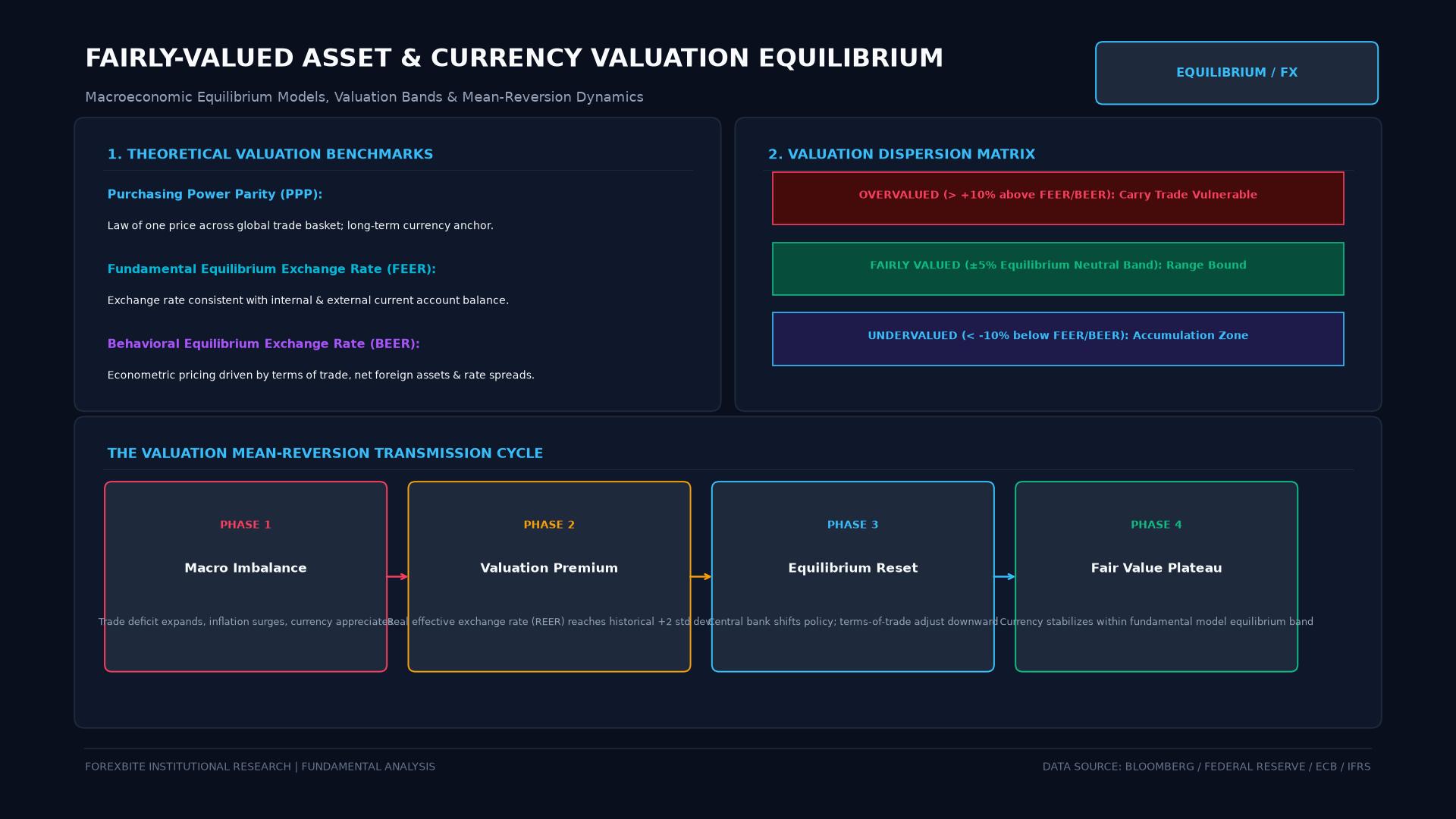 Figure: Macroeconomic fair value modeling framework comparing Purchasing Power Parity (PPP), Fundamental Equilibrium Exchange Rates (FEER), and Behavioral Equilibrium Exchange Rates (BEER) with mean-reverting valuation bands.
Technical Mechanics: Determining Fair Value
1. The Justified P/E Multiple (Gordon Growth Model)
The Justified P/E ratio represents what the market should pay for a dollar of current earnings given a company’s growth and risk characteristics:
$$\text{Justified P/E} = \frac{(1 - b)}{k - g} \cdot (1 + g)$$
Where:
- $b$: Earnings retention rate (1 - dividend payout ratio).
- $k$: Required rate of return (cost of equity, e.g., from CAPM).
- $g$: Sustainable long-term earnings growth rate.
If the market trades at the Justified P/E, the asset is considered fairly valued.
2. Tobin’s Q — Market Aggregate Fair Value Signal
$$\text{Tobin’s Q} = \frac{\text{Total Market Capitalization of All Public Companies}}{\text{Net Worth of All Businesses at Replacement Cost}}$$
- Q = 1.0: Fairly valued (market price = replacement cost of assets).
- Q > 1.5: Overvalued (Warren Buffett’s preferred macro-valuation signal).
- Q < 0.8: Undervalued (assets cheaper to buy on market than to build from scratch).
Comparative Matrix: Valuation Status Signals
| Metric | Undervalued Zone | Fairly Valued Zone | Overvalued Zone |
|---|---|---|---|
| Trailing P/E vs. Historical Average | < 75% of historical mean | 75–125% of historical mean | > 125% of historical mean |
| EV/EBITDA vs. Sector Peers | < Peer group median - 1σ | Within ±1σ of peer median | > Peer group median + 1σ |
| Price-to-Book vs. ROE | P/B < ROE-justified level | P/B = ROE-justified level | P/B >> ROE-justified level |
| Dividend Yield vs. Bond Yield | Dividend yield > Bond yield | Dividend yield ≈ Bond yield | Dividend yield << Bond yield |
Real-World Case Study: S&P 500 “Fair Value” Debate (2021–2022)
The institutional debate over the concept of fair value played out dramatically during the Federal Reserve’s post-pandemic monetary tightening cycle.
The Faulty "Fair Value" Defense of 2021:
1. The Bull Case: In late 2021, with the S&P 500 at 4,800 and trading at 25x trailing earnings, many Wall Street strategists declared the index "fairly valued" based on a low-interest-rate Justified P/E model: with 10-year Treasury yields at 1.5%, a 25x P/E was mathematically justifiable (Earnings Yield of 4.0% vs. Bond Yield of 1.5%).
2. The Rate Shock: The Federal Reserve then raised benchmark interest rates by 500 basis points between March 2022 and July 2023 — the fastest hiking cycle in 40 years.
3. The Valuation Collapse: As the risk-free rate rose from 0.25% to 5.50%, the "required rate of return" (k) in the Justified P/E formula increased dramatically, compressing the mathematically defensible P/E multiple from 25x down to approximately 17-18x.
4. The Market Reaction: The S&P 500 declined 25.4% from peak to trough in 2022 — not because earnings collapsed, but because what constituted "fair value" at the higher interest rate environment was dramatically lower.
Frequently Asked Questions (FAQ)
Why is it rare for experienced investors to find assets they agree are “fairly valued”?
True fair value is elusive and contested because every investor brings different assumptions about future earnings growth rates, appropriate discount rates, and macroeconomic outlooks. A growth investor might model a 20% annual earnings growth rate and conclude a stock is undervalued at 40x P/E. A value investor applying an 8% growth rate would classify the same stock as significantly overvalued. Since investors’ DCF inputs differ, the market price is virtually never universally agreed upon as “fair value.”
How does the concept of fairly valued apply to foreign exchange (forex) markets?
In FX markets, the fair value of a currency pair is estimated through Purchasing Power Parity (PPP) theory — a currency is fairly valued when a standardized basket of goods costs the same price in both countries after adjusting for the nominal exchange rate. When a currency trades significantly above PPP fair value, it is considered overvalued (likely to weaken over long time horizons). When significantly below PPP, it is undervalued. The Economist’s famous “Big Mac Index” operationalizes this concept.
Can an entire asset class — such as equities or bonds — be fairly valued?
Macro strategists and central banks regularly assess whether broad asset classes are fairly valued relative to their long-run historical averages. Federal Reserve economists publish the Cyclically Adjusted Price-to-Earnings Ratio (CAPE / Shiller P/E) — calculated as current price divided by the 10-year inflation-adjusted average earnings — as the most widely accepted measure of stock market aggregate fair value. A CAPE ratio at historical mean (~17x) suggests fair value; above 30x historically precedes poor 10-year forward returns.
Ready to trade forex?
Open a free demo account with a regulated broker. Practice with virtual funds before risking real money.