Fair Price Provision
A fair price provision is an anti-takeover corporate charter amendment requiring an acquiring bidder to pay minority shareholders a fair and uniform price per share—determined by statutory formula or equivalent to the highest price paid in early accumulation stages—unless the business combination is approved by a supermajority shareholder vote.
What Is a Fair Price Provision?
In corporate governance, mergers and acquisitions (M&A), and securities law, a fair price provision is a protective charter amendment designed to defend public companies and their minority stockholders against coercive, two-tiered tender offers and opportunistic corporate raids.
During a hostile takeover, an aggressive acquirer historically structured a two-tiered tender offer: offering a premium cash price in the first tier to rapidly accumulate 51% voting control, followed by a second-tier “squeeze-out” merger offering illiquid subordinated notes or discounted stock to remaining shareholders.
A fair price provision eliminates this coercive pressure. It legally mandates that unless a supermajority of shareholders (typically 75% to 80%) or a majority of disinterested independent directors approves the merger, the acquirer must pay remaining minority shareholders a price at least equal to the highest price paid by the bidder during the preceding 12 to 24 months.
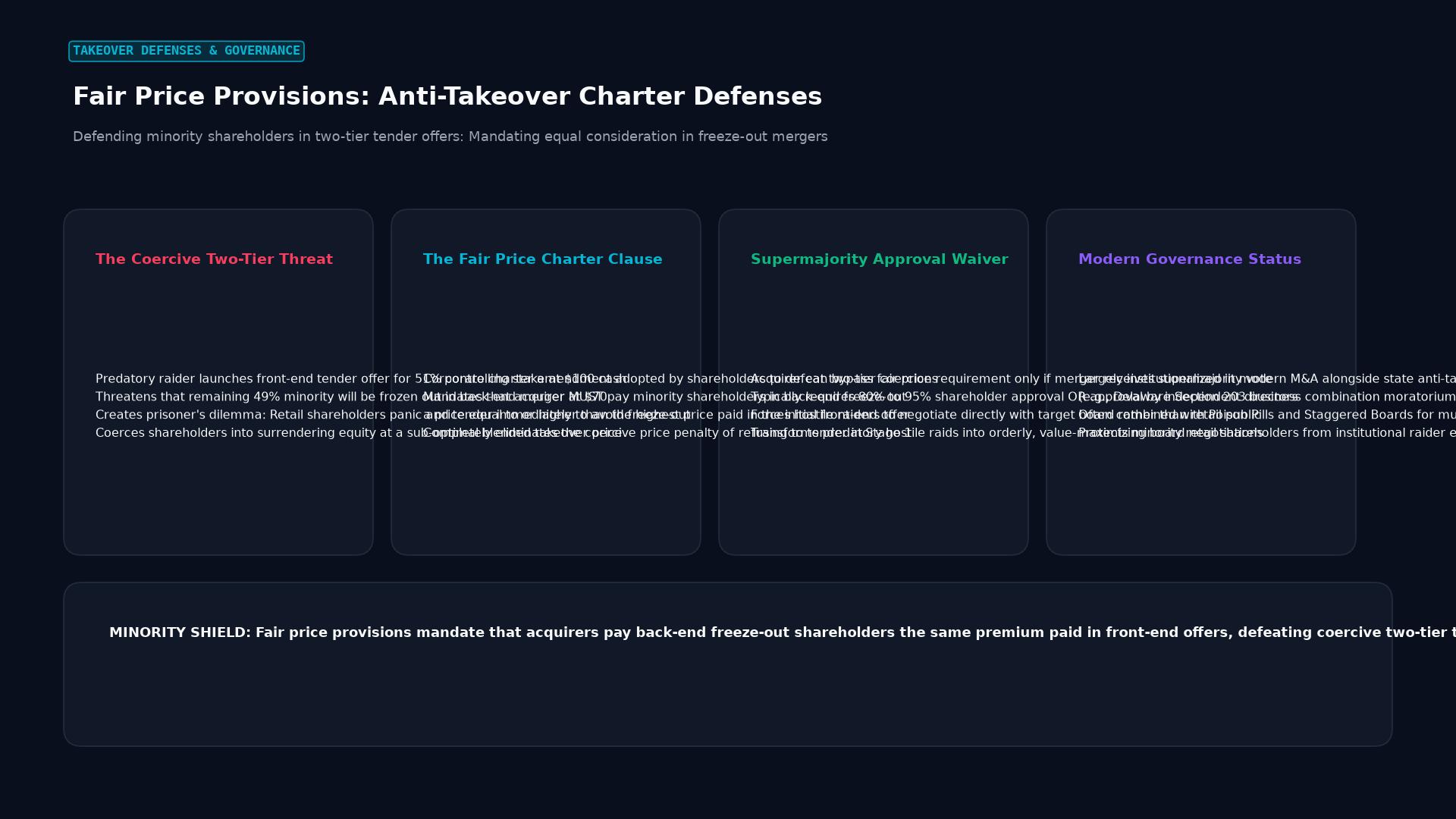 Figure: Defending minority shareholders in two-tier tender offers: Mandating equal consideration in freeze-out mergers
Technical Mechanics & Valuation Formulas
Under standard corporate bylaws in Delaware and other major corporate jurisdictions, a fair price clause triggers explicit pricing formulas:
1. Minimum Price Formula
The consideration paid to each common stockholder in the backend merger must equal or exceed the greatest of: $$P_{\text{Fair}} = \max\left(P_{\text{High}}, P_{\text{Market}} \times (1 + \text{Premium}), P_{\text{PE}}\right)$$
Where:
- $P_{\text{High}}$ = Highest gross price paid by the interested stockholder within the prior 2 years.
- $P_{\text{Market}}$ = Highest market closing price of the common stock between the acquisition date and the announcement date.
- Premium = Historical acquisition premium paid during the initial tender offer.
- $P_{\text{PE}}$ = Price reflecting the target company’s earnings per share multiplied by the bidder’s price-to-earnings ratio.
2. Elimination of Disparate Consideration
The provision prohibits the bidder from paying cash to preferred institutional insiders while issuing non-voting, junior securities to public retail shareholders. All classes of stock must receive identical consideration in form and currency.
Comparative Matrix: Anti-Takeover Defenses (“Shark Repellents”)
| Defense Mechanism | Primary Legal Objective | Implementation Method | Shareholder Approval Needed? | Impact on Target Stock Price |
|---|---|---|---|---|
| Fair Price Provision | Prevent coercive two-tier pricing; guarantee equal payout | Charter amendment / supermajority clause | Yes (Shareholder vote required) | Neutral to slightly positive |
| Poison Pill (Shareholder Rights Plan) | Dilute bidder’s voting stake by issuing discounted shares | Board resolution | No (Enacted directly by Board) | Moderately negative (entrenchment risk) |
| Staggered Board | Prevent acquirer from replacing board in single proxy battle | Multi-year election classes (3 years) | Yes (Charter amendment) | Neutral |
| Golden Parachute | Increase takeover cost via massive executive severance packages | Executive compensation agreements | Often subject to non-binding say-on-pay | Neutral |
Real-World Case Study: 1980s Leveraged Buyout Wave & Charter Defense
During the 1980s leveraged buyout (LBO) boom on Wall Street, corporate acquirers routinely utilized junk bond financing to launch two-tier tender offers against undervalued manufacturing firms:
- The Threat: In 1984, a prominent corporate raider accumulated a 14% stake in a Midwest industrial components manufacturer and issued a tender offer of $55 cash for up to 51% of shares, openly stating that remaining shares would be converted into 10-year junior debentures valued at approximately $38.
- The Defense: Sensing vulnerability, the target’s board of directors had previously submitted a comprehensive Fair Price Amendment to shareholders, which was ratified by 78% of voting stock.
- The Enforcement: When the raider reached 51%, the fair price provision triggered, legally preventing the backend merger unless every remaining shareholder received $55 in cash or an 80% supermajority voted in favor.
- The Outcome: Unable to finance the additional $240 million in cash required to cash out the remaining 49% at $55, the bidder was forced to enter friendly negotiations with the board, eventually selling their stake back at a moderate premium or accepting board representation.
Frequently Asked Questions (FAQ)
Does a fair price provision prevent all hostile takeovers?
No. A fair price provision does not prevent a bidder from acquiring a company if they make a fully financed, all-cash tender offer for 100% of the outstanding shares at a uniform, fair price. It only blocks predatory, two-tiered structural tactics that penalize holdout shareholders.
Why do institutional investors generally support fair price provisions?
Unlike poison pills or staggered boards—which can entrench underperforming management teams and destroy shareholder value—institutional asset managers (such as BlackRock and Vanguard) often vote in favor of fair price provisions because they directly protect fiduciary portfolios from being squeezed out at unfair discounts.
Can an acquirer bypass a fair price provision?
Yes, typically through two avenues:
- Gaining the approval of a supermajority vote (e.g., 80% of all voting shares).
- Securing the unanimous or supermajority approval of the target company’s continuing independent directors prior to crossing the ownership threshold.
Ready to trade forex?
Open a free demo account with a regulated broker. Practice with virtual funds before risking real money.