Earnings Management
Earnings management is the deliberate, opportunistic manipulation of a corporation's reported financial results by executive management through aggressive-but-legal accounting choices or outright fraudulent transactions, with the goal of meeting analyst consensus estimates, triggering executive bonuses, or sustaining stock valuations.
What Is Earnings Management?
Earnings management refers to the strategic, purposeful exploitation of managerial discretion embedded within Generally Accepted Accounting Principles (GAAP) — or outright violations thereof — to deliberately inflate, deflate, or smooth reported corporate financial results in order to achieve specific financial targets set by capital markets, executive compensation contracts, or debt covenant agreements.
Researchers and regulators distinguish between two distinct forms:
- Accrual-Based Earnings Management (Legal “Gray Zone”): Exercising subjective GAAP accounting choices within permissible boundaries — such as accelerating revenue recognition, extending asset useful lives to reduce depreciation charges, or releasing previously overstated bad-debt reserves — to shift reported income between accounting periods.
- Real Activity Earnings Management (Operationally Destructive): Making genuinely harmful business decisions that destroy long-term value purely to hit short-term quarterly earnings targets — such as slashing R&D budgets in December, offering year-end channel-stuffing discounts to flood distributors with unwanted inventory, or cutting essential maintenance capital expenditures.
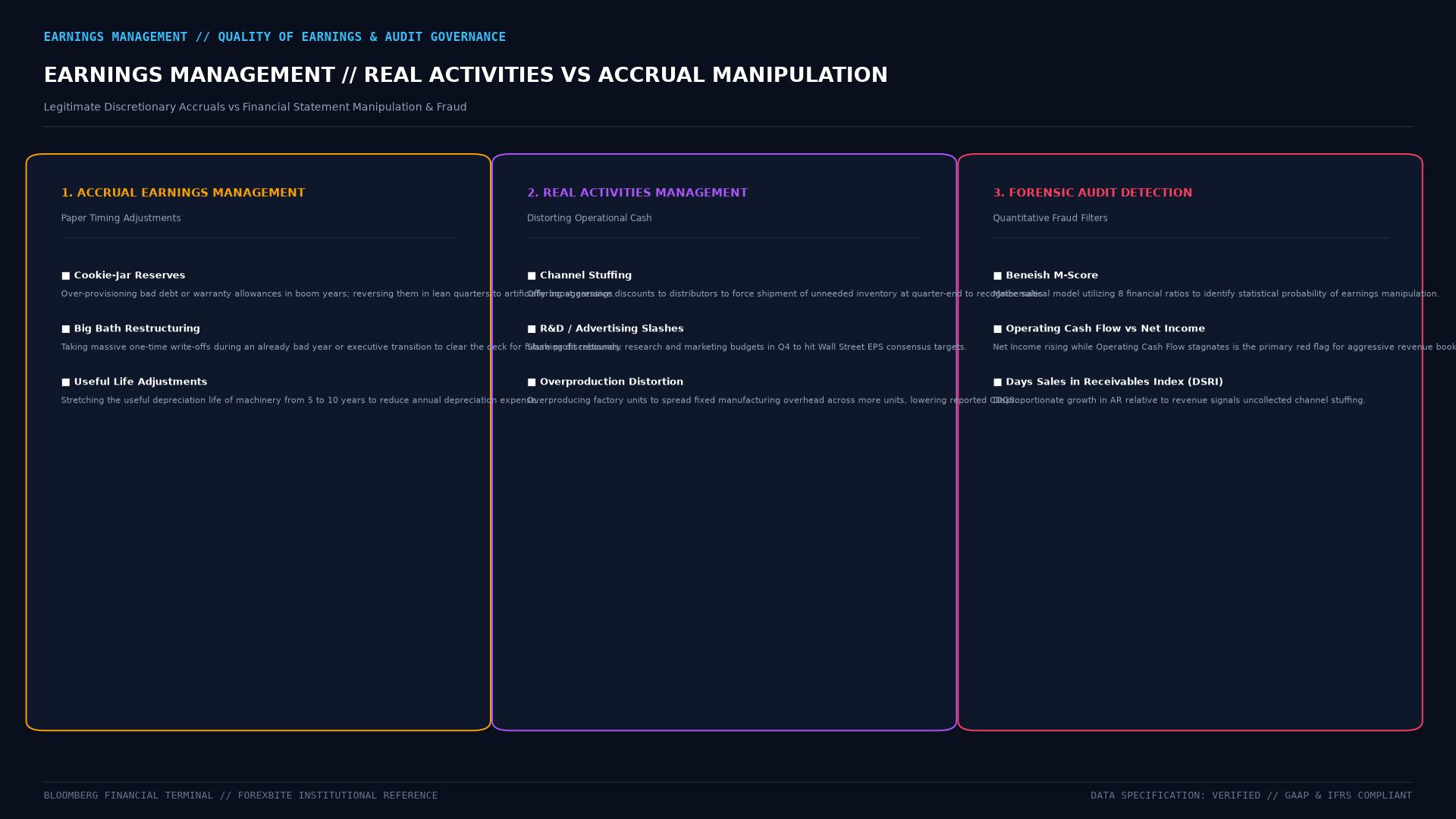 Figure: The Earnings Management continuum from conservative accounting and GAAP-compliant accrual timing to aggressive income smoothing and fraudulent financial statement manipulation (Beneish M-Score).
Technical Mechanics: Detecting Earnings Management
Forensic accountants and quantitative analysts utilize the Jones Model and its modifications to detect abnormal accrual manipulation:
The Modified Jones Model for Abnormal Accruals
Total accruals ($TA_t$) are decomposed into normal (economically justified) and abnormal (manipulation-driven) components:
$$\frac{TA_t}{A_{t-1}} = \alpha_1 \cdot \frac{1}{A_{t-1}} + \alpha_2 \cdot \frac{\Delta \text{Rev}_t - \Delta \text{AR}t}{A{t-1}} + \alpha_3 \cdot \frac{\text{PPE}t}{A{t-1}} + \varepsilon_t$$
Where:
- $A_{t-1}$: Total assets at beginning of period (scaling factor).
- $\Delta \text{Rev}_t - \Delta \text{AR}_t$: Change in revenue net of change in accounts receivable (isolates cash-backed sales from credit manipulation).
- $\text{PPE}_t$: Gross Property, Plant & Equipment (controls for depreciation accruals).
- $\varepsilon_t$: Abnormal accruals — the residual unexplained by business fundamentals, signaling potential manipulation.
High positive $\varepsilon_t$ (abnormally high accruals versus industry peers) is the primary forensic signal that investors and SEC enforcement teams investigate.
Comparative Matrix: Earnings Management Typologies
| Technique | GAAP Legal Status | Detection Difficulty | Long-Run Earnings Impact |
|---|---|---|---|
| Reserve Release / Cookie Jar | Legal (Aggressive GAAP) | Moderate | Future earnings depleted |
| Channel Stuffing | Legal but deceptive | Hard (requires channel checks) | Returns destroy future quarters |
| Bill-and-Hold Sales | Gray zone (SEC scrutinized) | Hard | Revenue pulled forward unsustainably |
| Round-Tripping | Illegal (Securities Fraud) | Hard (requires forensic audit) | No real revenue created |
| SPE / Off-Balance Sheet | Illegal (Post-Enron) | Very Hard | Massive restatement risk |
Real-World Case Study: General Electric’s “Cookie Jar” Reserves (1994–2004)
The most sophisticated legal-but-deceptive long-running earnings management program was conducted by General Electric Capital (GE) under CEO Jack Welch.
Anatomy of Industrial-Scale "Smoothing":
1. The Mechanism: GE Capital accumulated massive, deliberately overstated reserves during strong economic years.
2. The Release: During slower-growth quarters where GE's industrial businesses underperformed, finance executives released precisely the amount of reserve to deliver analysts their expected +10 to +12% quarterly EPS growth.
3. The Track Record: GE met or beat Wall Street consensus EPS estimates for 46 consecutive quarters, never once missing — a statistically near-impossible outcome in volatile global capital markets.
4. The Investigation: In 2009, the SEC investigated GE's earnings smoothing practices and eventually extracted a $50 million settlement, the largest financial reporting penalty in history at the time.
5. The Unraveling: When GE's insurance liabilities surfaced in 2017 requiring $15 billion in reserve top-ups, the market realized that decades of "smooth" earnings had been achieved by systematically understating hidden liabilities.
Frequently Asked Questions (FAQ)
What is the difference between earnings management and outright accounting fraud?
Earnings management exploits the genuine discretion built into GAAP accounting rules — selecting aggressive-but-permissible estimates (such as extending asset depreciation lives or releasing loan loss reserves). The results are technically accurate by accounting standards, even if economically misleading. Accounting fraud crosses into criminal securities law by fabricating transactions, fictitious revenue, or false invoices that never existed in economic reality. The former may result in SEC civil enforcement; the latter triggers federal criminal prosecution under the Sarbanes-Oxley Act (SOX) and securities fraud statutes.
What is “big bath” earnings management?
A big bath is a deliberate accounting strategy where a new incoming CEO or CFO massively overstates one-time losses, write-downs, restructuring charges, and asset impairments in a single disastrous quarter — deliberately making earnings appear catastrophic. By “taking all the pain at once,” the new management team lowers the accounting cost base for all subsequent periods, ensuring that future quarters produce dramatically improved, clean earnings — creating the perception of a successful corporate turnaround that directly benefits executive stock option grants.
How do institutional investors screen for earnings management risk?
Sophisticated quantitative equity analysts screen for earnings management red flags using several algorithmic indicators: the Beneish M-Score (a multivariate model that identifies statistical outliers in accrual ratios, asset quality indices, and sales growth patterns), monitoring the Days Sales Outstanding (DSO) trend relative to peers (rapidly rising DSO signals channel stuffing), tracking the ratio of Operating Cash Flow to Net Income (manipulated earnings frequently diverge sharply from actual cash generation), and examining auditor change patterns in company filings.
Ready to trade forex?
Open a free demo account with a regulated broker. Practice with virtual funds before risking real money.