Far option
A far option is the contract possessing the later expiration date within a multi-leg options strategy such as a calendar spread, diagonal spread, or volatility trade.
In derivatives and options trading, the term “far option” (frequently referred to as the back-month option or distant-leg contract) designates the specific options contract possessing the later expiration date within a multi-leg trading strategy. Most commonly deployed in horizontal calendar spreads, diagonal spreads, and ratio time structures, the far option is paired against a “near option” (front-month contract) with identical or differing strike prices. Because options pricing models incorporate time to expiration as an exponential variable, the far option exhibits distinct quantitative characteristics, including slower daily time decay (Theta) and substantially higher sensitivity to changes in implied volatility (Vega).
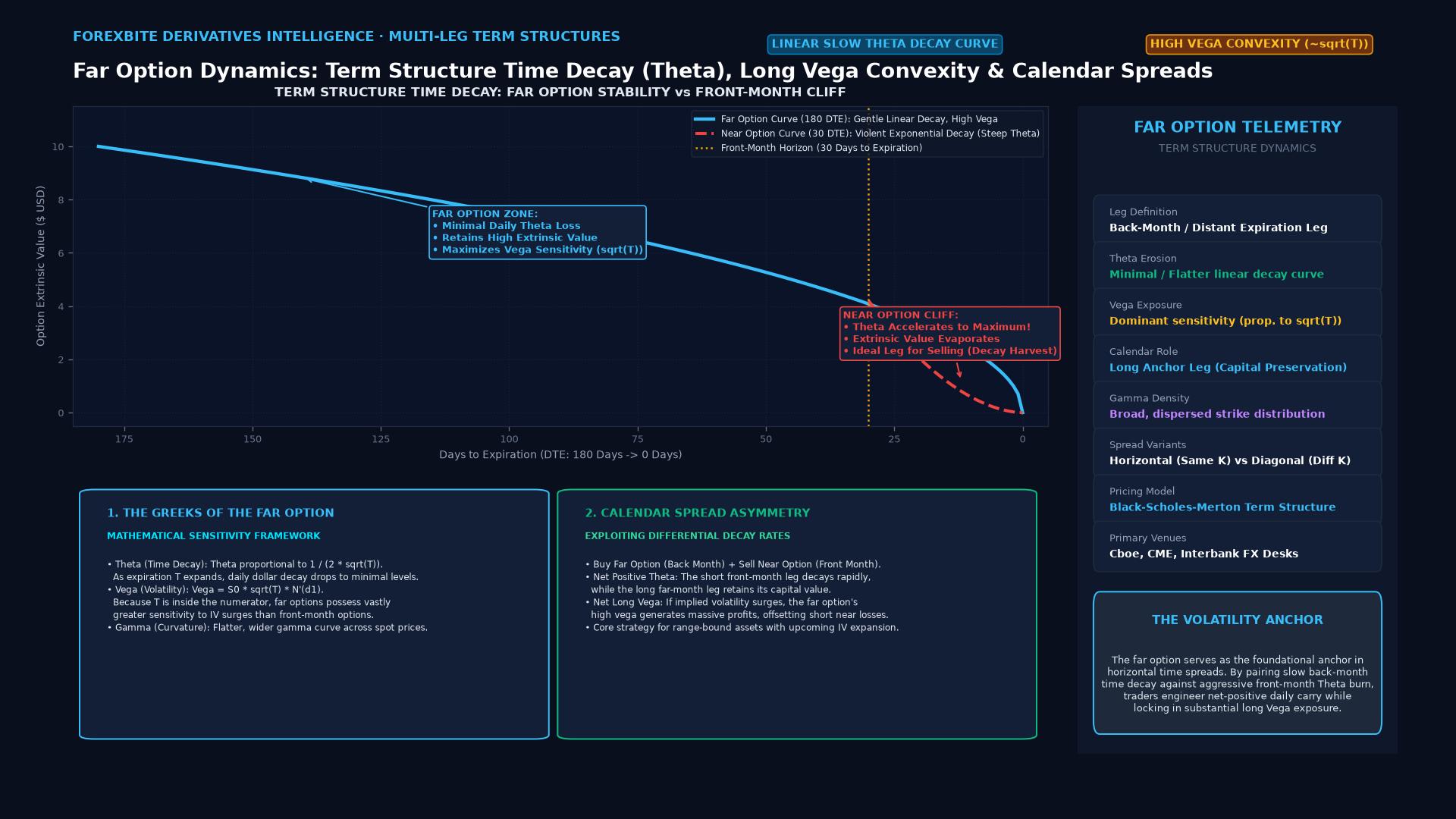 Figure: Options term structure comparison between a far option (slow linear theta erosion, high vega) and near option (exponential decay cliff).
The Mathematical Framework: Greeks of the Far Option
The behavior of a far option is governed by the Black-Scholes-Merton model and its sensitivity metrics (the Options Greeks). When analyzing a far option relative to a front-month near option, three mathematical dynamics dominate:
1. Theta ($\Theta$) and Non-Linear Time Decay
Theta measures the rate of decline in the value of an option due to the passage of time, assuming all other variables remain constant. The decay curve of an option is non-linear:
- For options with many months until expiration (far options), the erosion of extrinsic value is gradual and relatively flat.
- In the final 30 to 45 days prior to expiration (near options), the decay of at-the-money extrinsic value accelerates exponentially toward zero.
$$\Theta_{\text{call}} = -\frac{S_0 N’(d_1) \sigma}{2 \sqrt{T}} - r K e^{-rT} N(d_2)$$
Because time $T$ resides in the denominator, as $T$ becomes large in a far option, the absolute daily Theta decay is minimal compared to an option nearing expiration.
2. Vega ($\nu$) and Volatility Exposure
Vega measures the sensitivity of an option’s theoretical price to a one-percentage-point change in implied volatility. Unlike Theta, Vega expands with time to expiration:
$$\nu = S_0 \sqrt{T} N’(d_1)$$
Because the square root of time $\sqrt{T}$ multiplies the equation, a far option has far greater Vega than a near option. If market-wide implied volatility increases by 3 percentage points, the far option gains substantially more premium than the near option, creating a structural volatility advantage for long-calendar spread positions.
3. Gamma ($\Gamma$) and Delta ($\Delta$) Stability
Gamma measures the rate of change in Delta per unit move in the underlying asset. Near options exhibit extreme Gamma risk near expiration; if the underlying asset moves near the strike price, Delta can jump rapidly between 0 and 1. Far options, by contrast, feature broad, subdued Gamma profiles. The Delta of a far option changes smoothly, providing portfolio managers with stable, predictable directional hedging characteristics.
Strategic Applications in Multi-Leg Options Structures
Institutional derivatives desks and quantitative retail traders deploy far options across several core structures:
1. The Standard Long Calendar Spread (Time Spread)
In a horizontal long calendar spread, a trader sells an at-the-money near option (e.g., expiring in 30 days) and purchases an at-the-money far option (e.g., expiring in 90 days) at the identical strike price:
- Net Position: Debit spread with net positive Vega and net positive Theta.
- The Profit Engine: The trader aims for the underlying asset to remain stable near the strike price. The short near option decays rapidly to zero, allowing the trader to capture its extrinsic value. Meanwhile, the long far option retains the majority of its premium due to its slower decay curve.
- Post-Expiration Optionality: Once the near option expires, the trader still owns the far option, which can be sold to close the trade, held for further gains, or used to sell another newly created near-term option against it.
2. Diagonal Spreads
A diagonal spread combines differences in both expiration dates and strike prices. A trader might buy an in-the-money far call option with 120 days to expiration and sell an out-of-the-money near call option with 25 days to expiration. The far option serves as collateral and long-term synthetic exposure, while the near option generates recurring monthly premium income.
3. Synthetic Stock Replacement (Poor Man’s Covered Call)
Purchasing 100 shares of a high-priced mega-cap equity requires substantial capital. Instead, a trader can purchase a deep in-the-money far option (such as a LEAPS contract expiring in 12 to 24 months with an 0.80 to 0.90 Delta).
- The far option behaves almost identically to owning physical stock, moving point-for-point with the underlying asset.
- The trader then sells out-of-the-money near options on a monthly cycle against this far option, generating systematic cash flow while committing only a fraction of the capital required to purchase physical equity shares.
| Parameter | Near Option (Front-Month) | Far Option (Back-Month) |
|---|---|---|
| Typical Expiration | 7 to 45 Days | 60 to 730 Days (LEAPS) |
| Daily Theta Decay | High and accelerating exponentially | Low and relatively linear |
| Vega Sensitivity | Low; minimal impact from IV shifts | High; major driver of contract value |
| Gamma Risk | Severe near the strike at expiration | Low; gradual and manageable Delta shifts |
| Capital Requirement | Modest premium cost | Substantial premium cost due to high time value |
| Primary Trading Role | Income generation (typically sold short) | Asset anchor / hedge (typically held long) |
Risk Management and Volatility Skew Considerations
Trading structures that involve far options introduce complex risks that do not exist in single-leg option positions:
Term Structure of Implied Volatility
Options across different expirations do not trade at identical implied volatility levels. The relationship between implied volatility and time to expiration is known as the volatility term structure. If the market is in contango (longer-dated far options carry higher IV than near options), establishing a long calendar spread requires paying a premium. If an unexpected macroeconomic shock causes front-month IV to spike relative to back-month IV (backwardation), the calendar spread can suffer losses even if the underlying price remains stationary.
Liquidity and Bid-Ask Friction
Near-month contracts typically attract the heaviest retail and market-maker volume, resulting in tight penny-wide bid-ask spreads. Far options, particularly contracts with expiration dates beyond six months, frequently suffer from wider spreads and lower open interest. Institutional traders utilize limit orders and multi-leg net-price routing to avoid giving up edge when executing complex far-option combinations.
Frequently Asked Questions
Can a far option be exercised before the near option expires?
In American-style options markets, any option holder can exercise an option at any time prior to expiration. However, early exercise of a far option is almost never economically rational. Exercising an option early forfeits all remaining extrinsic (time) value. A trader wishing to exit a long far option position achieves far higher proceeds by selling the contract in the secondary market rather than exercising it.
What happens to a calendar spread if the underlying stock makes a massive gap move?
A massive price move in either direction hurts a standard at-the-money calendar spread. While the short near option may expire worthless or become deep in the money, the long far option loses substantial value if price moves far away from the strike, because the extrinsic value of out-of-the-money or deep-in-the-money far options diminishes. Calendar spreads achieve maximum profitability when the underlying asset settles directly at the strike price at near-option expiration.
How does rolling a near option affect the far option?
Rolling is the practice of closing an expiring near option and selling a new near-term option with a later expiration date while keeping the original far option in place. This technique continuously reduces the net debit (cost basis) of the long far option, eventually turning the multi-month position into a risk-free or negative-cost trade.
Ready to trade forex?
Open a free demo account with a regulated broker. Practice with virtual funds before risking real money.