Theta
A fundamental first-order option Greek that quantifies the rate of decline in a derivative contract's theoretical market value over time, representing the daily financial cost of time decay under ceteris paribus conditions.
What Is Theta?
In options pricing and quantitative derivatives modeling, Theta ($\Theta$) is the Greek metric that measures an option’s sensitivity to the passage of time. Frequently referred to by professional traders as “time decay” (or the “silent option thief”), Theta represents the absolute dollar or pip amount by which an option’s extrinsic value declines with each calendar day that elapses, assuming all other market variables—such as underlying price, implied volatility, and interest rates—remain completely constant.
Because every options contract possesses a finite expiration date, the probability that an out-of-the-money or at-the-money contract will expire with profitable intrinsic value mathematically diminishes with every passing second.
Consequently:
- Option Buyers (Long Options) hold a negative Theta ($\Theta < 0$) profile. Time decay works continuously against them, acting as a constant daily carrying cost.
- Option Sellers / Writers (Short Options) hold a positive Theta ($\Theta > 0$) profile. Time decay works directly in their favor, allowing them to earn daily premium income as the option slowly bleeds value toward expiration.
The Mathematical Derivation of Theta in the Black-Scholes Model
In the standard Black-Scholes-Merton continuous-time framework, Theta is expressed as the partial derivative of the option pricing function ($V$) with respect to time to maturity ($t$):
$$\Theta = -\frac{\partial V}{\partial t}$$
1. Theta for a European Call Option
$$\Theta_{\text{Call}} = -\frac{S \cdot \phi(d_1) \cdot \sigma}{2 \sqrt{t}} - r K e^{-r t} \Phi(d_2)$$
2. Theta for a European Put Option
$$\Theta_{\text{Put}} = -\frac{S \cdot \phi(d_1) \cdot \sigma}{2 \sqrt{t}} + r K e^{-r t} \Phi(-d_2)$$
Where:
- $S$: Current spot price of the underlying asset.
- $K$: Option strike price.
- $\sigma$: Annualized implied volatility.
- $t$: Time to maturity (in years).
- $r$: Risk-free interest rate.
- $\phi(d_1)$: Standard normal probability density function: $\phi(x) = \frac{1}{\sqrt{2\pi}} e^{-x^2 / 2}$.
- $\Phi(d_2)$: Cumulative standard normal distribution function.
Because trading platforms quote Theta on a per-day basis, the annualized Black-Scholes Theta is typically divided by 365 (or 252 trading days):
$$\text{Daily Theta} = \frac{\Theta_{\text{Annual}}}{365}$$
If a call option trades at $4.50 with a daily Theta of $-0.08$, and the market remains motionless over the next 24 hours, the option will open the following morning valued at $4.42.
The Non-Linear “30-Day Cliff” and Moneyness
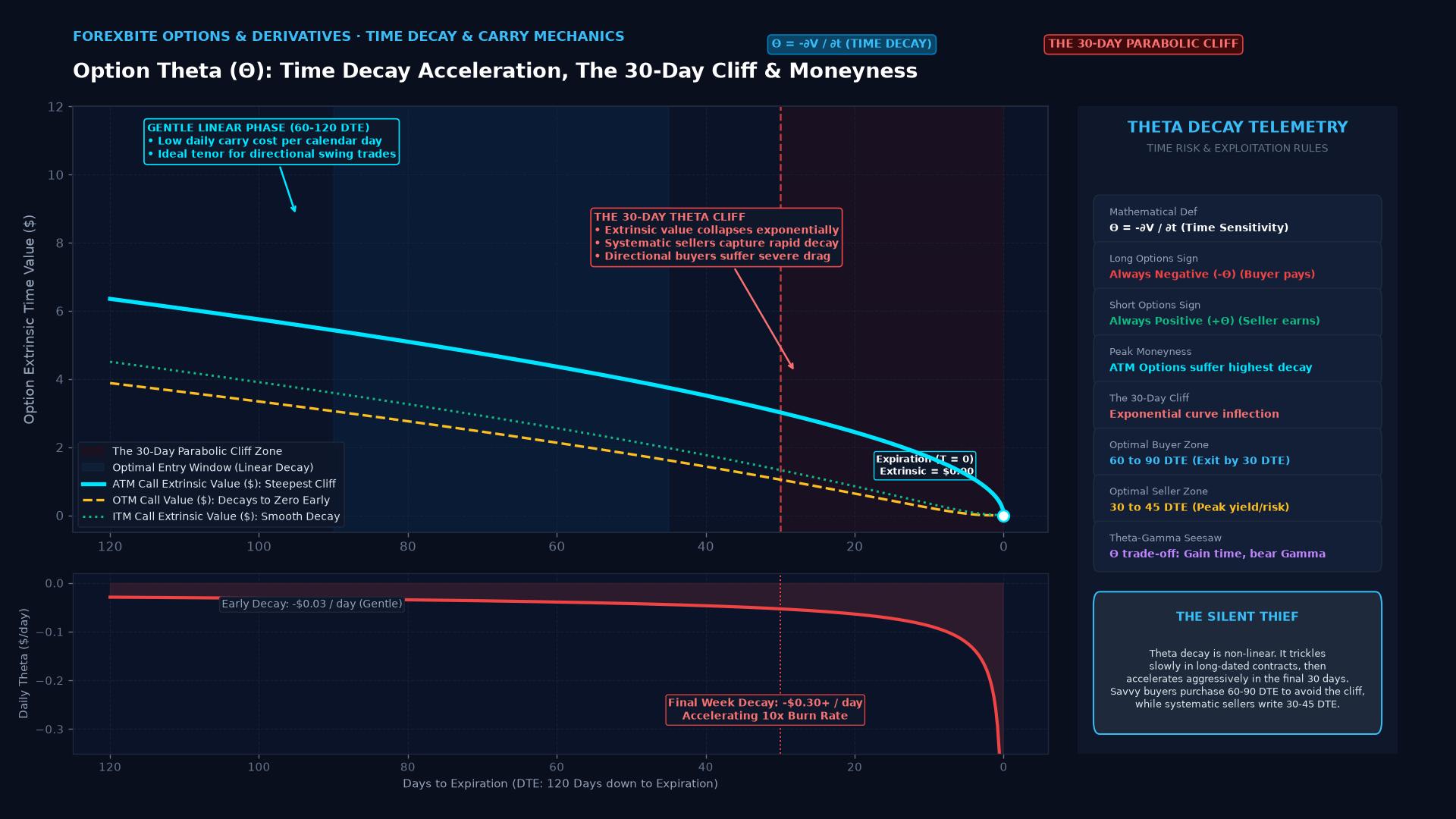
Theta decay is not constant; its velocity accelerates exponentially as expiration approaches:
- Long-Dated Options (90–180+ Days): The decay curve is remarkably gentle and linear. Options lose only a tiny fraction of their value each day, making long-dated contracts (such as LEAPS) ideal for directional buyers seeking to minimize time decay drag.
- The Final 30 Days (The Cliff): In the last 30 to 45 days of an option’s life, extrinsic value collapses along a parabolic curve. This steep decay is aggressively harvested by systematic option sellers deploying credit spreads and iron condors.
- Moneyness Impact: Absolute dollar Theta is highest for At-The-Money (ATM) options because they possess the maximum extrinsic time value. Deep In-The-Money (ITM) and deep Out-of-The-Money (OTM) options carry low absolute Theta because their values are dominated by intrinsic value or trade near zero, respectively.
The Fundamental Theta-Gamma Trade-Off
In quantitative derivatives trading, Theta cannot be viewed in isolation; it exists in a constant mathematical trade-off against Gamma ($\Gamma$):
$$\text{Black-Scholes PDE Relationship:} \quad \Theta + \frac{1}{2} \sigma^2 S^2 \Gamma = r V$$
                   THE THETA-GAMMA SEESAW BALANCE

  LONG OPTION POSITION:                      SHORT OPTION POSITION:
  - POSITIVE GAMMA (Γ > 0)                   - NEGATIVE GAMMA (Γ < 0)
    Gains accelerate as market moves           Losses accelerate if market breaks out
  - NEGATIVE THETA (Θ < 0)                   - POSITIVE THETA (Θ > 0)
You pay daily rent to hold the upside You collect daily rent, bearing crash risk- If you buy options (Long Gamma), you enjoy explosive upside if the market trends, but you pay a continuous “daily tax” in the form of negative Theta.
- If you sell options (Positive Theta), you collect steady daily income as long as the market stays calm, but you bear severe negative Gamma, leaving you vulnerable to catastrophic losses if a flash crash or gap occurs.
Real-World Institutional Case Study: The “Weekend Theta” Myth
A classic misconception among novice retail option sellers is the belief that writing options on Friday afternoon allows a trader to collect “three days of free Theta decay” over Saturday and Sunday while markets are closed.
       INSTITUTIONAL PRICING OF WEEKEND TIME DECAY

 Retail Misconception:
 - Sell options Friday at 15:55 EST.
 - Market closed Saturday and Sunday (zero price movement).
 - Buy back options Monday morning after 3 full days of Theta decay (Risk-free profit).

 Interbank Reality:
 1. Market makers (Citadel, Susquehanna, Jane Street) use continuous trading models
    calibrated to TRADING HOURS (252 days/year), not raw calendar days (365 days).
 2. By Thursday afternoon and Friday morning, institutional algorithms systematically
    discount weekend time decay, causing option Implied Volatility to compress prematurely.
 3. Outcome: On Monday morning, options open with an implied volatility adjustment
    that prevents retail sellers from extracting unhedged risk-free weekend profit.
Tactical Rules: How Traders Manage Theta Exposure
- Option Buyers Should Target 60–90 Days Out: If purchasing calls or puts for a swing trade, buy expirations at least 60 to 90 days away and plan to exit with 30 days remaining, completely avoiding the accelerating “30-day Theta cliff.”
- Option Sellers Should Target 30–45 Days Out: When executing credit spreads, cash-secured puts, or covered calls, writing contracts in the 30- to 45-day window captures the optimal inflection point where Theta decay accelerates rapidly while still collecting substantial upfront premium.
- Deploy Calendar Spreads to Exploit Differential Theta: A trader can buy a long-dated option (low daily Theta decay) and simultaneously sell a short-dated option with the same strike (high daily Theta decay), engineering a net positive Theta position that captures rapid decay on the front-month contract.
Frequently Asked Questions
Does Theta decay happen continuously or at a specific hour of the day?
Mathematically, in algorithmic pricing models, Theta decay is a continuous, unbroken function operating across every microsecond of the day. In retail brokerage platforms, however, displayed prices update whenever the market quotes change, with the most visible step-downs in option prices occurring overnight between market close and the subsequent morning open.
Can an option ever have positive Theta for the buyer?
Yes, in rare structural scenarios involving deep In-The-Money European put options on assets with high positive interest rates. If an investor holds a deep ITM put, the maximum payout ($K - S$) is already effectively achieved. Because European options cannot be exercised early, waiting for expiration delays the receipt of cash that could otherwise be earning risk-free interest, causing the option to trade at a discount to intrinsic value and producing a positive Theta for the long holder.
How does higher implied volatility affect Theta?
Higher implied volatility increases Theta decay. When volatility expands, option premiums swell because the probability of reaching distant strikes increases. Because there is more extrinsic time value embedded in the contract, the absolute dollar amount of time value that must evaporate before expiration rises, accelerating daily Theta decay.
Ready to trade forex?
Open a free demo account with a regulated broker. Practice with virtual funds before risking real money.