Fill
A fill is the completed execution of an order to buy or sell a financial instrument, confirming that the trader's order instructions have been matched with an offsetting counterparty at a designated price and quantity.
What Is a Fill?
In financial trading and market microstructure, a fill represents the completed execution of an order instruction. When an investor or algorithmic program transmits a trade request to a broker or electronic exchange, the order sits as an open request until it is matched against an offsetting buyer or seller. The moment the matching engine pairs the order with opposing liquidity, the order is officially filled.
A fill can be complete (where the entire requested order size is executed in a single transaction) or partial (where only a portion of the total requested volume is executed due to insufficient available liquidity at that specific price tier). The details of the fill—including the exact timestamp, filled quantity, execution venue, and fill price—are transmitted back to the trader terminal via an electronic execution confirmation.
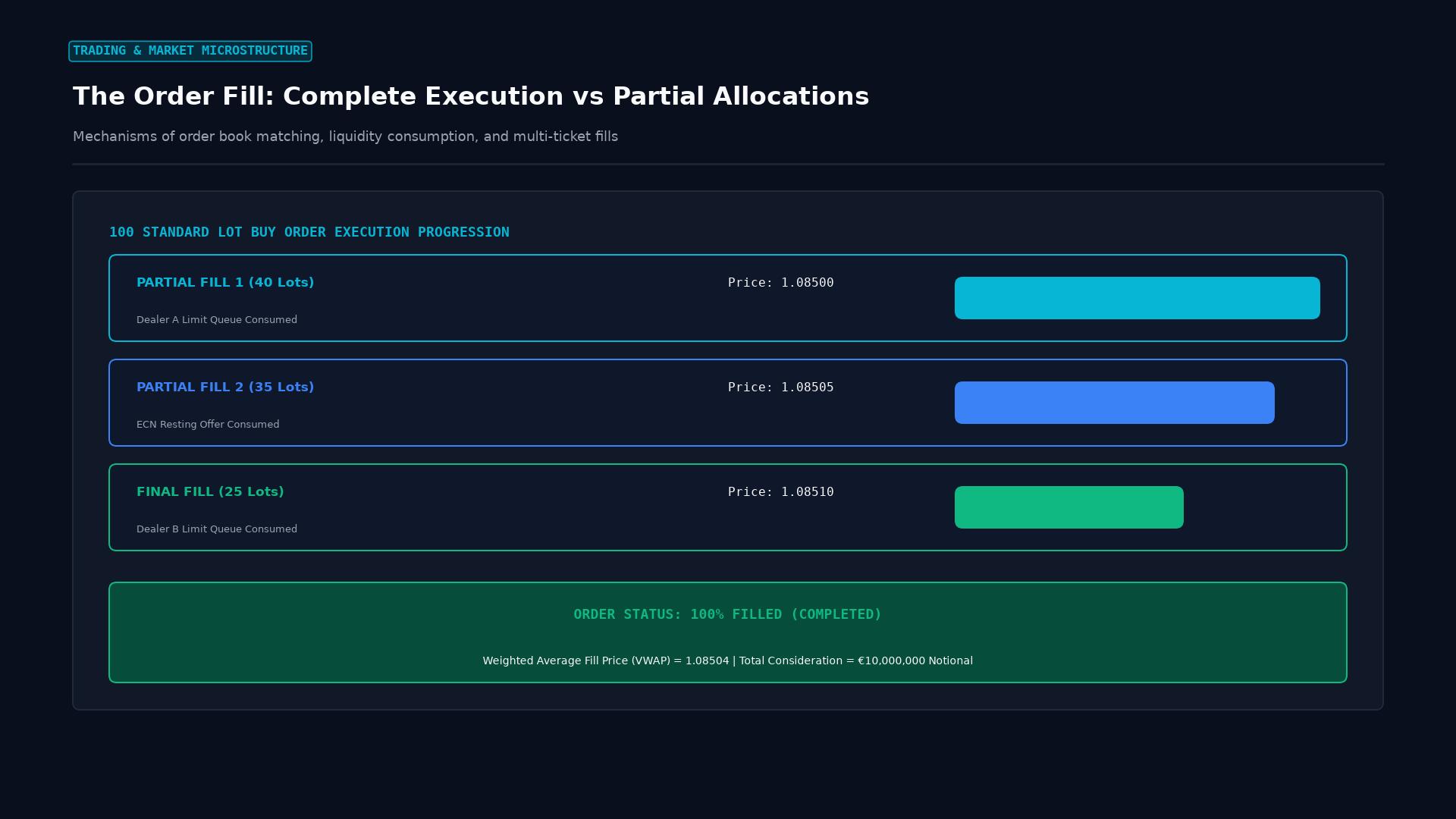 Figure: Matching engine execution progression: sweeping multiple resting limit order queues to achieve partial fills until complete block order volume is 100% satisfied.
Key Takeaways
- Execution Confirmation: A fill marks the legal transition from an unexecuted order instruction into an active, legally binding open position on the trader’s account blotter.
- Full vs. Partial Fills: Small retail orders almost always receive full fills instantly; large institutional block orders (e.g., $50 million) frequently receive multiple sequential partial fills as they sweep through the order book.
- Order Type Determinants: Market orders guarantee a fill but do not guarantee price; Limit orders guarantee price but do not guarantee that a fill will occur.
- FIX Protocol Reporting: In institutional trading, fills are communicated using the Financial Information eXchange (FIX) protocol via Execution Report messages (Tag 35=8) with
OrdStatus=2(Filled).
Full Fills vs. Partial Fills
Understanding how fills materialize across varying market conditions is critical for execution cost analysis:
| Fill Category | Description | Primary Market Cause | Strategic Action Required |
|---|---|---|---|
| Full Fill | 100% of the requested order volume is executed at or better than the target price in a single event. | Deep liquidity; standard retail order size matching top-of-book depth. | None; position is fully opened or closed as planned. |
| Partial Fill | A fraction of the requested order volume is executed (e.g., 40 out of 100 lots), leaving the remainder unfilled. | Order size exceeds available volume at the limit price; illiquid exotic currency pair. | The remaining balance sits open on the book, or is cancelled depending on order instructions (IOC/FOK). |
| Swept Fill (Multi-Tier) | The entire order volume is filled, but split across multiple price tiers with worsening execution prices. | Submitting a large market order that exhausts top-of-book liquidity. | Calculate Volume-Weighted Average Price (VWAP) to evaluate total slippage. |
How Order Types Influence Your Fill Probability
The choice of order type establishes the trade-off between price certainty and fill certainty:
          PRICE CERTAINTY                   FILL CERTAINTY
     ┌────────────────────────┐        ┌────────────────────────┐
     │      LIMIT ORDER       │        │      MARKET ORDER      │
     │ • Strict price ceiling │        │ • Guaranteed fill      │
     │ • ZERO negative slip   │        │ • Sweeps any price     │
     │ • High risk of NO FILL │        │ • Heavy SLIPPAGE risk  │
└────────────────────────┘ └────────────────────────┘- Market Orders: Prioritize fill certainty above all else. The matching engine matches against whatever resting limit orders exist. In fast markets, this results in immediate fills accompanied by severe negative slippage.
- Limit Orders: Prioritize price protection. A Buy Limit order can only fill at the specified limit price or lower. If the market reverses one pip before your price, you receive no fill.
- Stop-Limit Orders: A two-stage order. When the stop trigger price is touched, the order activates as a limit order rather than a market order, protecting the trader from filling at extreme slippage.
Why Do Orders Fail to Fill?
Traders often experience unfilled orders or order rejections due to specific market microstructure constraints:
- Price Gap Over Limit: During weekend opens or high-impact news releases, the market price can gap completely over an unexecuted limit order, leaving it untouched.
- Insufficient Free Margin: If account equity has declined, the broker’s pre-trade risk engine will reject the order before it reaches the matching engine.
- Slippage Tolerance Exceeded: In modern retail platforms, traders can configure maximum slippage limits (e.g., maximum 2 pips). If the only available fill price lies 3 pips away, the platform automatically aborts the order.
Frequently Asked Questions
What does “unfilled order” mean?
An unfilled order (or pending order) is a limit or stop order that remains active on the broker’s server or exchange order book because the market has not yet reached the price criteria specified in the order.
Can a partial fill be cancelled?
Yes. The portion of the order that has already filled cannot be reversed (it is an active trade). However, the remaining unfilled balance of a limit order can be cancelled at any time by the trader before another counterparty matches it.
How does an “All or None” (AON) instruction affect fills?
An All or None (AON) instruction commands the broker to fill the entire order quantity or none at all. Unlike standard orders, an AON order will not accept partial fills, though it can remain open on the order book until sufficient liquidity accumulates to satisfy the full size.
Ready to trade forex?
Open a free demo account with a regulated broker. Practice with virtual funds before risking real money.